Current Events

  • Irish Chronicles Document Links Between Volcanoes and Weather
    A study of over 40,000 written entries in Irish Annals and ice core measurements shows a strong corr...Read more

    x

    Irish Chronicles Document Links Between Volcanoes and Weather

    A study of over 40,000 written entries in Irish Annals and ice core measurements shows a strong correlation between the occurrence of volcanic eruptions and extreme cold weather in Ireland over a 1200 year period. Data analyzed in this study cover the period from 431 to 1649, during which time up to 48 volcanic eruptions are identified in Greenland ice core records through deposition of volcanic sulfate in annual layers of ice. You can find the study (open access), published on 6 June 2013 in IOP Publishing's journal Environmental Research Letters, at http://iopscience.iop.org/1748-9326/8/2/024035/article. Find out more about how volcanoes can influence climate.
  • EF-5 Tornado in El Reno, Oklahoma Widest Ever Recorded in US
    The EF-5 tornado that hit El Reno, Oklahoma on May 31st was the widest ever recorded in the US, acco...Read more

    x

    EF-5 Tornado in El Reno, Oklahoma Widest Ever Recorded in US

    The EF-5 tornado that hit El Reno, Oklahoma on May 31st was the widest ever recorded in the US, according to the National Weather Service in Norman Oklahoma. The tornado, which remained on the ground for 40 minutes and reached 2.6 miles across (4.2 km), took the lives of 18 people including storm chasers Tim Samaras, Paul Samaras and Carl Young. For more information on the tornado, visit http://ow.ly/i/2hfDG.
  • Atmospheric CO2 Level Tops 400 ppm
    During the week of May 13th, the CO2 level at the Mauna Loa Observatory in Hawaii topped 400 ppm rep...Read more

    x

    Atmospheric CO2 Level Tops 400 ppm

    During the week of May 13th, the CO2 level at the Mauna Loa Observatory in Hawaii topped 400 ppm repeatedly. Daily levels of CO2 can vary due to weather, and there are seasonal trends as well. The level of atmospheric greenhouse gases continues to increase, now over 120 ppm since the Industrial Revolution began. For more on the Keeling Curve, see http://keelingcurve.ucsd.edu/. Find out more about greenhouse gases and warming.

Where are we now? Climate "Today"

Before we move on to projections of future state of our planet's climate, let's take a few looks at the current state of Earth's climate.

These graphs show how carbon emissions, atmospheric concentrations of carbon dioxide, and global average temperatures have changed in recent times.

CO2 emissions

CO2 concentration

Global temperature

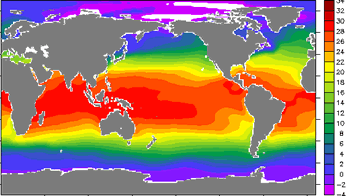
This image shows sea surface temperatures (SST) averaged over a whole year (in this case, 2001). Notice how temperatures range from freezing (0° C or 32° F) near the poles to around 30° C (about 86° F) in the tropics.
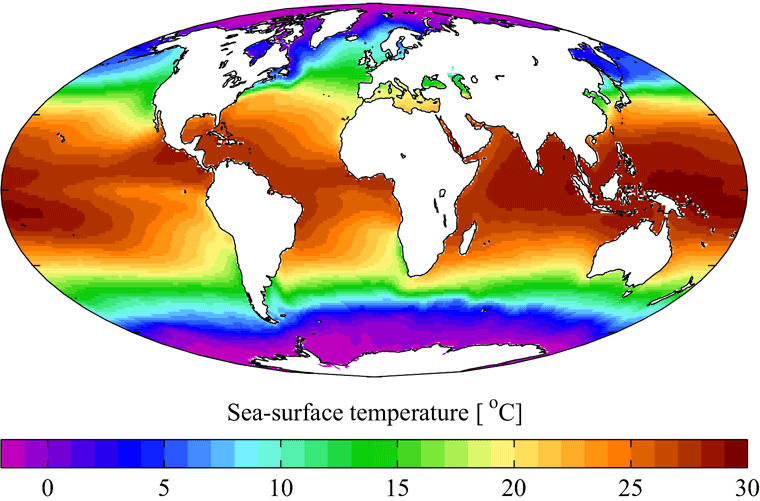
Global average SST in 2001

Credits: Image courtesy of Plumbago via Wikipedia, using data from the World Ocean Atlas 2001.

Here is Earth's surface air temperature in recent times. This image shows average temperatures for the period from 1961 to 1990.

Earth surface air temperatures present day

Credits: Image courtesy of Robert A. Rhohde and the Global Warming Art project.

Earth surface temperature around 2000

Average Global Temperature 1940-2005
Earth surface temperature 1940-2005
All values are in comparison to 1940-1980 average (green shading). Map at left shows 1995-2005 averages (the orange shaded region on the graph above). Blue points and lines on the graph are annual values; the red line is the 5-year smoothed average.

This map (above) shows recent changes in Earth's surface air temperatures. The colors indicate the temperatures in the decade around 2000 as compared to average values from about 40 years earlier. Specifically, the colors compare average temperatures during the years 1995 through 2004 versus the averages from 1940 through 1980. The global averge temperature increased about 0.42° C during this time.

Credits: Map image courtesy of Robert A. Rohde and the Global Warming Art project. Graph is original artwork by Windows to the Universe staff (Randy Russell) using data from NOAA.

Use the popup menu in the upper left corner of the interactive below to select a map to view. Choices include contemporary global surface air temperature and sea surface temperature, changes in temperature by 2000, and four climate model projections for possible future climate in 2025 and 2095.

Compare maps side-by-side using the viewer below.

Last modified September 1, 2010 by Randy Russell.

Shop Windows to the Universe Science Store!

The Spring 2010 issue of The Earth Scientist focuses on the ocean, including articles on polar research, coral reefs, ocean acidification, and climate. Includes a gorgeous full color poster!

Windows to the Universe Community

News

Opportunities

You might also be interested in:

Cool It! Game

Check out our online store - minerals, fossils, books, activities, jewelry, and household items!...more

World Leaders Developing a New Plan to Help Earth’s Changing Climate

Leaders from 192 nations of the world are trying to make an agreement about how to limit emissions of heat-trapping greenhouse gases, mitigate climate change, and adapt to changing environmental conditions....more

What Is Climate?

Climate in your place on the globe is called regional climate. It is the average weather pattern in a place over more than thirty years, including the variations in seasons. To describe the regional climate...more

Earth's Greenhouse Gases

Less than 1% of the gases in Earth's atmosphere are called greenhouse gases. Even though they are not very abundant, these greenhouse gases have a major effect. Carbon dioxide (CO2), water vapor (H2O),...more

Space Missions to study Earth's Atmosphere & Climate

Television weather forecasts in the space age routinely feature satellite views of cloud cover. Cameras and other instruments on spacecraft provide many types of valuable data about Earth's atmosphere...more

Modeling the Future of Climate Change

Predicting how our climate will change in the next century or beyond requires tools for assessing how planet responds to change. Global climate models, which are run on some of the world's fastest supercomputers,...more

Effects of Climate Change Today

The world's surface air temperature increased an average of 0.6° Celsius (1.1°F) during the last century according to the Intergovernmental Panel on Climate Change (IPCC). This may not sound like very...more

What Controls the Climate?

A factor that has an affect on climate is called a “forcing.” Some forcings, like volcanic eruptions and changes in the amount of solar energy, are natural. Others, like the addition of greenhouse gases...more

Shop Windows to the Universe

Learn about planets outside our solar system through Exoplanets and Alien Solar Systems by Tahir Yaqoob, Ph.D., a book in our online store book collection.

Windows to the Universe, a project of the National Earth Science Teachers Association, is sponsored in part by the National Science Foundation and NASA, our Founding Partners (the American Geophysical Union and American Geosciences Institute) as well as through Institutional, Contributing, and Affiliate Partners, individual memberships and generous donors. Thank you for your support! NASA AGU AGI NSF