Current Events

  • Irish Chronicles Document Links Between Volcanoes and Weather
    A study of over 40,000 written entries in Irish Annals and ice core measurements shows a strong corr...Read more

    x

    Irish Chronicles Document Links Between Volcanoes and Weather

    A study of over 40,000 written entries in Irish Annals and ice core measurements shows a strong correlation between the occurrence of volcanic eruptions and extreme cold weather in Ireland over a 1200 year period. Data analyzed in this study cover the period from 431 to 1649, during which time up to 48 volcanic eruptions are identified in Greenland ice core records through deposition of volcanic sulfate in annual layers of ice. You can find the study (open access), published on 6 June 2013 in IOP Publishing's journal Environmental Research Letters, at http://iopscience.iop.org/1748-9326/8/2/024035/article. Find out more about how volcanoes can influence climate.
  • EF-5 Tornado in El Reno, Oklahoma Widest Ever Recorded in US
    The EF-5 tornado that hit El Reno, Oklahoma on May 31st was the widest ever recorded in the US, acco...Read more

    x

    EF-5 Tornado in El Reno, Oklahoma Widest Ever Recorded in US

    The EF-5 tornado that hit El Reno, Oklahoma on May 31st was the widest ever recorded in the US, according to the National Weather Service in Norman Oklahoma. The tornado, which remained on the ground for 40 minutes and reached 2.6 miles across (4.2 km), took the lives of 18 people including storm chasers Tim Samaras, Paul Samaras and Carl Young. For more information on the tornado, visit http://ow.ly/i/2hfDG.
  • Atmospheric CO2 Level Tops 400 ppm
    During the week of May 13th, the CO2 level at the Mauna Loa Observatory in Hawaii topped 400 ppm rep...Read more

    x

    Atmospheric CO2 Level Tops 400 ppm

    During the week of May 13th, the CO2 level at the Mauna Loa Observatory in Hawaii topped 400 ppm repeatedly. Daily levels of CO2 can vary due to weather, and there are seasonal trends as well. The level of atmospheric greenhouse gases continues to increase, now over 120 ppm since the Industrial Revolution began. For more on the Keeling Curve, see http://keelingcurve.ucsd.edu/. Find out more about greenhouse gases and warming.
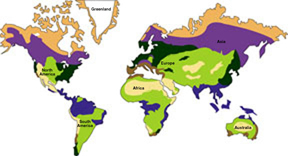
This map shows the eight biomes of the world. The orange area is tundra, purple is taiga, green is grassland, black is temperate forest, yellow is desert, blue is tropical rain forest, brown is chaparral and the white is ocean.
Click on image for full size
Windows to the Universe original image

Climate Changes with Latitude

Places located at high latitudes (far from the equator) receive less sunlight than places at low latitudes (close to the equator). The amount of sunlight and the amount of precipitation affects the types of plants and animals that can live in a place. The collection of all the living things in a place, as well as the non-living resources, is called an ecosystem or biome. Listed below are the types of ecosystems that exist in the climates of different latitudes.

The most sunlight is received at the equator of our planet, making this area very warm. The types of ecosystems that develop in this warm environment are:

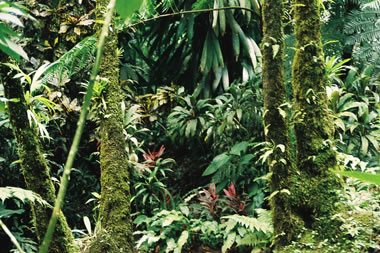
  • Rainforests: As the name suggests, rainforests receive a lot of rain. The temperature stays warm in the rainforest all year long.
  • Savanna: This ecosystem has a wet season and a very dry season.
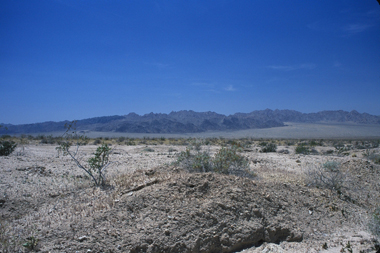
  • Deserts: Deserts receive less rainfall than other tropical ecosystems but are just as warm.

The area between the warm tropics and the chilly poles is called the mid latitudes. Climates in this zone are affected by both warm, tropical air moving towards the poles and cold, polar air moving towards the equator.

  • Chaparrel: This ecosystem has wet-winters and dry-summers.
  • Grasslands: This ecosystem is typically found on the dry interior of continents.
  • Temperate forest: A moist climate allows leafy deciduous trees to thrive.

High latitudes receive the least sunlight, creating cold climates.

  • Taiga: The forests of the taiga ecosystem survive despite long and very cold winters. Summers are short and still quite cool.
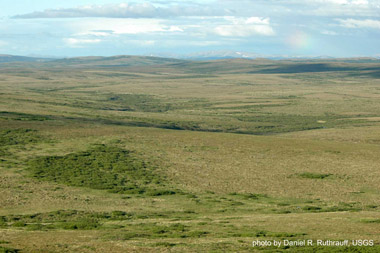
  • Tundra: Ocean winds in arctic coastal areas keep the temperatures from being as severe as interior regions. A long, chilly winter season is followed by a mild season.
Last modified May 18, 2004 by Lisa Gardiner.

Shop Windows to the Universe Science Store!

Cool It! is the new card game from the Union of Concerned Scientists that teaches kids about the choices we have when it comes to climate change—and how policy and technology decisions made today will matter. Cool It! is available in our online store.

Windows to the Universe Community

News

Opportunities

You might also be interested in:

Cool It! Game

Check out our online store - minerals, fossils, books, activities, jewelry, and household items!...more

Tropical Rainforests

Tropical rainforests are home to thousands of species of animals, plants, fungi and microbes. Scientists suspect that there are many species living in rainforests have not yet been found or described....more

The Desert Biome

Deserts are full of interesting questions. How can anything survive in a place with hardly any water? Why is it so dry to begin with? You can find at least one desert on every continent except Europe....more

Grasslands

Over one quarter of the Earth's surface is covered by grasslands. Grasslands are found on every continent except Antarctica, and they make up most of Africa and Asia. There are several types of grassland...more

Temperate Forests

The temperate forest biome is found in regions where winters are cold and summers are warm. Regions with this climate are common in the mid-latitudes, far from both the equator and the poles. Tropical...more

Tundra Biome

In the very cold places of the world, survival isn't easy. The soil is frozen, its top surface thawing only during summer, and no trees can grow. Yet plants and animals that are adapted for the harsh...more

What Is Climate?

The climate where you live is called regional climate. It is the average weather in a place over more than thirty years. To describe the regional climate of a place, people often tell what the temperatures...more

A New Plan to Help Earth’s Changing Climate

Leaders from 192 countries are meeting in Copenhagen, Denmark December 7-18, 2009 to decide how the world will deal with climate change. They are trying to decide how to limit the amount of greenhouse...more

Shop Windows to the Universe

Science, Evolution, and Creationism, by the National Academies, focuses on teaching evolution in today's classrooms. Check out the other publications in our online store.

Windows to the Universe, a project of the National Earth Science Teachers Association, is sponsored in part by the National Science Foundation and NASA, our Founding Partners (the American Geophysical Union and American Geosciences Institute) as well as through Institutional, Contributing, and Affiliate Partners, individual memberships and generous donors. Thank you for your support! NASA AGU AGI NSF