Current Events

  • Irish Chronicles Document Links Between Volcanoes and Weather
    A study of over 40,000 written entries in Irish Annals and ice core measurements shows a strong corr...Read more

    x

    Irish Chronicles Document Links Between Volcanoes and Weather

    A study of over 40,000 written entries in Irish Annals and ice core measurements shows a strong correlation between the occurrence of volcanic eruptions and extreme cold weather in Ireland over a 1200 year period. Data analyzed in this study cover the period from 431 to 1649, during which time up to 48 volcanic eruptions are identified in Greenland ice core records through deposition of volcanic sulfate in annual layers of ice. You can find the study (open access), published on 6 June 2013 in IOP Publishing's journal Environmental Research Letters, at http://iopscience.iop.org/1748-9326/8/2/024035/article. Find out more about how volcanoes can influence climate.
  • EF-5 Tornado in El Reno, Oklahoma Widest Ever Recorded in US
    The EF-5 tornado that hit El Reno, Oklahoma on May 31st was the widest ever recorded in the US, acco...Read more

    x

    EF-5 Tornado in El Reno, Oklahoma Widest Ever Recorded in US

    The EF-5 tornado that hit El Reno, Oklahoma on May 31st was the widest ever recorded in the US, according to the National Weather Service in Norman Oklahoma. The tornado, which remained on the ground for 40 minutes and reached 2.6 miles across (4.2 km), took the lives of 18 people including storm chasers Tim Samaras, Paul Samaras and Carl Young. For more information on the tornado, visit http://ow.ly/i/2hfDG.
  • Atmospheric CO2 Level Tops 400 ppm
    During the week of May 13th, the CO2 level at the Mauna Loa Observatory in Hawaii topped 400 ppm rep...Read more

    x

    Atmospheric CO2 Level Tops 400 ppm

    During the week of May 13th, the CO2 level at the Mauna Loa Observatory in Hawaii topped 400 ppm repeatedly. Daily levels of CO2 can vary due to weather, and there are seasonal trends as well. The level of atmospheric greenhouse gases continues to increase, now over 120 ppm since the Industrial Revolution began. For more on the Keeling Curve, see http://keelingcurve.ucsd.edu/. Find out more about greenhouse gases and warming.

Climate & Global Change Image & Multimedia Gallery

Atmosphere | Clouds | Weather

Atmosphere
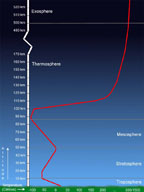

This is an image showing the temperature of the atmosphere throughout different layers. (Windows Original)
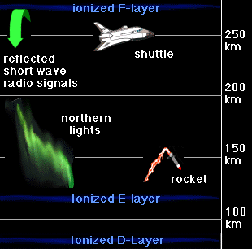

This is an image showing the layers of the atmosphere with emphasis on the ionized layers. (Windows Original)


These are images comparing amounts of ozone and ClO between two years. (Courtesy of NASA)


These are images comparing amounts of ozone and ClO between two other years. (Courtesy of NASA)


Clouds
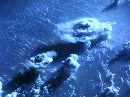

This is an image taken of cumulonimbus clouds in the atmosphere. (Courtesy of Aris Multimedia Entertainment, Inc. 1994)

This is a satellite image taken of clouds.

This is another satellite image taken of clouds.

This is another satellite image taken of clouds.
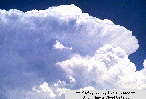

This is an image of a supercell. This occurs when cumulonimbus clouds quickly develop into powerful thunderstorm clouds. (courtesty of Kevin Knupp, University of Illinois cloud catalog)
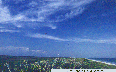

This is a picture of cirrus fall streaks which usually occur in good weather. They form when snowflakes and ice crystals fall from the high clouds. (courtesy of University of Illinois cloud catalog)
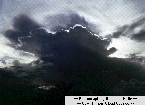

This is an image of a cumulonimbus cloud while the sun is setting behind it. (Courtesy of Ronald Holle, University of Illinois cloud catalog)
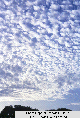

These are altocumulus clouds which appear to be puffy. (courtesy of Ronald Holle, University of Illinois cloud catalog)
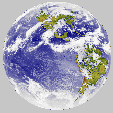

This infrared image of the Earth was taken by the GOES 6 satellite on September 21, 1986. A temperature threshold was used to isolate the clouds. The land and sea were separated and then the clouds, land and sea were separately colored and combined back together to produce this image. (Courtesy Rick Kohrs)
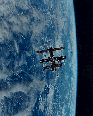

Image of clouds taken by the STS-63.


Weather
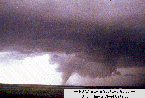

This is a typical image of a tornado spawning from a large cumulonimbus cloud. (Courtesy of NOAA Storm Spotters Guide and the University of Illinois Cloud Catalog)
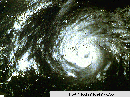

This is a satellite picture of a hurricane over Mississippi and Louisiana. The eye is in the center where there are low winds and no precipitation. (Courtesy of University of Illinois Cloud Catalog)
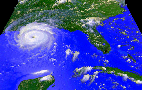

This is a satellite picture of Hurricane Andrew in 1992. (Courtesy of NASA)
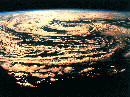

This is an image of a Cyclonic Storm. (courtesy of Aris Multimedia Entertainment, Inc. 1994)
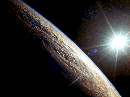

This is an image of a tropical storm. (courtesy of Aris Multimedia Entertainment, Inc. 1994)


Lightning. (image courtesy of JPL)


Lightning. (image courtesy of JPL)


This image of the Earth was taken by the Galileo spacecraft at about 6:10 a.m. PST on December 11, 1990. The spacecraft was about 1.3 million miles from the Earth. South America is near the center of the picture, and the white, sunlit continent of Antarctica is below. Picturesque weather fronts are visible in the South Atlantic, lower right. (courtesy of NASA/JPL)
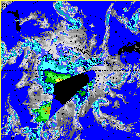

This is an image of an Antarctic Surface Plot of weather.
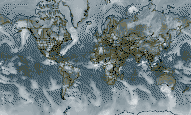

This is an example of what a current weather map looks like.
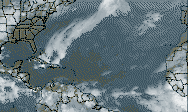

This is another example of what a current weather map looks like.
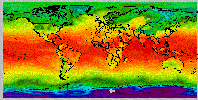

This is an image of what a current minimum temperature map would look like.
Last modified June 24, 2004 by Randy Russell.

Shop Windows to the Universe Science Store!

The Spring 2010 issue of The Earth Scientist focuses on the ocean, including articles on polar research, coral reefs, ocean acidification, and climate. Includes a gorgeous full color poster!

Windows to the Universe Community

News

Opportunities

You might also be interested in:

Cool It! Game

Check out our online store - minerals, fossils, books, activities, jewelry, and household items!...more

A New Plan to Help Earth’s Changing Climate

Leaders from 192 countries are meeting in Copenhagen, Denmark December 7-18, 2009 to decide how the world will deal with climate change. They are trying to decide how to limit the amount of greenhouse...more

What Is Climate?

The climate where you live is called regional climate. It is the average weather in a place over more than thirty years. To describe the regional climate of a place, people often tell what the temperatures...more

Earth's Greenhouse Gases

Even though only a tiny amount of the gases in Earth’s atmosphere are greenhouse gases, they have a huge effect on climate. There are several different types of greenhouse gases. The major ones are carbon...more

Space Missions to study Earth's Atmosphere & Climate

Satellites that orbit Earth help us study Earth's atmosphere, weather, and climate. Here are a few of the many spacecraft that study our atmosphere. Aura was launched in July 2004. It is studying pollution,...more

Modeling the Future of Climate Change

To figure out the future of climate change, scientists need tools to measure how Earth responds to change. Some of these tools are global climate models. Using models, scientists can better understand...more

Effects of Climate Change Today

Over 100 years ago, people worldwide began burning more coal and oil for homes, factories, and transportation. Burning these fossil fuels releases carbon dioxide and other greenhouse gases into the atmosphere....more

What Controls the Climate?

Some of the factors that have an affect on climate, like volcanic eruptions and changes in the amount of solar energy, are natural. Others, like the addition of greenhouse gases to the atmosphere, are...more

Shop Windows to the Universe

Arches National Park Geology Tour provides an extensive, visually rich description of the geology of Arches, by Deborah Ragland, Ph.D. See our DVD collection.

Windows to the Universe, a project of the National Earth Science Teachers Association, is sponsored in part by the National Science Foundation and NASA, our Founding Partners (the American Geophysical Union and American Geosciences Institute) as well as through Institutional, Contributing, and Affiliate Partners, individual memberships and generous donors. Thank you for your support! NASA AGU AGI NSF