Current Events

  • Irish Chronicles Document Links Between Volcanoes and Weather
    A study of over 40,000 written entries in Irish Annals and ice core measurements shows a strong corr...Read more

    x

    Irish Chronicles Document Links Between Volcanoes and Weather

    A study of over 40,000 written entries in Irish Annals and ice core measurements shows a strong correlation between the occurrence of volcanic eruptions and extreme cold weather in Ireland over a 1200 year period. Data analyzed in this study cover the period from 431 to 1649, during which time up to 48 volcanic eruptions are identified in Greenland ice core records through deposition of volcanic sulfate in annual layers of ice. You can find the study (open access), published on 6 June 2013 in IOP Publishing's journal Environmental Research Letters, at http://iopscience.iop.org/1748-9326/8/2/024035/article. Find out more about how volcanoes can influence climate.
  • EF-5 Tornado in El Reno, Oklahoma Widest Ever Recorded in US
    The EF-5 tornado that hit El Reno, Oklahoma on May 31st was the widest ever recorded in the US, acco...Read more

    x

    EF-5 Tornado in El Reno, Oklahoma Widest Ever Recorded in US

    The EF-5 tornado that hit El Reno, Oklahoma on May 31st was the widest ever recorded in the US, according to the National Weather Service in Norman Oklahoma. The tornado, which remained on the ground for 40 minutes and reached 2.6 miles across (4.2 km), took the lives of 18 people including storm chasers Tim Samaras, Paul Samaras and Carl Young. For more information on the tornado, visit http://ow.ly/i/2hfDG.
  • Atmospheric CO2 Level Tops 400 ppm
    During the week of May 13th, the CO2 level at the Mauna Loa Observatory in Hawaii topped 400 ppm rep...Read more

    x

    Atmospheric CO2 Level Tops 400 ppm

    During the week of May 13th, the CO2 level at the Mauna Loa Observatory in Hawaii topped 400 ppm repeatedly. Daily levels of CO2 can vary due to weather, and there are seasonal trends as well. The level of atmospheric greenhouse gases continues to increase, now over 120 ppm since the Industrial Revolution began. For more on the Keeling Curve, see http://keelingcurve.ucsd.edu/. Find out more about greenhouse gases and warming.
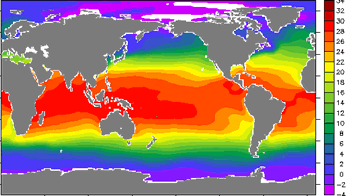
As the Sun warms the equator more than the poles, climate varies with latitude. This image shows how sea surface temperatures change at different latitudes. Red colors indicate warmer ocean water, blues and purples indicate cooler ocean water.
Click on image for full size
Image courtesy of NOAA. Public domain.

What Is Climate?

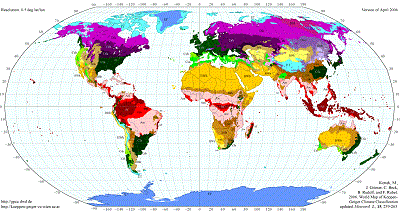
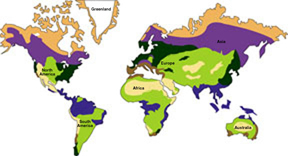
The climate where you live is called regional climate. It is the average weather in a place over more than thirty years. To describe the regional climate of a place, people often tell what the temperatures are like over the seasons, how windy it is, and how much rain or snow falls. The climate of a region depends on many factors including the amount of sunlight it receives, its height above sea level, the shape of the land, and how close it is to oceans. Since the equator receives more sunlight than the poles, climate varies depending on distance from the equator.

However, we can also think about the climate of an entire planet. Global climate is a description of the climate of a planet as a whole, with all the regional differences averaged. Overall, global climate depends on the amount of energy received by the Sun and the amount of energy that is trapped in the system. These amounts are different for different planets. Scientists who study Earth's climate and climate change study the factors that affect the climate of our whole planet.

While the weather can change in just a few hours, climate changes over longer timeframes. Climate events, like El Nino, happen over several years, small-scale fluctuations happen over decades, and larger climate changes happen over hundreds and thousands of years. Today, climates are changing. Our Earth is warming more quickly than it has in the past according to the research of scientists. Hot summer days may be quite typical of climates in many regions of the world, but global warming is causing Earth's average global temperature to increase. The amount of solar radiation, the chemistry of the atmosphere, clouds, and the biosphere all affect Earth's climate.

Last modified August 23, 2010 by Becca Hatheway.

Shop Windows to the Universe Science Store!

The Spring 2010 issue of The Earth Scientist focuses on the ocean, including articles on polar research, coral reefs, ocean acidification, and climate. Includes a gorgeous full color poster!

Windows to the Universe Community

News

Opportunities

You might also be interested in:

Cool It! Game

Check out our online store - minerals, fossils, books, activities, jewelry, and household items!...more

Climate Changes with Latitude

Places located at high latitudes (far from the equator) receive less sunlight than places at low latitudes (close to the equator). The amount of sunlight and the amount of precipitation affects the types...more

What Controls the Climate?

Some of the factors that have an affect on climate, like volcanic eruptions and changes in the amount of solar energy, are natural. Others, like the addition of greenhouse gases to the atmosphere, are...more

Growth Spurt in Tree Rings Prompts Questions About Climate Change

Studying tree rings doesn't only tell us the age of that tree. Tree rings also show what climate was like for each year of a tree's life, which means they can tell us about climates of the past and about...more

Sun's Effect on Earth

Energy from the Sun is very important to the Earth. The Sun warms our planet, heating the surface, the oceans and the atmosphere. This energy to the atmosphere is one of the primary drivers our weather....more

If a Tree Falls in the Forest, and No One Is Around to Hear It, Does Climate Change?

Forests cover almost a third of the land surface on Earth. A new report is out about forests and how they impact global climate. Scientists know that forests play a role in both lessening and adding to...more

Climate Helped Bring Angkor to Its Knees

The Earth keeps a record of past climate in several different ways, including tree rings, which show what climate was like for each year of a tree's life. A team of researchers has used tree ring data...more

Effects of Climate Change Today

Over 100 years ago, people worldwide began burning more coal and oil for homes, factories, and transportation. Burning these fossil fuels releases carbon dioxide and other greenhouse gases into the atmosphere....more

Shop Windows to the Universe

Warnings: The True Story of How Science Tamed the Weather by Mike Smith tells the story of our storm warning system. See our online store book collection.

Windows to the Universe, a project of the National Earth Science Teachers Association, is sponsored in part by the National Science Foundation and NASA, our Founding Partners (the American Geophysical Union and American Geosciences Institute) as well as through Institutional, Contributing, and Affiliate Partners, individual memberships and generous donors. Thank you for your support! NASA AGU AGI NSF