Current Events

  • Kansas Legislator Proposes Bill to Outlaw Sustainability Education
    A bill has been introduced in the Kansas legislature this week that would prohibit the promotion of ...Read more

    x

    Kansas Legislator Proposes Bill to Outlaw Sustainability Education

    A bill has been introduced in the Kansas legislature this week that would prohibit the promotion of sustainability. Here is a link to the one-page bill: http://www.kslegislature.org/li/b2013_14/measures/documents/hb2366_00_0000.pdf. See report on Bloomberg News.
  • Earth's Center Is 1,000 Degrees Hotter Than Previously Thought, Synchrotron X-Ray Experiment Shows
    Scientists have determined the temperature near the Earth’s center to be 6000 degrees Celsius, 1000 ...Read more

    x

    Earth's Center Is 1,000 Degrees Hotter Than Previously Thought, Synchrotron X-Ray Experiment Shows

    Scientists have determined the temperature near the Earth’s center to be 6000 degrees Celsius, 1000 degrees hotter than in a previous experiment run 20 years ago. These measurements confirm geophysical models that the temperature difference between the solid core and the mantle above, must be at least 1500 degrees to explain why the Earth has a magnetic field. For more information about this study, see the press release from the European Synchrotron Radiation Facility.
  • Ocean Volcanic Rocks Contain Samples of Recycled Crust
    Scientists have long believed that lava erupted from certain oceanic volcanoes contains materials fr...Read more

    x

    Ocean Volcanic Rocks Contain Samples of Recycled Crust

    Scientists have long believed that lava erupted from certain oceanic volcanoes contains materials from the early Earth’s crust. But decisive evidence for this phenomenon has proven elusive. New research from a team including Carnegie’s Erik Hauri demonstrates that oceanic volcanic rocks contain samples of recycled crust dating back to the Archean era 2.5 billion years ago. Their work is published in Nature. Oceanic crust sinks into the Earth’s mantle at so-called subduction zones, where two plates come together. Much of what happens to the crust during this journey is unknown. Model-dependent studies for how long subducted material can exist in the mantle are uncertain and evidence of very old crust returning to Earth’s surface via upwellings of magma has not been found until now. For more information about these results, see the press release from the Carnegie Institution.
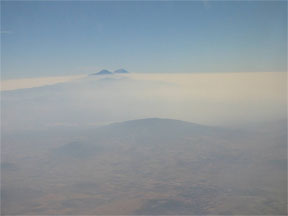
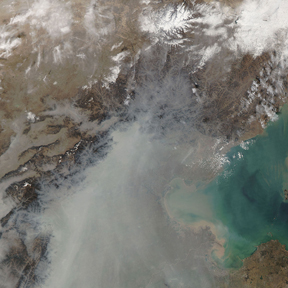
Satellite image of aerosol (particulate) pollution over Beijing, China.
Click on image for full size
NASA image courtesy the MODIS Rapid Response Team

Aerosols and Climate Change

Little particles in the atmosphere called aerosols may be small but they have the ability to change climate. These tiny particles are a natural part of the atmosphere, coming from erupting volcanoes, sea salt, and wildfires. However, since the start of the Industrial Revolution additional aerosols have been added to the atmosphere as fossil fuels are burned. This air pollution is having an impact on Earth's climate. These effects are complex, however, because different types of aerosols affect climate in different ways.

The amount and type of aerosols in the atmosphere has an impact on the albedo of our planet - the amount of solar energy that is reflected back out to space. Different types of aerosols have different effects on albedo. Aerosols like sea salt have a high albedo so they reflect solar radiation back out into space. Aerosols like black carbon have a low albedo and reflect very little solar energy.

Aerosols help clouds form and clouds have an impact on climate. The millions of little droplets of water that make up a cloud each need a little particle, like an aerosol, to condense upon. When more aerosols are released into the atmosphere, either from a natural event like a volcanic eruption or from burning of fossil fuels, the types and numbers of clouds that appear in the sky can change. The number and type of clouds overhead affects the amount of solar energy that makes its way to the Earth surface and the strength of the greenhouse effect. The amount of precipitation that falls in the region is affected too.

Also, climate is affected when the additional aerosols change chemical reactions that are going on in the atmosphere. Some reactions cause the little aerosols to grow larger, increasing their ability to either reflect sunlight away or absorb it. Scientists are actively studying how chemical reactions in the atmosphere are affected by aerosols.

Scientists think that over most of the last century the overall effect of the added aerosols was to reduce the amount of global warming. Today, however, as new technologies have allowed factories, power plants, and automobiles to release less air pollution into the atmosphere, the amount of aerosols has dropped. That's a good thing since air pollution is a problem for human health. But it has also stopped dampening the global warming which means the pace of warming is likely to increase.

Last modified May 13, 2011 by Jennifer Bergman.

Shop Windows to the Universe Science Store!

Cool It! is the new card game from the Union of Concerned Scientists that teaches kids about the choices we have when it comes to climate change—and how policy and technology decisions made today will matter. Cool It! is available in our online store.

Windows to the Universe Community

News

Opportunities

You might also be interested in:

Cool It! Game

Check out our online store - minerals, fossils, books, activities, jewelry, and household items!...more

Aerosols: Tiny Particulates in the Air

Aerosols, also called particulates, are tiny bits of solid or liquid suspended in the air. Some aerosols are so small that they are made only of a few molecules – so small that they are invisible because...more

What Is Climate?

Climate in your place on the globe is called regional climate. It is the average weather pattern in a place over more than thirty years, including the variations in seasons. To describe the regional climate...more

Air Pollution

What do smog, acid rain, carbon monoxide, fossil fuel exhausts, and tropospheric ozone have in common? They are all examples of air pollution. Air pollution is not new. As far back as the 13 th century,...more

Albedo

This picture shows a part of the Earth surface as seen from the International Space Station high above the Earth. A perspective like this reminds us that there are lots of different things that cover the...more

Black Carbon

Little particles in the atmosphere called aerosols may be small but they have the ability to change climate. These tiny particles are a natural part of the atmosphere, coming from erupting volcanoes, sea...more

How Clouds Form

A cloud is composed of tiny water droplets or ice crystals that are suspended in the air. A series of processes have to happen in order for these water droplets or ice crystals to form into clouds in the...more

Effects of Climate Change Today

The world's surface air temperature increased an average of 0.6° Celsius (1.1°F) during the last century according to the Intergovernmental Panel on Climate Change (IPCC). This may not sound like very...more

Shop Windows to the Universe

Hands On Mineral Identification helps you to identify over 14,500 minerals! By M. Darby Dyar, Ph.D. See our DVD collection.

Windows to the Universe, a project of the National Earth Science Teachers Association, is sponsored in part by the National Science Foundation and NASA, our Founding Partners (the American Geophysical Union and American Geosciences Institute) as well as through Institutional, Contributing, and Affiliate Partners, individual memberships and generous donors. Thank you for your support! NASA AGU AGI NSF