Current Events

  • Kansas Legislator Proposes Bill to Outlaw Sustainability Education
    A bill has been introduced in the Kansas legislature this week that would prohibit the promotion of ...Read more

    x

    Kansas Legislator Proposes Bill to Outlaw Sustainability Education

    A bill has been introduced in the Kansas legislature this week that would prohibit the promotion of sustainability. Here is a link to the one-page bill: http://www.kslegislature.org/li/b2013_14/measures/documents/hb2366_00_0000.pdf. See report on Bloomberg News.
  • Earth's Center Is 1,000 Degrees Hotter Than Previously Thought, Synchrotron X-Ray Experiment Shows
    Scientists have determined the temperature near the Earth’s center to be 6000 degrees Celsius, 1000 ...Read more

    x

    Earth's Center Is 1,000 Degrees Hotter Than Previously Thought, Synchrotron X-Ray Experiment Shows

    Scientists have determined the temperature near the Earth’s center to be 6000 degrees Celsius, 1000 degrees hotter than in a previous experiment run 20 years ago. These measurements confirm geophysical models that the temperature difference between the solid core and the mantle above, must be at least 1500 degrees to explain why the Earth has a magnetic field. For more information about this study, see the press release from the European Synchrotron Radiation Facility.
  • Ocean Volcanic Rocks Contain Samples of Recycled Crust
    Scientists have long believed that lava erupted from certain oceanic volcanoes contains materials fr...Read more

    x

    Ocean Volcanic Rocks Contain Samples of Recycled Crust

    Scientists have long believed that lava erupted from certain oceanic volcanoes contains materials from the early Earth’s crust. But decisive evidence for this phenomenon has proven elusive. New research from a team including Carnegie’s Erik Hauri demonstrates that oceanic volcanic rocks contain samples of recycled crust dating back to the Archean era 2.5 billion years ago. Their work is published in Nature. Oceanic crust sinks into the Earth’s mantle at so-called subduction zones, where two plates come together. Much of what happens to the crust during this journey is unknown. Model-dependent studies for how long subducted material can exist in the mantle are uncertain and evidence of very old crust returning to Earth’s surface via upwellings of magma has not been found until now. For more information about these results, see the press release from the Carnegie Institution.
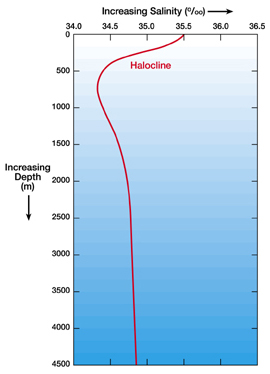
This image shows a generalized salinity-depth profile for the South Atlantic Ocean.
Click on image for full size
Windows Original

Standard Salinity Profile

This is a salinity versus depth profile for ocean water. This salinity versus depth profile is typical of the South Atlantic ocean. Salinity versus depth profiles at other locations in the ocean could look quite different.

In this profile, salinity at the surface is high (evaporation at this latitude is high) and then salinity decreases until a depth of about 1,000 meters. Salinity then increases again slightly with increasing depth.

The halocline is a layer of water where the salinity changes rapidly with depth.

Last modified January 12, 2011 by Jennifer Bergman.

Shop Windows to the Universe Science Store!

The Spring 2010 issue of The Earth Scientist, focuses on the ocean, including articles on polar research, coral reefs, ocean acidification, and climate. Includes a gorgeous full color poster!

Windows to the Universe Community

News

Opportunities

You might also be interested in:

Cool It! Game

Check out our online store - minerals, fossils, books, activities, jewelry, and household items!...more

Salinity

About 70% of the Earth is covered with water, and we find 97% of that water in the oceans. Everyone who has taken in a mouthful of ocean water while swimming knows that the ocean is really salty. All water...more

Arctic Ocean Currents

To understand the dynamics of the Arctic Ocean and its impact on surrounding areas and global climate, one must understand the fundamentals of the system. Cold, relatively fresh water comes into the Arctic...more

Aquifer

An aquifer is the name for a layer of rock which is capable of holding a large amount of water. Some layers are better at holding water than others, for example a layer of sandstone can hold a good deal...more

Carbonates

Carbonate is a name for rocks and minerals which contain a certain form of carbon/oxygen compound known as CO32-. (CO32- is also known as the molecule carbonate). Limestone is an example of a calcium carbonate,...more

Deep Water and the CO2 cycle

The deep ocean waters are under pressure and are much colder than layers of the ocean which are closer to the surface. Dissolved carbon dioxide seems to be absent from the deep ocean water and as a result...more

Evaporation

One process which transfers water from the ground back to the atmosphere is evaporation. Evaporation is when water passes from a liquid phase to a gas phase. Rates of evaporation of water depend on factors...more

Surface Ocean Currents

The water at the ocean surface is moved primarily by winds. Large scale winds move in specific directions because they are affected by Earth’s spin and the Coriolis Effect. Because Earth spins constantly,...more

Shop Windows to the Universe

Become a nitrogen atom in the nitrogen cycle in our Traveling Nitrogen Classroom Activity Kit/Game. See all our games, activity kits and classroom activities.

Windows to the Universe, a project of the National Earth Science Teachers Association, is sponsored in part by the National Science Foundation and NASA, our Founding Partners (the American Geophysical Union and American Geosciences Institute) as well as through Institutional, Contributing, and Affiliate Partners, individual memberships and generous donors. Thank you for your support! NASA AGU AGI NSF