Current Events

  • Atmospheric CO2 Level Tops 400 ppm
    During the week of May 13th, the CO2 level at the Mauna Loa Observatory in Hawaii topped 400 ppm rep...Read more

    x

    Atmospheric CO2 Level Tops 400 ppm

    During the week of May 13th, the CO2 level at the Mauna Loa Observatory in Hawaii topped 400 ppm repeatedly. Daily levels of CO2 can vary due to weather, and there are seasonal trends as well. The level of atmospheric greenhouse gases continues to increase, now over 120 ppm since the Industrial Revolution began. For more on the Keeling Curve, see http://keelingcurve.ucsd.edu/. Find out more about greenhouse gases and warming.
  • Massive Tornado Outbreak on Tornado Alley
    The week of May 19 brings dozens of tornadoes to Tornado Alley in the states of Oklahoma, Kansas, Io...Read more

    x

    Massive Tornado Outbreak on Tornado Alley

    The week of May 19 brings dozens of tornadoes to Tornado Alley in the states of Oklahoma, Kansas, Iowa, Illinois and Missouri. On May 20th, a massive tornado struck Moore, Oklahoma, devastating communities - destroying over 100 homes and hitting two elementary schools and a hospital - with many casualties and deaths. Our thoughts are with our friends and colleagues suffering from these storms. For more on the May 20th storms, see the NOAA Storm Prediction Center Storm Report.
  • Kansas Legislator Proposes Bill to Outlaw Sustainability Education
    A bill has been introduced in the Kansas legislature this week that would prohibit the promotion of ...Read more

    x

    Kansas Legislator Proposes Bill to Outlaw Sustainability Education

    A bill has been introduced in the Kansas legislature this week that would prohibit the promotion of sustainability. Here is a link to the one-page bill: http://www.kslegislature.org/li/b2013_14/measures/documents/hb2366_00_0000.pdf. See report on Bloomberg News.
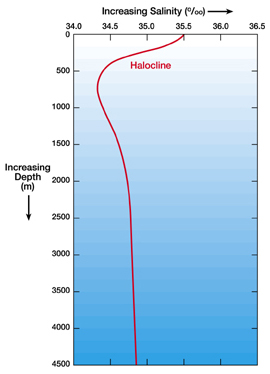
This image shows a generalized salinity-depth profile for the South Atlantic Ocean.
Click on image for full size
Windows Original

Standard Salinity Profile

This is a salinity versus depth profile for ocean water. This salinity versus depth profile is typical of the South Atlantic ocean. Salinity versus depth profiles at other locations in the ocean could look quite different.

In this profile, salinity at the surface is high and then salinity decreases until a depth of about 1,000 meters. Salinity then increases again slightly with increasing depth.

The halocline is a layer of water where the salinity changes rapidly with depth.

Last modified January 12, 2011 by Jennifer Bergman.

Shop Windows to the Universe Science Store!

We have beautiful specimens of banded iron formation in our online store from Nature's Own, along with many other mineral specimens.

Windows to the Universe Community

News

Opportunities

You might also be interested in:

Cool It! Game

Check out our online store - minerals, fossils, books, activities, jewelry, and household items!...more

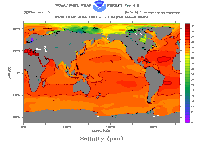
Salinity

About 70% of the Earth is covered with water. Over 97% of that water is found in the oceans. Everyone who has taken in a mouthful of ocean water while swimming knows that the ocean is really salty! Dissolved...more

Arctic Ocean Currents

The majority of the world's population does not live in the Arctic. But even if you don't live in the Arctic, it is very important to understand how the Arctic Ocean works because it has an impact on surrounding...more

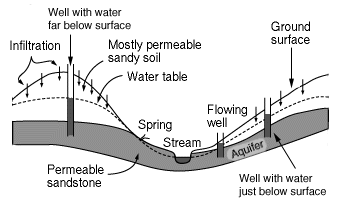
Aquifer

An aquifer is the name for a layer of rock which is capable of holding a large amount of water. Some layers are better at holding water than others, for example a layer of sandstone can hold a good deal...more

Carbonates

Carbonate is a name for rocks and minerals which contain a molecule made of both carbon and oxygen known as CO32-. (CO32- is also known as the molecule carbonate). Limestone is an example of a calcium...more

Deep Water and the CO2 cycle

The deep ocean waters are under pressure and are much colder than layers of the ocean which are closer to the surface. Dissolved carbon dioxide seems to be absent from the deep ocean water and as a result...more

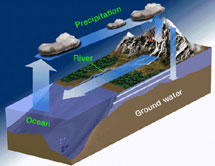
Evaporation

One process which transfers water from the ground back to the atmosphere is evaporation. Evaporation is when water passes from a liquid phase to a gas phase. Rates of evaporation of water depend on things...more

Surface Ocean Currents

The water at the ocean surface is moved primarily by winds that blow in certain patterns because of the Earth’s spin and the Coriolis Effect. Winds are able to move the top 400 meters of the ocean creating...more

Shop Windows to the Universe

We now offer the Cool It! card game in our Science Store. Cool It! is the new card game from UCS that teaches kids about the choices we have when it comes to climate change.

Windows to the Universe, a project of the National Earth Science Teachers Association, is sponsored in part by the National Science Foundation and NASA, our Founding Partners (the American Geophysical Union and American Geosciences Institute) as well as through Institutional, Contributing, and Affiliate Partners, individual memberships and generous donors. Thank you for your support! NASA AGU AGI NSF