Current Events

  • Irish Chronicles Document Links Between Volcanoes and Weather
    A study of over 40,000 written entries in Irish Annals and ice core measurements shows a strong corr...Read more

    x

    Irish Chronicles Document Links Between Volcanoes and Weather

    A study of over 40,000 written entries in Irish Annals and ice core measurements shows a strong correlation between the occurrence of volcanic eruptions and extreme cold weather in Ireland over a 1200 year period. Data analyzed in this study cover the period from 431 to 1649, during which time up to 48 volcanic eruptions are identified in Greenland ice core records through deposition of volcanic sulfate in annual layers of ice. You can find the study (open access), published on 6 June 2013 in IOP Publishing's journal Environmental Research Letters, at http://iopscience.iop.org/1748-9326/8/2/024035/article. Find out more about how volcanoes can influence climate.
  • EF-5 Tornado in El Reno, Oklahoma Widest Ever Recorded in US
    The EF-5 tornado that hit El Reno, Oklahoma on May 31st was the widest ever recorded in the US, acco...Read more

    x

    EF-5 Tornado in El Reno, Oklahoma Widest Ever Recorded in US

    The EF-5 tornado that hit El Reno, Oklahoma on May 31st was the widest ever recorded in the US, according to the National Weather Service in Norman Oklahoma. The tornado, which remained on the ground for 40 minutes and reached 2.6 miles across (4.2 km), took the lives of 18 people including storm chasers Tim Samaras, Paul Samaras and Carl Young. For more information on the tornado, visit http://ow.ly/i/2hfDG.
  • Atmospheric CO2 Level Tops 400 ppm
    During the week of May 13th, the CO2 level at the Mauna Loa Observatory in Hawaii topped 400 ppm rep...Read more

    x

    Atmospheric CO2 Level Tops 400 ppm

    During the week of May 13th, the CO2 level at the Mauna Loa Observatory in Hawaii topped 400 ppm repeatedly. Daily levels of CO2 can vary due to weather, and there are seasonal trends as well. The level of atmospheric greenhouse gases continues to increase, now over 120 ppm since the Industrial Revolution began. For more on the Keeling Curve, see http://keelingcurve.ucsd.edu/. Find out more about greenhouse gases and warming.

Earth's Ocean

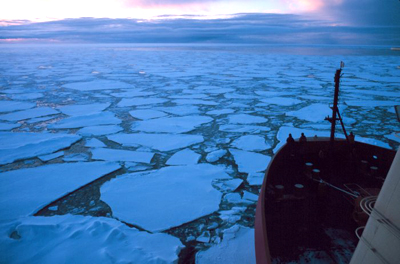
Earth's ocean covers more than 70% of our planet's surface. There are five major ocean basins: the Pacific, the Atlantic, the Indian Ocean, the Arctic Ocean, and the Southern Ocean that surrounds Antarctica.

Seawater is salty. Anyone who has taken a gulp of water while swimming in the ocean knows that. The saltiness of the water is called salinity. Salt is dissolved in the seawater. There are other minerals and gases dissolved in seawater too.

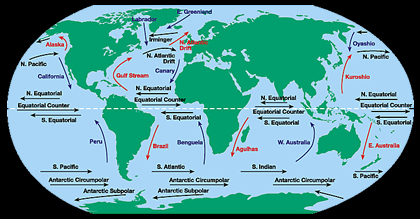
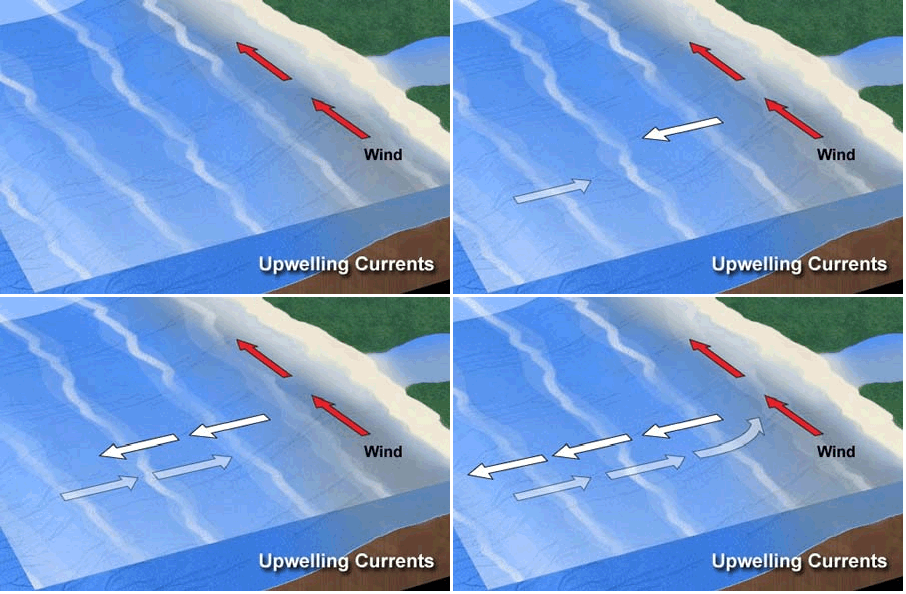
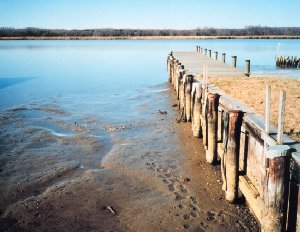
Ocean water is always moving. It moves around surface ocean currents in the top part of the ocean. It also moves from the deep ocean to shallow areas by upwelling and moves back to the deep ocean by downwelling. Currents along coastlines move water too. Each day ocean water moves with the tides, shifting where the water meets the shore.

Over a long time water moves from the deep ocean to shallow ocean and back again to the deep in the global ocean conveyor. As Earth’s climate warms this pattern might change.

The height of the ocean surface is called sea level. Over a long time, sea level can change for a number of reasons. Today sea level is rising because Earth’s climate is getting warmer.

Coral reefs are affected as the ocean changes because of global warming, pollution, and other changes. The ocean is becoming more acidic, which is harmful to corals and other marine life.

Last modified February 15, 2011 by Jennifer Bergman.

Shop Windows to the Universe Science Store!

The Summer 2010 issue of The Earth Scientist, available in our online store, includes articles on rivers and snow, classroom planetariums, satellites and oceanography, hands-on astronomy, and global warming.

Windows to the Universe Community

News

Opportunities

You might also be interested in:

Traveling Nitrogen Classroom Activity Kit

Check out our online store - minerals, fossils, books, activities, jewelry, and household items!...more

The Southern Ocean

The Southern Ocean is sometimes known as the Antarctic Ocean or South Polar Ocean. It surrounds Antarctica in the South Polar Region. The Southern Ocean is a bit different from other oceans. Other oceans...more

Antarctica

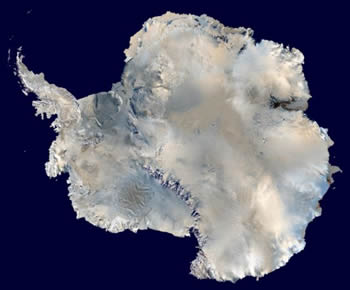
Antarctica is the coldest, windiest, and driest continent on Earth. It is about one and a half times the size of the United States. Almost all of Antarctica is covered with a thick layer of ice called...more

Salinity

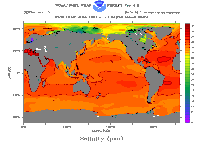
Almost 3/4 of the Earth is covered with water. Almost all of that water is in the oceans. Have you ever been swimming in the ocean? If you have and you accidentally got water in your mouth, you know the...more

Surface Ocean Currents

The water at the ocean surface is moved by powerful wind. The wind is able to move the top 400 meters of the ocean. This moving water is called surface ocean currents. Surface ocean currents form large...more

Ocean Upwelling

There are places in the ocean where water from the deep sea travels up to the surface. These are called areas of upwelling. The deep waters can have a large influence on marine life and the climate too....more

Currents at the Coast

When waves get to the beach at an angle, water moves along the coast in a longshore current. Longshore currents grow stronger when the waves come towards the beach at a large angle, if the waves are large,...more

Tidewater

Have you ever walked along the same beach at different times during the day? Did you notice that sometimes the water was higher up on the beach than at other times? Changes in the height of ocean water...more

Shop Windows to the Universe

Learn about planets outside our solar system through Exoplanets and Alien Solar Systems by Tahir Yaqoob, Ph.D., a book in our online store book collection.

Windows to the Universe, a project of the National Earth Science Teachers Association, is sponsored in part by the National Science Foundation and NASA, our Founding Partners (the American Geophysical Union and American Geosciences Institute) as well as through Institutional, Contributing, and Affiliate Partners, individual memberships and generous donors. Thank you for your support! NASA AGU AGI NSF