Current Events

  • Irish Chronicles Document Links Between Volcanoes and Weather
    A study of over 40,000 written entries in Irish Annals and ice core measurements shows a strong corr...Read more

    x

    Irish Chronicles Document Links Between Volcanoes and Weather

    A study of over 40,000 written entries in Irish Annals and ice core measurements shows a strong correlation between the occurrence of volcanic eruptions and extreme cold weather in Ireland over a 1200 year period. Data analyzed in this study cover the period from 431 to 1649, during which time up to 48 volcanic eruptions are identified in Greenland ice core records through deposition of volcanic sulfate in annual layers of ice. You can find the study (open access), published on 6 June 2013 in IOP Publishing's journal Environmental Research Letters, at http://iopscience.iop.org/1748-9326/8/2/024035/article. Find out more about how volcanoes can influence climate.
  • EF-5 Tornado in El Reno, Oklahoma Widest Ever Recorded in US
    The EF-5 tornado that hit El Reno, Oklahoma on May 31st was the widest ever recorded in the US, acco...Read more

    x

    EF-5 Tornado in El Reno, Oklahoma Widest Ever Recorded in US

    The EF-5 tornado that hit El Reno, Oklahoma on May 31st was the widest ever recorded in the US, according to the National Weather Service in Norman Oklahoma. The tornado, which remained on the ground for 40 minutes and reached 2.6 miles across (4.2 km), took the lives of 18 people including storm chasers Tim Samaras, Paul Samaras and Carl Young. For more information on the tornado, visit http://ow.ly/i/2hfDG.
  • Atmospheric CO2 Level Tops 400 ppm
    During the week of May 13th, the CO2 level at the Mauna Loa Observatory in Hawaii topped 400 ppm rep...Read more

    x

    Atmospheric CO2 Level Tops 400 ppm

    During the week of May 13th, the CO2 level at the Mauna Loa Observatory in Hawaii topped 400 ppm repeatedly. Daily levels of CO2 can vary due to weather, and there are seasonal trends as well. The level of atmospheric greenhouse gases continues to increase, now over 120 ppm since the Industrial Revolution began. For more on the Keeling Curve, see http://keelingcurve.ucsd.edu/. Find out more about greenhouse gases and warming.
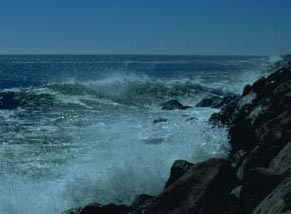
This is a photo of the crashing waves of the ocean. Because the ocean holds so much of the Earth's water, it is the greatest source of evaporated water to the atmosphere.
Click on image for full size
Corel Photography

Evaporation

One process which transfers water from the ground back to the atmosphere is evaporation. Evaporation is when water passes from a liquid phase to a gas phase. Rates of evaporation of water depend on things like the temperature, humidity, and wind.

Water that is held in lakes and rivers evaporates directly into the atmosphere. Some of the water in the ground may also be returned to the atmosphere by way of evaporation through the soil surface. Of course, the ocean is the greatest source for water evaporated into the atmosphere.

Shop Windows to the Universe Science Store!

The Summer 2010 issue of The Earth Scientist, available in our online store, includes articles on rivers and snow, classroom planetariums, satellites and oceanography, hands-on astronomy, and global warming.

Windows to the Universe Community

News

Opportunities

You might also be interested in:

Traveling Nitrogen Classroom Activity Kit

Check out our online store - minerals, fossils, books, activities, jewelry, and household items!...more

Rivers

Rivers are very important to Earth because they are major forces that shape the landscape. Also, they provide transportation and water for drinking, washing and farming. Rivers can flow on land or underground...more

Rain

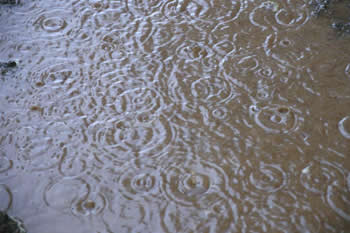
Rain is precipitation that falls to the Earth in drops of 5mm or more in diameter according to the US National Weather Service. Virga is rain that evaporates before reaching the ground. Raindrops form...more

The Atmosphere of Triton

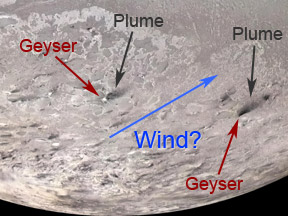
Triton is by far the largest moon of Neptune. It is slightly smaller than Earth's Moon. The surface of Triton is colder than the surface of any other planet or moon in our Solar System. It is so cold on...more

Chemical Sedimentary Rocks

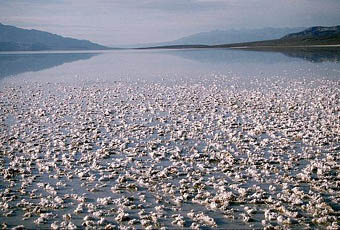
Unlike most other sedimentary rocks, chemical rocks are not made of pieces of sediment. Instead, they have mineral crystals made from elements that are dissolved in water. The water in the oceans, lakes,...more

Contrails

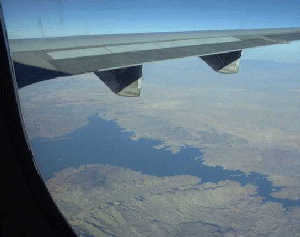
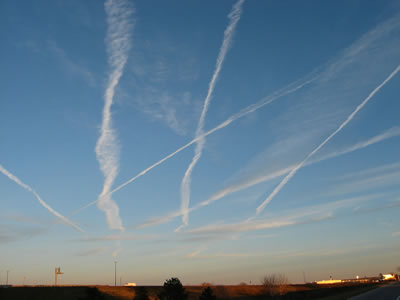
The white streaks you see coming off high-flying jet airplanes are called contrails, which is short for condensation trail. Contrails are clouds that formed when water vapor condenses and freezes around...more

Lenticular

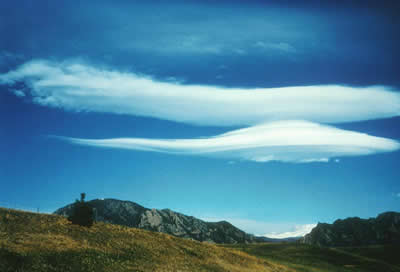
Lenticular clouds form on the downwind side of mountains. Wind blows most types of clouds across the sky, but lenticular clouds seem to stay in one place. Air moves up and over a mountain, and at the point...more

Type of Wind: Chinook or Foehn

There are several different types of wind. One type is the foehn wind. This type of wind is a characteristic of mountainous areas such as the Rocky Mountains and the Alps. The wind off of the Rocky Mountains...more

Shop Windows to the Universe

Arches National Park Geology Tour provides an extensive, visually rich description of the geology of Arches, by Deborah Ragland, Ph.D. See our DVD collection.

Windows to the Universe, a project of the National Earth Science Teachers Association, is sponsored in part by the National Science Foundation and NASA, our Founding Partners (the American Geophysical Union and American Geosciences Institute) as well as through Institutional, Contributing, and Affiliate Partners, individual memberships and generous donors. Thank you for your support! NASA AGU AGI NSF