Current Events

  • Irish Chronicles Document Links Between Volcanoes and Weather
    A study of over 40,000 written entries in Irish Annals and ice core measurements shows a strong corr...Read more

    x

    Irish Chronicles Document Links Between Volcanoes and Weather

    A study of over 40,000 written entries in Irish Annals and ice core measurements shows a strong correlation between the occurrence of volcanic eruptions and extreme cold weather in Ireland over a 1200 year period. Data analyzed in this study cover the period from 431 to 1649, during which time up to 48 volcanic eruptions are identified in Greenland ice core records through deposition of volcanic sulfate in annual layers of ice. You can find the study (open access), published on 6 June 2013 in IOP Publishing's journal Environmental Research Letters, at http://iopscience.iop.org/1748-9326/8/2/024035/article. Find out more about how volcanoes can influence climate.
  • EF-5 Tornado in El Reno, Oklahoma Widest Ever Recorded in US
    The EF-5 tornado that hit El Reno, Oklahoma on May 31st was the widest ever recorded in the US, acco...Read more

    x

    EF-5 Tornado in El Reno, Oklahoma Widest Ever Recorded in US

    The EF-5 tornado that hit El Reno, Oklahoma on May 31st was the widest ever recorded in the US, according to the National Weather Service in Norman Oklahoma. The tornado, which remained on the ground for 40 minutes and reached 2.6 miles across (4.2 km), took the lives of 18 people including storm chasers Tim Samaras, Paul Samaras and Carl Young. For more information on the tornado, visit http://ow.ly/i/2hfDG.
  • Atmospheric CO2 Level Tops 400 ppm
    During the week of May 13th, the CO2 level at the Mauna Loa Observatory in Hawaii topped 400 ppm rep...Read more

    x

    Atmospheric CO2 Level Tops 400 ppm

    During the week of May 13th, the CO2 level at the Mauna Loa Observatory in Hawaii topped 400 ppm repeatedly. Daily levels of CO2 can vary due to weather, and there are seasonal trends as well. The level of atmospheric greenhouse gases continues to increase, now over 120 ppm since the Industrial Revolution began. For more on the Keeling Curve, see http://keelingcurve.ucsd.edu/. Find out more about greenhouse gases and warming.

Charged Particle Motion in Earth's Magnetosphere

Precipitation of Magnetospheric Charged Particles

Magnetospheric charged particles on closed magnetic field lines (both ends of which penetrate the earth’s atmosphere) find themselves in a magnetic mirror geometry. Unless they are traveling nearly parallel to the magnetic field, they bounce back and forth between the Northern and Southern Hemispheres on paths high above the dense regions of the earth’s upper atmosphere.

Animation courtesy the COMET and HAO programs at UCAR/NCAR.

If, however, their paths are nearly parallel to the field lines, they can reach atmospheric regions where they collide with neutrals. By this process, charged particles precipitate from the magnetosphere into the atmosphere. The range of small pitch angles through which particles are precipitated is called the loss cone.

Pitch angles

As plasma sheet field lines approach the earth, the loss cone expands. In addition, charged particles can be scattered into the loss cone by magnetic and electrical disturbances in the magnetosphere. Particles precipitated via the loss cone from the magnetosphere into the upper atmosphere produce the aurora.

Animation courtesy the COMET and HAO programs at UCAR/NCAR.

Last modified May 17, 2005 by Randy Russell.

Shop Windows to the Universe Science Store!

Our online store includes issues of NESTA's quarterly journal, The Earth Scientist, full of classroom activities on different topics in Earth and space science, as well as books on science education!

You might also be interested in:

Traveling Nitrogen Classroom Activity Kit

Check out our online store - minerals, fossils, books, activities, jewelry, and household items!...more

Earth's Magnetic Poles

Earth has a magnetic field. If you imagine a gigantic bar magnet inside of Earth, you'll have a pretty good idea what Earth's magnetic field is shaped like. Of course, Earth DOESN'T have a giant bar magnet...more

Earth's North Magnetic Pole

Earth has a magnetic field with a north pole and a south pole. Earth's magnetic field is pretty much like the magnetic field around a bar magnet. Earth's North Magnetic Pole (NMP) is not in the same place...more

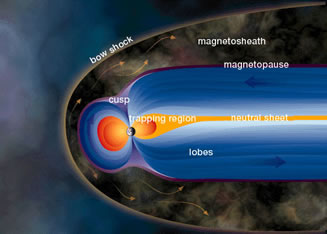
Charged Particle Motion in Earth's Magnetosphere

Motions within Earth's metallic core generate the planet's global magnetic field. This magnetic field extends beyond Earth's surface and atmosphere into the space surrounding our home planet. The interaction...more

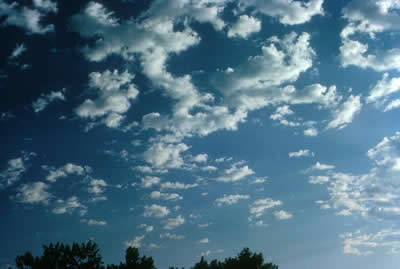
Altocumulus

Altocumulus clouds are part of the Middle Cloud group. They are grayish-white with one part of the cloud darker than the other. Altocumulus clouds usually form in groups. Altocumulus clouds are about...more

Altostratus

Altostratus clouds belong to the Middle Cloud group. An altostratus cloud usually covers the whole sky. The cloud looks gray or blue-gray. The sun or moon may shine through an altostratus cloud, but will...more

Cirrocumulus

Cirrocumulus clouds belong to the High Cloud group. They are small rounded puffs that usually appear in long rows. Cirrocumulus are usually white, but sometimes appear gray. Cirrocumulus clouds are the...more

Cirrostratus

Cirrostratus clouds belong to the High Cloud group. They are sheetlike thin clouds that usually cover the entire sky. The sun or moon can shine through cirrostratus clouds. When looking at the sun through...more

Shop Windows to the Universe

Warnings: The True Story of How Science Tamed the Weather by Mike Smith tells the story of our storm warning system. See our online store book collection.

Windows to the Universe, a project of the National Earth Science Teachers Association, is sponsored in part by the National Science Foundation and NASA, our Founding Partners (the American Geophysical Union and American Geosciences Institute) as well as through Institutional, Contributing, and Affiliate Partners, individual memberships and generous donors. Thank you for your support! NASA AGU AGI NSF