Current Events

  • Atmospheric CO2 Level Tops 400 ppm
    During the week of May 13th, the CO2 level at the Mauna Loa Observatory in Hawaii topped 400 ppm rep...Read more

    x

    Atmospheric CO2 Level Tops 400 ppm

    During the week of May 13th, the CO2 level at the Mauna Loa Observatory in Hawaii topped 400 ppm repeatedly. Daily levels of CO2 can vary due to weather, and there are seasonal trends as well. The level of atmospheric greenhouse gases continues to increase, now over 120 ppm since the Industrial Revolution began. For more on the Keeling Curve, see http://keelingcurve.ucsd.edu/. Find out more about greenhouse gases and warming.
  • Massive Tornado Outbreak on Tornado Alley
    The week of May 19 brings dozens of tornadoes to Tornado Alley in the states of Oklahoma, Kansas, Io...Read more

    x

    Massive Tornado Outbreak on Tornado Alley

    The week of May 19 brings dozens of tornadoes to Tornado Alley in the states of Oklahoma, Kansas, Iowa, Illinois and Missouri. On May 20th, a massive tornado struck Moore, Oklahoma, devastating communities - destroying over 100 homes and hitting two elementary schools and a hospital - with many casualties and deaths. Our thoughts are with our friends and colleagues suffering from these storms. For more on the May 20th storms, see the NOAA Storm Prediction Center Storm Report.
  • Kansas Legislator Proposes Bill to Outlaw Sustainability Education
    A bill has been introduced in the Kansas legislature this week that would prohibit the promotion of ...Read more

    x

    Kansas Legislator Proposes Bill to Outlaw Sustainability Education

    A bill has been introduced in the Kansas legislature this week that would prohibit the promotion of sustainability. Here is a link to the one-page bill: http://www.kslegislature.org/li/b2013_14/measures/documents/hb2366_00_0000.pdf. See report on Bloomberg News.

Charged Particle Motion in Earth's Magnetosphere

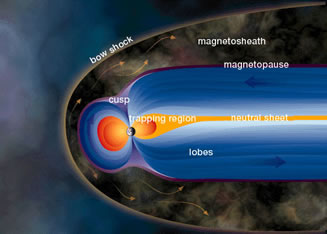
Regions of Earth's Magnetosphere

When dayside reconnection opens magnetic field lines at the magnetopause, hot, subsonic solar wind plasma in the magnetosheath gains direct access to the magnetosphere, producing the dayside cusp and plasma mantle. As open field lines are dragged into the magnetotail, they relinquish some of their hot solar wind plasma and fill with cool ionospheric plasma, producing a low density mixed plasma in the magnetotail lobes.

Click on the terms along the left side ("Bow Shock", "Magnetopause", etc.) to highlight those features of the magnetosphere in the image.

Animation courtesy the COMET and HAO programs at UCAR/NCAR.

Upon magnetotail reconnection, earthward-bound closed field lines compress the plasma forming the plasma sheet. Particle energies in the plasma sheet increase through compression as the field lines approach the Earth, and the energetic particles begin to drift around the Earth (ions to the west and electrons to the east), forming the outer radiation belt and extending the plasma sheet to the dayside magnetosphere. The inner radiation belt, produced by cosmic rays, lies inside the plasmasphere, which rotates with the Earth's atmosphere, and does not take part in large-scale magnetospheric convection.

Last modified May 13, 2005 by Randy Russell.

Shop Windows to the Universe Science Store!

Our online store includes issues of NESTA's quarterly journal, The Earth Scientist, full of classroom activities on different topics in Earth and space science, as well as books on science education!

You might also be interested in:

Cool It! Game

Check out our online store - minerals, fossils, books, activities, jewelry, and household items!...more

Charged Particle Motion in Earth's Magnetosphere

Motions within Earth's metallic core generate the planet's global magnetic field. This magnetic field extends beyond Earth's surface and atmosphere into the space surrounding our home planet. The interaction...more

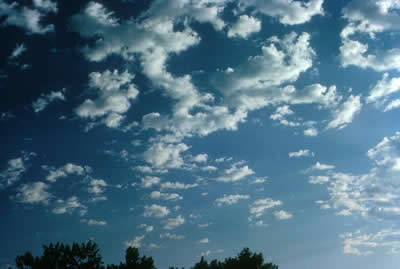
Altocumulus

Altocumulus clouds are part of the Middle Cloud group (2000-7000m up). They are grayish-white with one part of the cloud darker than the other. Altocumulus clouds usually form in groups and are about...more

Altostratus

Altostratus belong to the Middle Cloud group (2000-7000m up). An altostratus cloud usually covers the whole sky and has a gray or blue-gray appearance. The sun or moon may shine through an altostratus...more

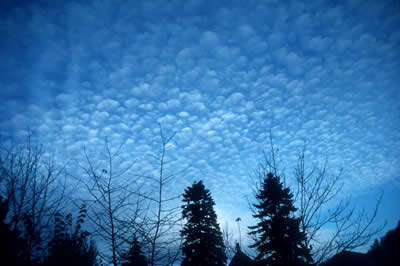
Cirrocumulus

Cirrocumulus clouds belong to the High Cloud group (5000-13000m). They are small rounded puffs that usually appear in long rows. Cirrocumulus are usually white, but sometimes appear gray. Cirrocumulus...more

Cirrostratus

Cirrostratus clouds belong to the High Cloud (5000-13000m) group. They are sheetlike thin clouds that usually cover the entire sky. The sun or moon can shine through cirrostratus clouds . Sometimes, the...more

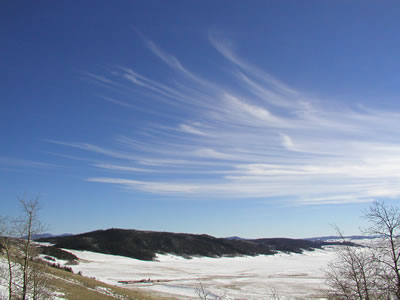
Cirrus

Cirrus clouds are the most common of the High Cloud (5000-13000m) group. They are composed entirely of ice and consist of long, thin, wispy streamers. They are commonly known as "mare's tails" because...more

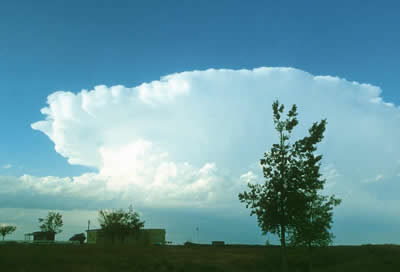
Cumulonimbus

Cumulonimbus clouds belong to the Clouds with Vertical Growth group. They are generally known as thunderstorm clouds. A cumulonimbus cloud can grow up to 10km high. At this height, high winds will flatten...more

Shop Windows to the Universe

Young Voices for the Planet DVD in our online store includes 8 films where students speak out and take action on climate change.

Windows to the Universe, a project of the National Earth Science Teachers Association, is sponsored in part by the National Science Foundation and NASA, our Founding Partners (the American Geophysical Union and American Geosciences Institute) as well as through Institutional, Contributing, and Affiliate Partners, individual memberships and generous donors. Thank you for your support! NASA AGU AGI NSF