Current Events

  • Atmospheric CO2 Level Tops 400 ppm
    During the week of May 13th, the CO2 level at the Mauna Loa Observatory in Hawaii topped 400 ppm rep...Read more

    x

    Atmospheric CO2 Level Tops 400 ppm

    During the week of May 13th, the CO2 level at the Mauna Loa Observatory in Hawaii topped 400 ppm repeatedly. Daily levels of CO2 can vary due to weather, and there are seasonal trends as well. The level of atmospheric greenhouse gases continues to increase, now over 120 ppm since the Industrial Revolution began. For more on the Keeling Curve, see http://keelingcurve.ucsd.edu/. Find out more about greenhouse gases and warming.
  • Massive Tornado Outbreak on Tornado Alley
    The week of May 19 brings dozens of tornadoes to Tornado Alley in the states of Oklahoma, Kansas, Io...Read more

    x

    Massive Tornado Outbreak on Tornado Alley

    The week of May 19 brings dozens of tornadoes to Tornado Alley in the states of Oklahoma, Kansas, Iowa, Illinois and Missouri. On May 20th, a massive tornado struck Moore, Oklahoma, devastating communities - destroying over 100 homes and hitting two elementary schools and a hospital - with many casualties and deaths. Our thoughts are with our friends and colleagues suffering from these storms. For more on the May 20th storms, see the NOAA Storm Prediction Center Storm Report.
  • Kansas Legislator Proposes Bill to Outlaw Sustainability Education
    A bill has been introduced in the Kansas legislature this week that would prohibit the promotion of ...Read more

    x

    Kansas Legislator Proposes Bill to Outlaw Sustainability Education

    A bill has been introduced in the Kansas legislature this week that would prohibit the promotion of sustainability. Here is a link to the one-page bill: http://www.kslegislature.org/li/b2013_14/measures/documents/hb2366_00_0000.pdf. See report on Bloomberg News.
This image shows a picture of a whale's tail sticking out of the water. Whales can often be identified by their tail features.
Click on image for full size
Windows Original, adapted from Corel Photography

Whales

Whales, like dolphins, are part of the Cetacea order. The name Cetacea comes from the Latin 'cetus', which means large marine creature or sea monster! But, whales are no danger to people...

Actually, it is people who are a threat to whales. Over the last 150 years, many species of whales have been brought close to extinction because of unconstrained whale hunting.

Whales strain plankton from the sea or they eat fish. Killer whales do eat squid and sometimes seals and otters too.

Whales make lots of unique and complex noises. We call them whale songs. One song may last as long as 35 minutes. The songs are used in identifying other whales, warning other whales of the same pod and in increasing sexual attraction between possible mating pairs.


Last modified May 15, 2009 by Jennifer Bergman.

Shop Windows to the Universe Science Store!

"Science, Evolution, and Creationism", by the National Academies, provides fascinating background on these topics for all, and is particularly useful for the Earth and space science classroom. Check our other books in our online store.

Windows to the Universe Community

News

Opportunities

You might also be interested in:

Traveling Nitrogen Classroom Activity Kit

Check out our online store - minerals, fossils, books, activities, jewelry, and household items!...more

Robots Watch out for Poisonous Plankton!

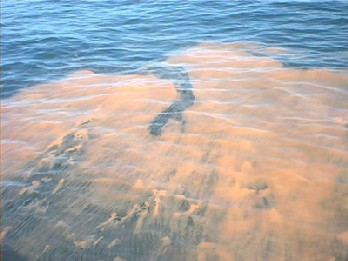
Tiny algae that float in the sea may look harmless but certain species are toxic and, in large numbers, they are able to kill fish, poison seafood and even choke swimmers. Now special underwater robots...more

Missing Link Between Whales and Four-Footed Ancestors Discovered

Scientists have discovered the missing link between whales and their four-footed ancestors. The result is reported in this week's issue of the journal Nature. The research is funded by the National Science...more

Life in the Open Ocean

The open ocean, called the pelagic zone, is the largest area of the marine ecosystem. It extends from the coasts to the middle of the ocean and includes all areas above the ocean floor. The living things...more

Life in the Deep Ocean

The deep ocean is very cold, under high pressure, and always dark because sunlight can not penetrate that far. The only light comes from bioluminescence – a chemical reaction inside the bodies of some...more

Early Whales Gave Birth on Land

Two newly described fossil whales--a pregnant female and a male of the same species--reveal how primitive whales gave birth and provide new insights into how whales made the transition from land to sea....more

Can there be Life in the Environment of Jupiter?

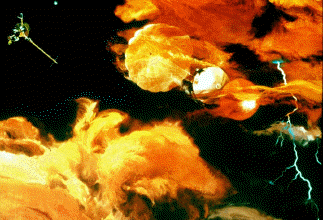
Jupiter's atmospheric environment is one of strong gravity, high pressure, strong winds, from 225 miles per hour to 1000 miles per hour, and cold temperatures of -270 degrees to +32 degrees (freezing temperature)....more

The possible discovery of Life on Mars

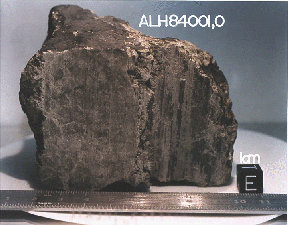
In July, 1996, it was announced that Dr. David McKay, along with a team of scientists at Johnson Space Center (a division of NASA), had discovered possible fossils of bacteria in an ancient rock from Mars....more

Shop Windows to the Universe

The Spring 2011 issue of The Earth Scientist is focused on modernizing seismology education. Thanks to IRIS, you can download this issue for free as a pdf. Print copies are available in our online store.

Windows to the Universe, a project of the National Earth Science Teachers Association, is sponsored in part by the National Science Foundation and NASA, our Founding Partners (the American Geophysical Union and American Geosciences Institute) as well as through Institutional, Contributing, and Affiliate Partners, individual memberships and generous donors. Thank you for your support! NASA AGU AGI NSF