Current Events

  • Atmospheric CO2 Level Tops 400 ppm
    During the week of May 13th, the CO2 level at the Mauna Loa Observatory in Hawaii topped 400 ppm rep...Read more

    x

    Atmospheric CO2 Level Tops 400 ppm

    During the week of May 13th, the CO2 level at the Mauna Loa Observatory in Hawaii topped 400 ppm repeatedly. Daily levels of CO2 can vary due to weather, and there are seasonal trends as well. The level of atmospheric greenhouse gases continues to increase, now over 120 ppm since the Industrial Revolution began. For more on the Keeling Curve, see http://keelingcurve.ucsd.edu/. Find out more about greenhouse gases and warming.
  • Massive Tornado Outbreak on Tornado Alley
    The week of May 19 brings dozens of tornadoes to Tornado Alley in the states of Oklahoma, Kansas, Io...Read more

    x

    Massive Tornado Outbreak on Tornado Alley

    The week of May 19 brings dozens of tornadoes to Tornado Alley in the states of Oklahoma, Kansas, Iowa, Illinois and Missouri. On May 20th, a massive tornado struck Moore, Oklahoma, devastating communities - destroying over 100 homes and hitting two elementary schools and a hospital - with many casualties and deaths. Our thoughts are with our friends and colleagues suffering from these storms. For more on the May 20th storms, see the NOAA Storm Prediction Center Storm Report.
  • Kansas Legislator Proposes Bill to Outlaw Sustainability Education
    A bill has been introduced in the Kansas legislature this week that would prohibit the promotion of ...Read more

    x

    Kansas Legislator Proposes Bill to Outlaw Sustainability Education

    A bill has been introduced in the Kansas legislature this week that would prohibit the promotion of sustainability. Here is a link to the one-page bill: http://www.kslegislature.org/li/b2013_14/measures/documents/hb2366_00_0000.pdf. See report on Bloomberg News.
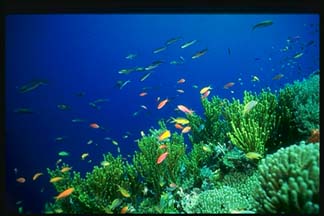
School of Anthias over green algae
Click on image for full size
Image courtesy of Corel Photography

Kingdom Protista

Members of the Kingdom Protista are the simplest of the eukaryotes. Protists are an unusual group of organisms that were put together because they don't really seem to belong to any other group. Some protists perform photosynthesis like plants while others move around and act like animals, but protists are neither plants nor animals. They're not fungi either - even though some might like to "think" they are!

In some ways, the Kingdom Protista is home for the "leftover" organisms that couldn't be classified elsewhere. You might not think a tiny one-celled amoeba has much in common with a giant sea kelp, but they're both members of this kingdom.

Shop Windows to the Universe Science Store!

"Ready, Set, SCIENCE!: Putting Research to Work in K-8 Science Classrooms", from the National Research Council, provides insight on the types of instructional experiences help K-8 students learn science with understanding. Check our other books in our online store.

Windows to the Universe Community

News

Opportunities

You might also be interested in:

Traveling Nitrogen Classroom Activity Kit

Check out our online store - minerals, fossils, books, activities, jewelry, and household items!...more

Kingdom Plantae

Kingdom Plantae contains almost 300,000 different species of plants. It is not the largest kingdom, but it is a very important one! In the process known as "photosynthesis", plants use the energy of the...more

Pre-Cambrian Life

About 2.5 billion years ago (BYA), after the iron in the ocean was gone to form iron ore deposits, oxygen began collecting in the atmosphere. Life took advantage of this change and developed eukaryotic...more

Sulfate Aerosols from Plankton

Aerosols are tiny particles or drops of liquid that float around in the atmosphere. For example, tiny flecks of smoke particles from fires or smokestacks are a type of aerosol. Some kinds of aerosols come...more

Life in the Open Ocean

The open ocean, called the pelagic zone, is the largest area of the marine ecosystem. It reaches from coasts to the middle of the ocean. The living things that survive in the open ocean need to have a...more

Microscopic Fossils Offer Big Clues to Earth's Climate

Some scientists look for fossils that are so small they need an electron microscope to find them. The fossils may be small, but what they can tell us about the climate of ancient Earth can be huge. These...more

Global Warming Causes Outbreak of Rare Algae in Caribbean Corals

The Caribbean Sea is usually a warm place, but during 2005 it became much warmer than normal. The extra heat put corals in extreme danger. Now scientists have figured out how some corals survived the event...more

Can there be Life in the Environment of Jupiter?

Jupiter's atmospheric environment is one of strong gravity, high pressure, strong winds, from 225 miles per hour to 1000 miles per hour, and cold temperatures of -270 degrees to +32 degrees (freezing temperature)....more

Shop Windows to the Universe

The Winter 2010 issue of The Earth Scientist includes a variety of educational resources, ranging from astronomy to glaciers. Check out the other publications and classroom materials in our online store.

Windows to the Universe, a project of the National Earth Science Teachers Association, is sponsored in part by the National Science Foundation and NASA, our Founding Partners (the American Geophysical Union and American Geosciences Institute) as well as through Institutional, Contributing, and Affiliate Partners, individual memberships and generous donors. Thank you for your support! NASA AGU AGI NSF