Current Events

  • Irish Chronicles Document Links Between Volcanoes and Weather
    A study of over 40,000 written entries in Irish Annals and ice core measurements shows a strong corr...Read more

    x

    Irish Chronicles Document Links Between Volcanoes and Weather

    A study of over 40,000 written entries in Irish Annals and ice core measurements shows a strong correlation between the occurrence of volcanic eruptions and extreme cold weather in Ireland over a 1200 year period. Data analyzed in this study cover the period from 431 to 1649, during which time up to 48 volcanic eruptions are identified in Greenland ice core records through deposition of volcanic sulfate in annual layers of ice. You can find the study (open access), published on 6 June 2013 in IOP Publishing's journal Environmental Research Letters, at http://iopscience.iop.org/1748-9326/8/2/024035/article. Find out more about how volcanoes can influence climate.
  • EF-5 Tornado in El Reno, Oklahoma Widest Ever Recorded in US
    The EF-5 tornado that hit El Reno, Oklahoma on May 31st was the widest ever recorded in the US, acco...Read more

    x

    EF-5 Tornado in El Reno, Oklahoma Widest Ever Recorded in US

    The EF-5 tornado that hit El Reno, Oklahoma on May 31st was the widest ever recorded in the US, according to the National Weather Service in Norman Oklahoma. The tornado, which remained on the ground for 40 minutes and reached 2.6 miles across (4.2 km), took the lives of 18 people including storm chasers Tim Samaras, Paul Samaras and Carl Young. For more information on the tornado, visit http://ow.ly/i/2hfDG.
  • Atmospheric CO2 Level Tops 400 ppm
    During the week of May 13th, the CO2 level at the Mauna Loa Observatory in Hawaii topped 400 ppm rep...Read more

    x

    Atmospheric CO2 Level Tops 400 ppm

    During the week of May 13th, the CO2 level at the Mauna Loa Observatory in Hawaii topped 400 ppm repeatedly. Daily levels of CO2 can vary due to weather, and there are seasonal trends as well. The level of atmospheric greenhouse gases continues to increase, now over 120 ppm since the Industrial Revolution began. For more on the Keeling Curve, see http://keelingcurve.ucsd.edu/. Find out more about greenhouse gases and warming.

Video courtesy of the National Science Foundation and Twin Cities Public Television.

Secrets of Plant Genomes: Revealed!

Plant genome research is already revolutionizing the field of biology. Currently, scientists are unlocking the secrets of some of the most important plants in our lives, including corn, cotton and potatoes. Secrets of Plant Genomes: Revealed! takes viewers on a lively, upbeat journey that explores how these plants got to be the way they are and investigates how we can make better use of them in the future. Plant scientists are hard at work - in the lab, in the field and at the computer - to increase our understanding of nature. Secrets of Plant Genomes: Revealed! makes the study of plants exciting and relevant by showing how learning more about plants can improve our everyday lives.

Last modified April 2, 2010 by Randy Russell.

Shop Windows to the Universe Science Store!

The Spring 2010 issue of The Earth Scientist, focuses on the ocean, including articles on polar research, coral reefs, ocean acidification, and climate. Includes a gorgeous full color poster!

Windows to the Universe Community

News

Opportunities

You might also be interested in:

Traveling Nitrogen Classroom Activity Kit

Check out our online store - minerals, fossils, books, activities, jewelry, and household items!...more

Can there be Life in the Environment of Jupiter?

Jupiter's atmospheric environment is one of strong gravity, high pressure, strong winds, from 225 miles per hour to 1000 miles per hour, and cold temperatures of -270 degrees to +32 degrees (freezing temperature)....more

The possible discovery of Life on Mars

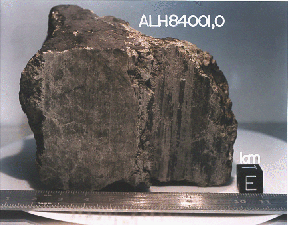
In July, 1996, it was announced that Dr. David McKay, along with a team of scientists at Johnson Space Center (a division of NASA), had discovered possible fossils of bacteria in a meteorite named ALH84...more

The Environment of Saturn

Saturn's atmospheric environment is one of strong gravity, high pressure, strong winds, from 225 miles per hour to 1000 miles per hour, and cold temperatures of -270 degrees to +80 degrees. With winds...more

Can there be Life in the Environment of Titan?

Titan's atmosphere is a lot like the Earth's, except that it is very cold, from -330 degrees to -290 degrees! Like the Earth, there is a lot of Nitrogen and other complex molecules. There also may be an...more

Autotrophs

Autotrophs are organisms that can "make their own food" from an inorganic source of carbon (carbon dioxide) given a source of energy. Most autotrophs use sunlight in the process of photosynthesis to make...more

Coacervates

In the warm primordial ocean, aggregates of amino acids, proteins, and other hydrocarbons came together into a form called *coacervates*. Amino acids will spontaneously form coacervates in the same way...more

Early Life

Over a very long time, gradual changes in the earliest cells gave rise to new life forms. These new cells were very different from the earlier heterotrophs because they were able to get their energy from...more

Shop Windows to the Universe

Our Glaciers: Then and Now activity kit helps you see the changes taking place in glaciers around the world. See all our activity kits and classroom activities.

Windows to the Universe, a project of the National Earth Science Teachers Association, is sponsored in part by the National Science Foundation and NASA, our Founding Partners (the American Geophysical Union and American Geosciences Institute) as well as through Institutional, Contributing, and Affiliate Partners, individual memberships and generous donors. Thank you for your support! NASA AGU AGI NSF