Current Events

  • Atmospheric CO2 Level Tops 400 ppm
    During the week of May 13th, the CO2 level at the Mauna Loa Observatory in Hawaii topped 400 ppm rep...Read more

    x

    Atmospheric CO2 Level Tops 400 ppm

    During the week of May 13th, the CO2 level at the Mauna Loa Observatory in Hawaii topped 400 ppm repeatedly. Daily levels of CO2 can vary due to weather, and there are seasonal trends as well. The level of atmospheric greenhouse gases continues to increase, now over 120 ppm since the Industrial Revolution began. For more on the Keeling Curve, see http://keelingcurve.ucsd.edu/. Find out more about greenhouse gases and warming.
  • Massive Tornado Outbreak on Tornado Alley
    The week of May 19 brings dozens of tornadoes to Tornado Alley in the states of Oklahoma, Kansas, Io...Read more

    x

    Massive Tornado Outbreak on Tornado Alley

    The week of May 19 brings dozens of tornadoes to Tornado Alley in the states of Oklahoma, Kansas, Iowa, Illinois and Missouri. On May 20th, a massive tornado struck Moore, Oklahoma, devastating communities - destroying over 100 homes and hitting two elementary schools and a hospital - with many casualties and deaths. Our thoughts are with our friends and colleagues suffering from these storms. For more on the May 20th storms, see the NOAA Storm Prediction Center Storm Report.
  • Kansas Legislator Proposes Bill to Outlaw Sustainability Education
    A bill has been introduced in the Kansas legislature this week that would prohibit the promotion of ...Read more

    x

    Kansas Legislator Proposes Bill to Outlaw Sustainability Education

    A bill has been introduced in the Kansas legislature this week that would prohibit the promotion of sustainability. Here is a link to the one-page bill: http://www.kslegislature.org/li/b2013_14/measures/documents/hb2366_00_0000.pdf. See report on Bloomberg News.
An eagle is an example of a heterotroph. All animals are heterotrophs.
Click on image for full size
Image courtesy of Corel Photography

Heterotrophs

Heterotrophs are organisms that get the carbon necessary for life from organic substrates. They cannot synthesize organic carbon-based compounds from inorganic sources in the environment like an autotroph can.

Heterotrophs are known as consumers in the food chain. They can feed on autotrophs, heterotrophs, or sometimes their own waste products. More simply, a heterotroph might eat plants or another animal to get necessary carbon to sustain its own life.

The term heterotroph can refer to single-celled organisms as well as multi-celled organisms. Most bacteria and all animal and fungal species are heterotrophic.

Last modified August 9, 2006 by Jennifer Bergman.

Shop Windows to the Universe Science Store!

"Ready, Set, SCIENCE!: Putting Research to Work in K-8 Science Classrooms", from the National Research Council, provides insight on the types of instructional experiences help K-8 students learn science with understanding. Check our other books in our online store.

Windows to the Universe Community

News

Opportunities

You might also be interested in:

Traveling Nitrogen Classroom Activity Kit

Check out our online store - minerals, fossils, books, activities, jewelry, and household items!...more

Autotrophs

Autotrophs are organisms that produce organic compounds from an inorganic source of carbon (carbon dioxide) given a source of energy. If the source of energy is the reactions of inorganic chemical compounds,...more

The First Living Cells

The first beings were probably much like coacervates. As a group, these bacteria are called heterotrophic anaerobes. Because there was virtually no oxygen in the atmosphere at this time, these bacteria...more

Carbon-14 Dating (Radiocarbon Dating)

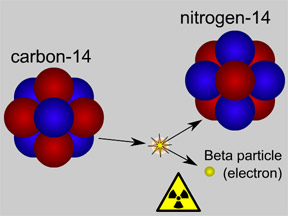
Carbon-14 dating (also called "radiocarbon dating") is used to determine the age of materials that contain carbon that was originally in living things. It is often used in archeology and some...more

Can there be Life in the Environment of Jupiter?

Jupiter's atmospheric environment is one of strong gravity, high pressure, strong winds, from 225 miles per hour to 1000 miles per hour, and cold temperatures of -270 degrees to +32 degrees (freezing temperature)....more

The possible discovery of Life on Mars

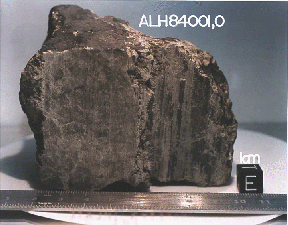
In July, 1996, it was announced that Dr. David McKay, along with a team of scientists at Johnson Space Center (a division of NASA), had discovered possible fossils of bacteria in an ancient rock from Mars....more

The Environment of Saturn

Saturn's atmospheric environment is one of strong gravity, high pressure, strong winds, from 225 miles per hour to 1000 miles per hour, and cold temperatures of -270 degrees to +80 degrees. With winds...more

The Environment of Titan, can there be Life?

Titan's atmosphere is a lot like the Earth's, except that it is very cold, from -330 degrees to -290 degrees! Like the Earth, there is a lot of Nitrogen and other complex molecules. There also may be an...more

Shop Windows to the Universe

Learn about planets outside our solar system through Exoplanets and Alien Solar Systems by Tahir Yaqoob, Ph.D., a book in our online store book collection.

Windows to the Universe, a project of the National Earth Science Teachers Association, is sponsored in part by the National Science Foundation and NASA, our Founding Partners (the American Geophysical Union and American Geosciences Institute) as well as through Institutional, Contributing, and Affiliate Partners, individual memberships and generous donors. Thank you for your support! NASA AGU AGI NSF