Current Events

  • Irish Chronicles Document Links Between Volcanoes and Weather
    A study of over 40,000 written entries in Irish Annals and ice core measurements shows a strong corr...Read more

    x

    Irish Chronicles Document Links Between Volcanoes and Weather

    A study of over 40,000 written entries in Irish Annals and ice core measurements shows a strong correlation between the occurrence of volcanic eruptions and extreme cold weather in Ireland over a 1200 year period. Data analyzed in this study cover the period from 431 to 1649, during which time up to 48 volcanic eruptions are identified in Greenland ice core records through deposition of volcanic sulfate in annual layers of ice. You can find the study (open access), published on 6 June 2013 in IOP Publishing's journal Environmental Research Letters, at http://iopscience.iop.org/1748-9326/8/2/024035/article. Find out more about how volcanoes can influence climate.
  • EF-5 Tornado in El Reno, Oklahoma Widest Ever Recorded in US
    The EF-5 tornado that hit El Reno, Oklahoma on May 31st was the widest ever recorded in the US, acco...Read more

    x

    EF-5 Tornado in El Reno, Oklahoma Widest Ever Recorded in US

    The EF-5 tornado that hit El Reno, Oklahoma on May 31st was the widest ever recorded in the US, according to the National Weather Service in Norman Oklahoma. The tornado, which remained on the ground for 40 minutes and reached 2.6 miles across (4.2 km), took the lives of 18 people including storm chasers Tim Samaras, Paul Samaras and Carl Young. For more information on the tornado, visit http://ow.ly/i/2hfDG.
  • Atmospheric CO2 Level Tops 400 ppm
    During the week of May 13th, the CO2 level at the Mauna Loa Observatory in Hawaii topped 400 ppm rep...Read more

    x

    Atmospheric CO2 Level Tops 400 ppm

    During the week of May 13th, the CO2 level at the Mauna Loa Observatory in Hawaii topped 400 ppm repeatedly. Daily levels of CO2 can vary due to weather, and there are seasonal trends as well. The level of atmospheric greenhouse gases continues to increase, now over 120 ppm since the Industrial Revolution began. For more on the Keeling Curve, see http://keelingcurve.ucsd.edu/. Find out more about greenhouse gases and warming.

Patterns of Inheritance

Aunt Maggie says you have your father's eyes.
Grandma says you have your mother's smile.

Could you actually have the traits from these other people? If you are genetically related to them then yes, you could. Half of your genes are from your mother and half are from your father. But you might look more like one of them than the other. Why is that? Genes are shuffled during meiosis, bringing together different mixes of genes in each gamete. Thus, your brother might look more like one of your parents while you look more like the other.

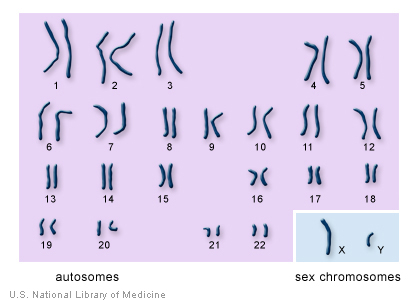
Within each of the trillions of cells in your body are chromosomes. Chromosomes come in pairs. You got one chromosome of each pair from your mother and one from your father. Along each chromosome are genes, one for each trait. This means that you have two copies of each gene, one from your mother and one from your father. Both genes of a pair deal with the same trait, but they might differ in their information about it. For instance, one gene for eye color might say blue while the other one says brown.

  • If the two genes are actually the same, for instance, if both genes give instructions for blue eyes, then the genes are called homozygous.
  • If the two are different, for instance, if one is for blue eyes and the other is for brown eyes, then the genes are called heterozygous.

In a heterozygous situation, the two genes have different instructions. Often one of those genes wins out and its instructions are carried out (that's called the dominant gene). The other one is still present but its instructions are not carried out (that's called a recessive gene). As a custom, people designate dominant genes with uppercase letters and lowercase genes with lowercase letters. For example gene "A" is dominant and gene "a" is recessive.

The genes of an individual are called its geneotype. They determine what it will look like, which is called its phenotype!
Last modified February 29, 2008 by Lisa Gardiner.

Shop Windows to the Universe Science Store!

Traveling Nitrogen is a fun group game appropriate for the classroom. Players follow nitrogen atoms through living and nonliving parts of the nitrogen cycle. For grades 5-9.

Windows to the Universe Community

News

Opportunities

You might also be interested in:

Traveling Nitrogen Classroom Activity Kit

Check out our online store - minerals, fossils, books, activities, jewelry, and household items!...more

Chromosomes, DNA and Genes: Tiny Things That Have a Huge Effect on Who We Are!

Do you look a bit like your siblings? Do you and your siblings look a bit like your parents? The similarities are because, unless you were adopted, you and the other members of your family have genetic...more

Cell Division by Meiosis

Plants, animals and many other species within the domain Eukaryota are able to make more individuals by sexual reproduction. In its simplest form, this means that offspring are made from gametes. Gametes...more

Can there be Life in the Environment of Jupiter?

Jupiter's atmospheric environment is one of strong gravity, high pressure, strong winds, from 225 miles per hour to 1000 miles per hour, and cold temperatures of -270 degrees to +32 degrees (freezing temperature)....more

The possible discovery of Life on Mars

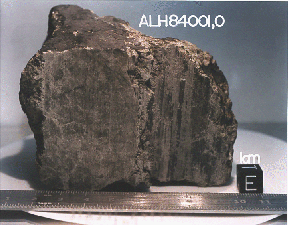
In July, 1996, it was announced that Dr. David McKay, along with a team of scientists at Johnson Space Center (a division of NASA), had discovered possible fossils of bacteria in an ancient rock from Mars....more

The Environment of Saturn

Saturn's atmospheric environment is one of strong gravity, high pressure, strong winds, from 225 miles per hour to 1000 miles per hour, and cold temperatures of -270 degrees to +80 degrees. With winds...more

The Environment of Titan, can there be Life?

Titan's atmosphere is a lot like the Earth's, except that it is very cold, from -330 degrees to -290 degrees! Like the Earth, there is a lot of Nitrogen and other complex molecules. There also may be an...more

Autotrophs

Autotrophs are organisms that produce organic compounds from an inorganic source of carbon (carbon dioxide) given a source of energy. If the source of energy is the reactions of inorganic chemical compounds,...more

Shop Windows to the Universe

Young Voices for the Planet DVD in our online store includes 8 films where students speak out and take action on climate change.

Windows to the Universe, a project of the National Earth Science Teachers Association, is sponsored in part by the National Science Foundation and NASA, our Founding Partners (the American Geophysical Union and American Geosciences Institute) as well as through Institutional, Contributing, and Affiliate Partners, individual memberships and generous donors. Thank you for your support! NASA AGU AGI NSF