Current Events

  • Irish Chronicles Document Links Between Volcanoes and Weather
    A study of over 40,000 written entries in Irish Annals and ice core measurements shows a strong corr...Read more

    x

    Irish Chronicles Document Links Between Volcanoes and Weather

    A study of over 40,000 written entries in Irish Annals and ice core measurements shows a strong correlation between the occurrence of volcanic eruptions and extreme cold weather in Ireland over a 1200 year period. Data analyzed in this study cover the period from 431 to 1649, during which time up to 48 volcanic eruptions are identified in Greenland ice core records through deposition of volcanic sulfate in annual layers of ice. You can find the study (open access), published on 6 June 2013 in IOP Publishing's journal Environmental Research Letters, at http://iopscience.iop.org/1748-9326/8/2/024035/article. Find out more about how volcanoes can influence climate.
  • EF-5 Tornado in El Reno, Oklahoma Widest Ever Recorded in US
    The EF-5 tornado that hit El Reno, Oklahoma on May 31st was the widest ever recorded in the US, acco...Read more

    x

    EF-5 Tornado in El Reno, Oklahoma Widest Ever Recorded in US

    The EF-5 tornado that hit El Reno, Oklahoma on May 31st was the widest ever recorded in the US, according to the National Weather Service in Norman Oklahoma. The tornado, which remained on the ground for 40 minutes and reached 2.6 miles across (4.2 km), took the lives of 18 people including storm chasers Tim Samaras, Paul Samaras and Carl Young. For more information on the tornado, visit http://ow.ly/i/2hfDG.
  • Atmospheric CO2 Level Tops 400 ppm
    During the week of May 13th, the CO2 level at the Mauna Loa Observatory in Hawaii topped 400 ppm rep...Read more

    x

    Atmospheric CO2 Level Tops 400 ppm

    During the week of May 13th, the CO2 level at the Mauna Loa Observatory in Hawaii topped 400 ppm repeatedly. Daily levels of CO2 can vary due to weather, and there are seasonal trends as well. The level of atmospheric greenhouse gases continues to increase, now over 120 ppm since the Industrial Revolution began. For more on the Keeling Curve, see http://keelingcurve.ucsd.edu/. Find out more about greenhouse gases and warming.
A meal fit for a human heterotroph!
C.Alexander

Living Things Get Energy from Different Sources

We all know that living things need food to survive, but not all life forms eat the same things. Autotrophs, known as *self-feeders* are beings which create "food" using energy from the sun, heat energy from the Earth, or other means to feed themselves. Heterotrophs, known as *other-feeders* are beings which feed themselves by eating other creatures, plant life, or food which exist outside of themselves. On Earth, nature provides the following three ways for living creatures to get energy.


Last modified January 11, 2005 by Lisa Gardiner.

Shop Windows to the Universe Science Store!

"Science, Evolution, and Creationism", by the National Academies, provides fascinating background on these topics for all, and is particularly useful for the Earth and space science classroom. Check our other books in our online store.

Windows to the Universe Community

News

Opportunities

You might also be interested in:

Traveling Nitrogen Classroom Activity Kit

Check out our online store - minerals, fossils, books, activities, jewelry, and household items!...more

Autotrophs

Organisms that are able to "make their own food" are called autotrophs, meaning "self-feeders". Some examples of autotrophs are plants and algae (shown in the picture). Both plants and algae use photosynthesis...more

Photosynthesis

There are many different kinds of plants. Some have big leaves. Some have small leaves. Some even have flowers. All plants make their own food. When sunlight hits the leaves of a plant, photosynthesis...more

Respiration

You may have heard of photosynthesis. That's where a plant uses energy from the Sun's rays to make its own food. The opposite of photosynthesis is called respiration. The difference is that respiration...more

Can there be Life in the Environment of Jupiter?

Jupiter's atmospheric environment is one of powerful winds, going 250 miles per hour, and temperatures from -270 degrees to +32 degrees (freezing temperature). These winds make it hard for life forms to...more

The possible discovery of Life on Mars

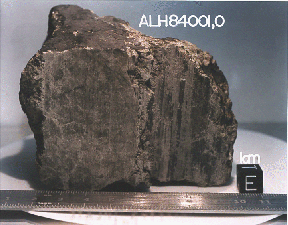
In July, 1996 a team of scientists said that they had discovered possible fossils of bacteria in a meteorite named ALH84001 that came from Mars. It was found in Antarctica in 1984 after having landed there...more

The Environment of Saturn

Saturn's atmospheric environment is one of powerful winds, going 250 miles per hour, and temperatures from -270 degrees to +80 degrees. With winds like these, it is hard to have peace and quiet. The region...more

Can there be Life in the Environment of Titan?

The air of Titan is a lot like the Earth's, except that it is very cold, from -330 degrees to -290 degrees! Like the Earth, there is a lot of Nitrogen and other complex molecules. There also may be an...more

Shop Windows to the Universe

Earth Science Rocks! Select one of our four cool NESTA t-shirts from our online store, and express your love of Earth and space science!

Windows to the Universe, a project of the National Earth Science Teachers Association, is sponsored in part by the National Science Foundation and NASA, our Founding Partners (the American Geophysical Union and American Geosciences Institute) as well as through Institutional, Contributing, and Affiliate Partners, individual memberships and generous donors. Thank you for your support! NASA AGU AGI NSF