Current Events

  • Atmospheric CO2 Level Tops 400 ppm
    During the week of May 13th, the CO2 level at the Mauna Loa Observatory in Hawaii topped 400 ppm rep...Read more

    x

    Atmospheric CO2 Level Tops 400 ppm

    During the week of May 13th, the CO2 level at the Mauna Loa Observatory in Hawaii topped 400 ppm repeatedly. Daily levels of CO2 can vary due to weather, and there are seasonal trends as well. The level of atmospheric greenhouse gases continues to increase, now over 120 ppm since the Industrial Revolution began. For more on the Keeling Curve, see http://keelingcurve.ucsd.edu/. Find out more about greenhouse gases and warming.
  • Massive Tornado Outbreak on Tornado Alley
    The week of May 19 brings dozens of tornadoes to Tornado Alley in the states of Oklahoma, Kansas, Io...Read more

    x

    Massive Tornado Outbreak on Tornado Alley

    The week of May 19 brings dozens of tornadoes to Tornado Alley in the states of Oklahoma, Kansas, Iowa, Illinois and Missouri. On May 20th, a massive tornado struck Moore, Oklahoma, devastating communities - destroying over 100 homes and hitting two elementary schools and a hospital - with many casualties and deaths. Our thoughts are with our friends and colleagues suffering from these storms. For more on the May 20th storms, see the NOAA Storm Prediction Center Storm Report.
  • Kansas Legislator Proposes Bill to Outlaw Sustainability Education
    A bill has been introduced in the Kansas legislature this week that would prohibit the promotion of ...Read more

    x

    Kansas Legislator Proposes Bill to Outlaw Sustainability Education

    A bill has been introduced in the Kansas legislature this week that would prohibit the promotion of sustainability. Here is a link to the one-page bill: http://www.kslegislature.org/li/b2013_14/measures/documents/hb2366_00_0000.pdf. See report on Bloomberg News.
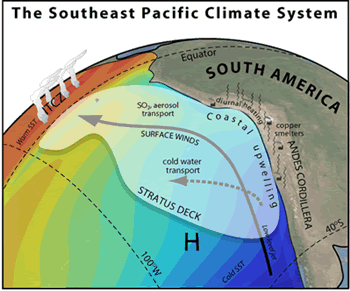
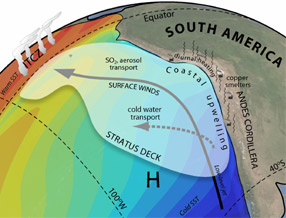
Winds along the west coast of South America blow from south to north.
Click on image for full size
Image courtesy of Ron Woods.

Winds in the Southeast Pacific

The winds in the Southeast Pacific mainly blow from south to north. They affect the weather and climate in the region. They also affect the climate in other places around the world.

Air near the equator is very hot. Hot air rises. It forms clouds which make rain. That is why there are rainforests near the equator. Later, the air falls back down towards the ground. It does that around 30° South latitude. Next the air flows back north along the ground towards the equator. Those winds are called the trade winds. The spin of the Earth makes the trade winds turn a bit towards the west. The high "wall" of the Andes Mountains helps to steer the winds along the coast. These winds blow pretty hard most of the time.

The air in the trade winds is dry. The dry winds help create the Atacama Desert in Chile. It is one of the driest places on Earth. The strong winds also help stir up the ocean. They also help bring cold water from deep in the ocean to the surface. The atmosphere and the ocean in this area are connected in many ways. The strong winds also carry aerosol particles from industries in South America out to sea. The aerosol particles change how clouds form in the area.

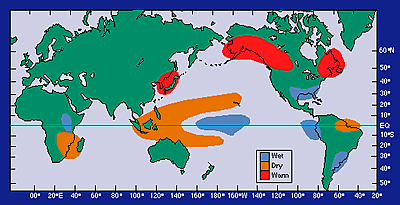
The winds in the Southeast Pacific also affect the weather and climate in other parts of the world. These winds are a big part of the cause of El Niño and La Niña.

Last modified October 27, 2008 by Randy Russell.

Shop Windows to the Universe Science Store!

The Fall 2009 issue of The Earth Scientist, which includes articles on student research into building design for earthquakes and a classroom lab on the composition of the Earth’s ancient atmosphere, is available in our online store.

Windows to the Universe Community

News

Opportunities

You might also be interested in:

Traveling Nitrogen Classroom Activity Kit

Check out our online store - minerals, fossils, books, activities, jewelry, and household items!...more

Wind

Wind is moving air. Warm air rises, and cool air comes in to take its place. This movement creates the winds around the globe. Winds move at different speeds and have different names based on their speed....more

Southeast Pacific Climate

There are a lot of clouds over the Southeast Pacific Ocean off the coasts of Peru and Chile in South America. In fact, this area has the largest amount of stratus and stratocumulus clouds in the world!...more

Teleconnections: Changes in Weather Linked Together

Changes in the atmosphere in one place can affect the weather very far away. Scientists call this phenomenon teleconnections. Sometimes the way air moves around the atmosphere changes over time. The changes...more

How Clouds Form

A cloud is composed of tiny water droplets or ice crystals. A series of things have to happen in order for these water droplets or ice crystals to form into clouds in the atmosphere, and different types...more

Rain

Raindrops form when tiny water droplets collide together in clouds to form bigger ones. When they get too heavy, rain falls out of the clouds. Rain is more than 5mm in diameter. The types of clouds that...more

Tropical Rainforests

Have you ever been to a rainforest? Rainforests have very different trees than the ones you might climb in your yard. Thousands of species of plants and animals live in the rain forests of the world. But...more

Atacama Desert

The Atacama Desert is one of the driest places on Earth. The Atacama is in the country of Chile in South America. In an average year, this desert gets less than 1 millimeter (0.04 inch) of rain! It is...more

Shop Windows to the Universe

Ready, Set, SCIENCE!, by the National Research Council, focuses on K-8 science classsrooms. Check out the other publications in our online store, as well as classroom materials.

Windows to the Universe, a project of the National Earth Science Teachers Association, is sponsored in part by the National Science Foundation and NASA, our Founding Partners (the American Geophysical Union and American Geosciences Institute) as well as through Institutional, Contributing, and Affiliate Partners, individual memberships and generous donors. Thank you for your support! NASA AGU AGI NSF