Current Events

  • Atmospheric CO2 Level Tops 400 ppm
    During the week of May 13th, the CO2 level at the Mauna Loa Observatory in Hawaii topped 400 ppm rep...Read more

    x

    Atmospheric CO2 Level Tops 400 ppm

    During the week of May 13th, the CO2 level at the Mauna Loa Observatory in Hawaii topped 400 ppm repeatedly. Daily levels of CO2 can vary due to weather, and there are seasonal trends as well. The level of atmospheric greenhouse gases continues to increase, now over 120 ppm since the Industrial Revolution began. For more on the Keeling Curve, see http://keelingcurve.ucsd.edu/. Find out more about greenhouse gases and warming.
  • Massive Tornado Outbreak on Tornado Alley
    The week of May 19 brings dozens of tornadoes to Tornado Alley in the states of Oklahoma, Kansas, Io...Read more

    x

    Massive Tornado Outbreak on Tornado Alley

    The week of May 19 brings dozens of tornadoes to Tornado Alley in the states of Oklahoma, Kansas, Iowa, Illinois and Missouri. On May 20th, a massive tornado struck Moore, Oklahoma, devastating communities - destroying over 100 homes and hitting two elementary schools and a hospital - with many casualties and deaths. Our thoughts are with our friends and colleagues suffering from these storms. For more on the May 20th storms, see the NOAA Storm Prediction Center Storm Report.
  • Kansas Legislator Proposes Bill to Outlaw Sustainability Education
    A bill has been introduced in the Kansas legislature this week that would prohibit the promotion of ...Read more

    x

    Kansas Legislator Proposes Bill to Outlaw Sustainability Education

    A bill has been introduced in the Kansas legislature this week that would prohibit the promotion of sustainability. Here is a link to the one-page bill: http://www.kslegislature.org/li/b2013_14/measures/documents/hb2366_00_0000.pdf. See report on Bloomberg News.
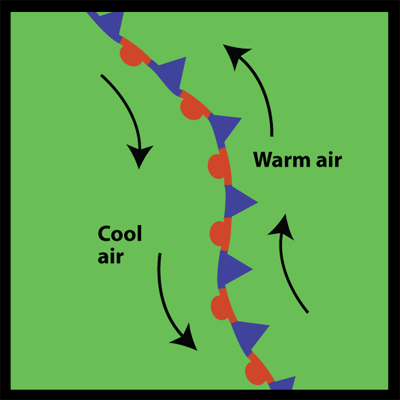
Weather map showing a stationary front
Windows to the Universe image by Lisa Gardiner

Stationary Fronts

A stationary front forms when a cold front or warm front stops moving. This happens when two masses of air are pushing against each other but neither is powerful enough to move the other.

A stationary front may stay put for days.  The front may start moving again, becoming either a cold or warm front. Or it may break apart.

Air temperature and wind can be different on opposite sides of a stationary front. The weather is often cloudy along a stationary front and rain or snow often falls, especially if the front is in an area of low atmospheric pressure.

On a weather map, a stationary front is shown as alternating red half circles and blue triangles like in the map at the left.

Last modified August 12, 2009 by Lisa Gardiner.

Shop Windows to the Universe Science Store!

The Fall 2009 issue of The Earth Scientist, which includes articles on student research into building design for earthquakes and a classroom lab on the composition of the Earth’s ancient atmosphere, is available in our online store.

Windows to the Universe Community

News

Opportunities

You might also be interested in:

Ready, Set, SCIENCE!: Putting Research to Work in K-8 Science Classrooms

What types of instructional experiences help K-8 students learn science with understanding? What do science educators teachers, teacher leaders, science specialists, professional development staff, curriculum designers, school administrators need to know to create and support such experiences?...more

Precipitation

Precipitation (pre-sip-uh-tay-shun) is any form of water that falls to the Earth's surface. Different forms of precipitation include drizzle, rain, hail, snow, sleet, and freezing rain. Precipitation...more

Cumulus Stage

The sun heats the earth during the day. The heat on the surface warms the air around it. Since warm air is lighter than cool air, it starts to rise. If the air has water in it, then the warm air turns...more

Dissipating Stage

After about 30 minutes, the thunderstorm begins to disappear. The cool downward wind stops the warm air from rising. No more rain is in the cloud. The cloud disappears. The whole process takes about one...more

Mature Stage

When the cumulus cloud becomes big, the water in it becomes heavy. It starts to fall out of the cloud. At the same time, cool dry air starts to enter the cloud. Cool air is heavier than warm air. The...more

Sound Waves vs. Light Waves

You see a flash of lightning across the night sky. Five seconds later, your hear the rumble of thunder. If lightning and thunder come from the same source, then why don't they occur at the same time?...more

Thunderstorm Safety

Thunderstorms can be really dangerous! Flash floods, lightning bolts, hail, tornadoes...all of these things can hurt you if you're not careful. So here's some safety tips. GO INSIDE! If you hear distant...more

Lightning Formation

The sky is filled with electric charge. In a calm sky, the positive (+) and negative (-) charges are mixed up. Inside a thunderstorm, the + and - charges are separated into two sections. All of the +...more

Shop Windows to the Universe

Become a nitrogen atom in the nitrogen cycle in our Traveling Nitrogen Classroom Activity Kit/Game. See all our games, activity kits and classroom activities.

Windows to the Universe, a project of the National Earth Science Teachers Association, is sponsored in part by the National Science Foundation and NASA, our Founding Partners (the American Geophysical Union and American Geosciences Institute) as well as through Institutional, Contributing, and Affiliate Partners, individual memberships and generous donors. Thank you for your support! NASA AGU AGI NSF