Current Events

  • Atmospheric CO2 Level Tops 400 ppm
    During the week of May 13th, the CO2 level at the Mauna Loa Observatory in Hawaii topped 400 ppm rep...Read more

    x

    Atmospheric CO2 Level Tops 400 ppm

    During the week of May 13th, the CO2 level at the Mauna Loa Observatory in Hawaii topped 400 ppm repeatedly. Daily levels of CO2 can vary due to weather, and there are seasonal trends as well. The level of atmospheric greenhouse gases continues to increase, now over 120 ppm since the Industrial Revolution began. For more on the Keeling Curve, see http://keelingcurve.ucsd.edu/. Find out more about greenhouse gases and warming.
  • Massive Tornado Outbreak on Tornado Alley
    The week of May 19 brings dozens of tornadoes to Tornado Alley in the states of Oklahoma, Kansas, Io...Read more

    x

    Massive Tornado Outbreak on Tornado Alley

    The week of May 19 brings dozens of tornadoes to Tornado Alley in the states of Oklahoma, Kansas, Iowa, Illinois and Missouri. On May 20th, a massive tornado struck Moore, Oklahoma, devastating communities - destroying over 100 homes and hitting two elementary schools and a hospital - with many casualties and deaths. Our thoughts are with our friends and colleagues suffering from these storms. For more on the May 20th storms, see the NOAA Storm Prediction Center Storm Report.
  • Kansas Legislator Proposes Bill to Outlaw Sustainability Education
    A bill has been introduced in the Kansas legislature this week that would prohibit the promotion of ...Read more

    x

    Kansas Legislator Proposes Bill to Outlaw Sustainability Education

    A bill has been introduced in the Kansas legislature this week that would prohibit the promotion of sustainability. Here is a link to the one-page bill: http://www.kslegislature.org/li/b2013_14/measures/documents/hb2366_00_0000.pdf. See report on Bloomberg News.
This photo shows a dramatic lightning display over the plains east of Boulder, CO.
Click on image for full size
Image Courtesy of University Corporation for Atmospheric Research/Carlye Calvin

Types of Lightning

Lightning occurs during a thunderstorm. Most lightning takes place within a single cloud. Sometimes lightning moves from a cloud to the ground. Other times it jumps from one cloud to another or into the air around it.

Most of the lightning we see looks like a single line of bright light, which is called streak lightning. Some other types of lightning include the following: forked lightning is when a second lightning stroke follows a zigzagging pattern and looks like branches; ribbon lightning is separated by the wind and looks like parallel streaks of light; and sheet lightning is hidden by the clouds and we just see the whole sky as a flash of light.

Last modified May 27, 2010 by Becca Hatheway.

Shop Windows to the Universe Science Store!

Cool It! is the new card game from the Union of Concerned Scientists that teaches kids about the choices we have when it comes to climate change—and how policy and technology decisions made today will matter. Cool It! is available in our online store.

Windows to the Universe Community

News

Opportunities

You might also be interested in:

Clouds

Clouds are the pretty white fluffs you see in the sky. They are made up of tiny water drops. Sometimes, if the wind is fast enough, you can even watch the clouds move. Clouds can come in all sizes and...more

Forked Lightning

Forked lightning occurs when a second lightning stroke doesn't follow the same path as the first lightning stroke. Thus, it appears forked....more

Stationary Fronts

A stationary front forms when a cold front or warm front stops moving. This happens when two masses of air are pushing against each other but neither is powerful enough to move the other. A stationary...more

Warm Fronts

A warm front is where warm air is pushing into colder air. Warm fronts move more slowly than cold fronts. It is harder for the warm air to move against the cold, dense air. When a warm front passes through,...more

Cold Fronts

A cold front is where cold air is pushing into a warmer air. A cold front can cause a big change in the weather. Cold fronts are able to move up to twice as fast as a warm front. If a cold front passes...more

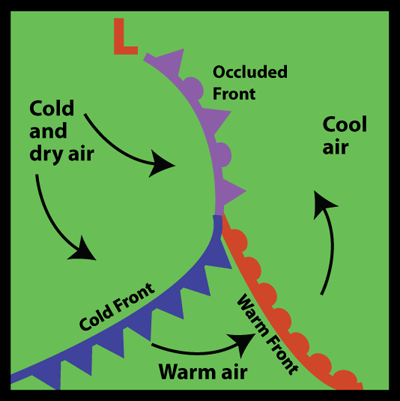
Occluded Fronts

Sometimes a cold front follows right behind a warm front. Because cold fronts move faster, the cold front can run into the warm front. This is called an occluded front. At an occluded front, the cold air...more

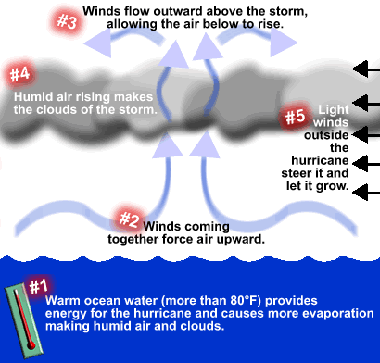
How Hurricanes Form

One in a while, a tropical thunderstorm grows and grows, becoming a giant hurricane. First the storm grows a little bit. It combines with other thunderstorms and they all spin around an area of low pressure....more

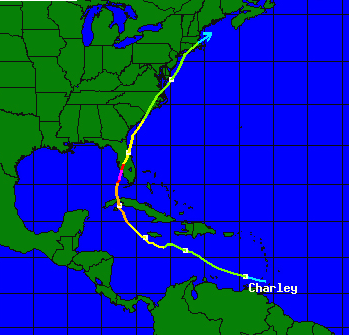
Hurricane Movement

Each hurricane moves across the ocean and usually hits the land too. How do we know which way a hurricane will go? Several different things control where a hurricane goes.   Global winds carry hurricanes...more

Shop Windows to the Universe

Dig into Montana Before History: 11K Years of Hunter-Gatherers in the Rockies and Plains by D. H. MacDonald, Ph.D. See our online store book collection.

Windows to the Universe, a project of the National Earth Science Teachers Association, is sponsored in part by the National Science Foundation and NASA, our Founding Partners (the American Geophysical Union and American Geosciences Institute) as well as through Institutional, Contributing, and Affiliate Partners, individual memberships and generous donors. Thank you for your support! NASA AGU AGI NSF