Current Events

  • Kansas Legislator Proposes Bill to Outlaw Sustainability Education
    A bill has been introduced in the Kansas legislature this week that would prohibit the promotion of ...Read more

    x

    Kansas Legislator Proposes Bill to Outlaw Sustainability Education

    A bill has been introduced in the Kansas legislature this week that would prohibit the promotion of sustainability. Here is a link to the one-page bill: http://www.kslegislature.org/li/b2013_14/measures/documents/hb2366_00_0000.pdf. See report on Bloomberg News.
  • Earth's Center Is 1,000 Degrees Hotter Than Previously Thought, Synchrotron X-Ray Experiment Shows
    Scientists have determined the temperature near the Earth’s center to be 6000 degrees Celsius, 1000 ...Read more

    x

    Earth's Center Is 1,000 Degrees Hotter Than Previously Thought, Synchrotron X-Ray Experiment Shows

    Scientists have determined the temperature near the Earth’s center to be 6000 degrees Celsius, 1000 degrees hotter than in a previous experiment run 20 years ago. These measurements confirm geophysical models that the temperature difference between the solid core and the mantle above, must be at least 1500 degrees to explain why the Earth has a magnetic field. For more information about this study, see the press release from the European Synchrotron Radiation Facility.
  • Ocean Volcanic Rocks Contain Samples of Recycled Crust
    Scientists have long believed that lava erupted from certain oceanic volcanoes contains materials fr...Read more

    x

    Ocean Volcanic Rocks Contain Samples of Recycled Crust

    Scientists have long believed that lava erupted from certain oceanic volcanoes contains materials from the early Earth’s crust. But decisive evidence for this phenomenon has proven elusive. New research from a team including Carnegie’s Erik Hauri demonstrates that oceanic volcanic rocks contain samples of recycled crust dating back to the Archean era 2.5 billion years ago. Their work is published in Nature. Oceanic crust sinks into the Earth’s mantle at so-called subduction zones, where two plates come together. Much of what happens to the crust during this journey is unknown. Model-dependent studies for how long subducted material can exist in the mantle are uncertain and evidence of very old crust returning to Earth’s surface via upwellings of magma has not been found until now. For more information about these results, see the press release from the Carnegie Institution.
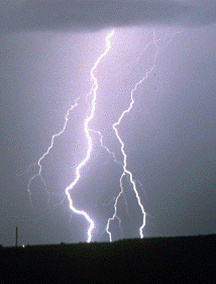
This is an image of lightning.
Click on image for full size
Photograph provided courtesy of Steve Albers

Sound Waves vs. Light Waves

You see a flash of lightning across the night sky. Five seconds later, your hear the rumble of thunder. If lightning and thunder come from the same source, then why don't they occur at the same time?

Actually, they do occur at the same time. The time difference that you sense is due to the way sound and light travel. Light travels extremely fast (300,000,000 m/s). In fact, it is faster than anything else. Sound travels at a measly 343 m/s through air. Therefore we can see light in an instant, but it takes a while to hear thunder.

Sound has another disadvantage because it tends to bounce off molecules in the air. This makes the sound travel in all different directions. The further away the source of the sound is, the more the sound gets distorted.

Therefore, when you hear rumbling thunder, the lightning bolt was far away. When you hear a crack or boom of thunder, the lightning bolt is close to you (<100 m).


Shop Windows to the Universe Science Store!

The Fall 2009 issue of The Earth Scientist, which includes articles on student research into building design for earthquakes and a classroom lab on the composition of the Earth’s ancient atmosphere, is available in our online store.

Windows to the Universe Community

News

Opportunities

You might also be interested in:

Science, Evolution, and Creationism

How did life evolve on Earth? The answer to this question can help us understand our past and prepare for our future. Although evolution provides credible and reliable answers, polls show that many people turn away from science, seeking other explanations with which they are more comfortable....more

Sound Waves vs. Light Waves

You see a flash of lightning across the night sky. Five seconds later, your hear the rumble of thunder. If lightning and thunder come from the same source, then why don't they occur at the same time?...more

Cumulus Stage

The sun heats the earth's surface during the day. The heat on the surface and warms the air around it. Since warm air is lighter than cool air, it starts to rise (known as an updraft). If the air is moist,...more

Dissipating Stage

After about 30 minutes, the thunderstorm begins to dissipate. This occurs when the downdrafts in the cloud begins to dominate over the updraft. Since warm moist air can no longer rise, cloud droplets...more

Mature Stage

When the cumulus cloud becomes very large, the water in it become large and heavy. Raindrops start to fall through the cloud when the rising air can no longer hold them up. Meanwhile, cool dry air starts...more

Thunderstorm Safety

Thunderstorms can be really dangerous! Flash floods, lightning bolts, hail, tornadoes...all of these things can hurt you if you're not careful. So here's some safety tips. GO INSIDE! If you hear distant...more

Lightning Formation

The sky is filled with electric charge. In a calm sky, the positive (+) and negative (-) charges are evenly spaced throughout the atmosphere. Therefore, a calm sky has a neutral charge. Inside a thunderstorm,...more

Create Your Own Lightning

Here's a safe and easy way to make lightning. You will need a cotton or wool blanket. This experiment works best on a dry, cool night. Turn out all the lights and let your eyes adjust to the darkness....more

Shop Windows to the Universe

Learn about planets outside our solar system through Exoplanets and Alien Solar Systems by Tahir Yaqoob, Ph.D., a book in our online store book collection.

Windows to the Universe, a project of the National Earth Science Teachers Association, is sponsored in part by the National Science Foundation and NASA, our Founding Partners (the American Geophysical Union and American Geosciences Institute) as well as through Institutional, Contributing, and Affiliate Partners, individual memberships and generous donors. Thank you for your support! NASA AGU AGI NSF