This drawing shows that before lightning strikes, positive and negative particles are mixed throughout the cloud.
Click on image for full size
Image courtesy of Windows to the Universe
Lightning Formation
The sky is filled with electric charge. In a calm sky, the positive (+) and negative (-) charges are evenly spaced throughout the atmosphere. Therefore, a calm sky has a neutral charge.
Inside a thunderstorm, the electric charge is spread out differently. A thunderstorm is made up of ice crystals and hailstones. The ice crystals have a positive charge, and the hailstones have a negative charge. An updraft pushes the ice crystals to the top of the thunderstorm cloud. At the same time, the hailstones are pushed to the bottom of the thunderstorm by its downdraft. These processes separate the positive and negative charges of the cloud into two levels: the positive charge at the top and the negative charge at the bottom.
During a thunderstorm, the Earth's surface has a positive charge. Because opposites attract, the negative charge at the bottom of the thunder cloud wants to link up with the positive charge of the Earth's surface.
Once the negative charge at the bottom of the cloud gets large enough, a flow of negative charge rushes toward the Earth. This is known as a stepped leader. The positive charges of the Earth are attracted to this stepped leader, so a flow of positive charge moves into the air. When the stepped leader and the positive charge from the earth meet, a strong electric current carries positive charge up into the cloud. This electric current is known as the return stroke and humans can see it as lightning.
You might also be interested in:
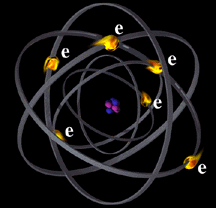
Protons are positively charged, electrons are negatively charged and neutrons have no charge. As you look down at the nucleus, you see that there are the same number of protons below you as there are
...more
Hail forms in a cumulonimbus cloud from graupel, large frozen raindrops, that are tossed around the cloud by wind. The top of a cumulonimbus cloud reaches high heights in the sky where temperatures are
...more
Clouds can come in all sizes and shapes, and can form near the ground or high in the atmosphere. Clouds are groups of tiny water droplets or ice crystals in the sky and are formed by different processes.
...more
Forked lightning occurs when a second lightning stroke doesn't follow the same path as the first lightning stroke. Thus, it appears forked.
...more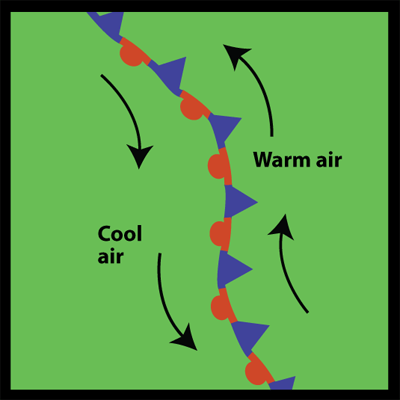
A stationary front forms when a cold front or warm front stops moving. This happens when two masses of air are pushing against each other but neither is powerful enough to move the other. Winds blowing
...more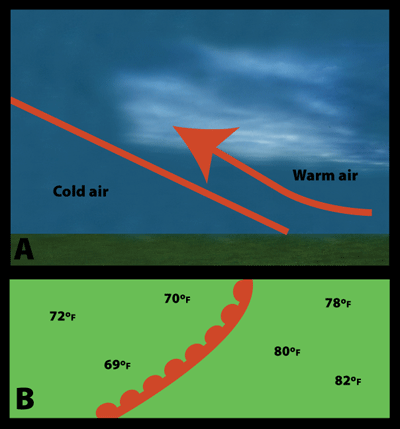
A warm front is where a warm air mass is pushing into a colder air mass. Warm fronts move more slowly than cold fronts because it is more difficult for the warm air to move against the cold, dense air.
...more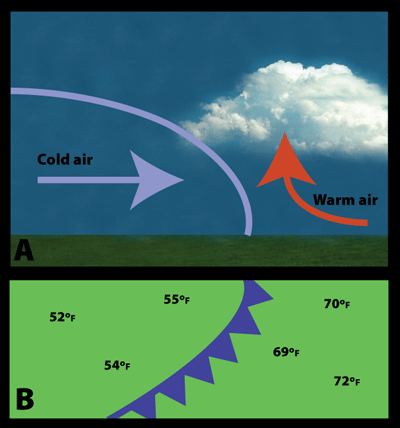
A cold front is where a cold air mass is pushing into a warmer air mass. Cold fronts can produce dramatic changes in the weather. They move fast, up to twice as fast as a warm front. Cold air is dense
...more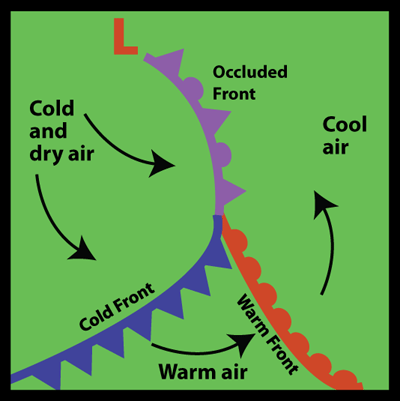
Sometimes a cold front follows right behind a warm front. A warm air mass pushes into a colder air mass (the warm front) and then another cold air mass pushes into the warm air mass (the cold front). Because
...more