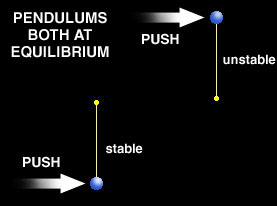
Example of a stable and an unstable equilibrium, respectively.
Click on image for full size
Stability
Have you ever tried to balance a long stick on your hand? Hard, isn't
it? That's because the stick is part of an
unstable
system. If the wind pushes the stick a little bit, it will keep going in
that direction. If you hold the stick upside-down it's much easier to
keep straight. That's because when the stick is held from above it's a
stable system. If a breeze moves the stick, it will
come back to its starting position.
The atmosphere can also be stable or unstable. If it's unstable, then
clouds can form. The
more unstable the atmosphere is, the more
severe the weather can
be. Clouds and storms form when pockets of air rise and cool because
they expand in the lower
pressure of the upper atmosphere. The air
pockets become saturated and the water vapor condenses to form clouds.
These air pockets don't rise because they want to; something needs to give
them a push. This is called the
lifting mechanism. If
there is no lifting mechanism, no storms will form regardless of how
unstable the atmosphere is. The more unstable the atmosphere, the less
of a lift is needed. It's similar to trying to balance a stick with a
smaller and smaller cross-secion. A log is easier to balance on end than
a twig and the twig is easier to tip over--it's more unstable.
You might also be interested in:

How did life evolve on Earth? The answer to this question can help us understand our past and prepare for our future. Although evolution provides credible and reliable answers, polls show that many people turn away from science, seeking other explanations with which they are more comfortable.
...more
When you inflate a balloon or a tire, you are increasing the pressure on the inside of the object in order to "blow it up". Pressure is a scientific concept that applies to gases and liquids. Pressure
...more
The short duration and complicated nature of tornadoes make them nearly impossible forecast. Meteorologists don't really know the specifics of how they form, but they do know what atmospheric conditions
...more
The stratosphere is a layer of Earth's atmosphere. The stratosphere is the second layer, as one moves upward from Earth's surface, of the atmosphere. The stratosphere is above the troposphere and below
...more
Sound travels in waves. These waves have both a frequency and an amplitude. The frequency is measured in hertz, which is one wave cycle per second. A cycle is a repeated pattern of positive and negative
...more
Storms chasers are different than storm spotters. Chasers travel around Tornado Alley looking for severe storms and tornadoes. This area in the Great Plains is the best for chasing. Besides having a lot
...more
A tornado is the most destructive force in nature; that doesn't mean it has the most energy. Thunderstorms which produce tornadoes can have 40,000 times as much energy as a tornado! Tornadoes are so destructive
...more
The Doppler effect was named after Christian Doppler, who first came up with the idea in 1842. He determined that the frequency of sound waves would change if either the source of the sound or the observer
...more