This early radar device was used during World War II on the beach in Normandy. Photograph taken on June 22, 1944.
Click on image for full size
Image courtesy of the public domain
The History of Radar
People understood the concept of radar long before scientists first built a radar system. In 1888 Heinrich Hertz, a German physicist, demonstrated that metal objects will reflect radio waves. Then in 1904 a German Engineer named Christian Hulsmeyer obtained patents for a device based on Hertz's findings. In the late 1930's all of the major nations involved in World War II rushed to create better radar systems to use in the war.
Great Britain was one of the leading developers of radar in the years leading up to World War II. The research they conducted led to an early warning radar system called "Chain Home". They built radar stations around the British Isles to provide warning of an aerial invasion. This was one of the advantages which helped the outnumbered Royal Air Force defeat the German Luftwaffe during the Battle of Britain.
While radar development was encouraged by wartime efforts, people were also interested in using radar as an anti-collision system. This became a popular idea when the Titanic sank after colliding with an iceberg in 1912. Radar was seen as a way to detect objects such as icebergs in inclement weather, when spotlights weren't effective.
Out of these all of these efforts, weather radar was developed.
You might also be interested in:

How did life evolve on Earth? The answer to this question can help us understand our past and prepare for our future. Although evolution provides credible and reliable answers, polls show that many people turn away from science, seeking other explanations with which they are more comfortable.
...more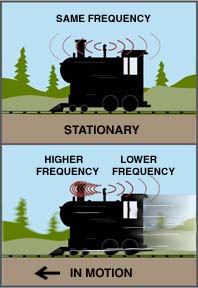
The Doppler effect was named after Christian Doppler, who first came up with the idea in 1842. He determined that the frequency of sound waves would change if either the source of the sound or the observer
...more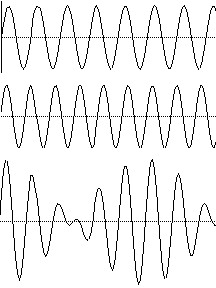
Sound travels in waves. These waves have both a frequency and an amplitude. The frequency is measured in hertz, which is one wave cycle per second. A cycle is a repeated pattern of positive and negative
...more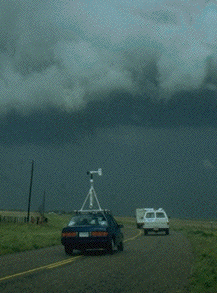
Storms chasers are different than storm spotters. Chasers travel around Tornado Alley looking for severe storms and tornadoes. This area in the Great Plains is the best for chasing. Besides having a lot
...more
A tornado is the most destructive force in nature; that doesn't mean it has the most energy. Thunderstorms which produce tornadoes can have 40,000 times as much energy as a tornado! Tornadoes are so destructive
...more
The short duration and complicated nature of tornadoes make them nearly impossible forecast. Meteorologists don't really know the specifics of how they form, but they do know what atmospheric conditions
...more
Scientists once thought that you should open your windows during a tornado so your house won't explode. The thinking behind this idea is that the extreme low pressure in a tornado would cause the air in
...moreTornadoes are very destructive, so it's important to know when one may form so you can take shelter. Forecastors at the National Weather Service are always on the lookout for developing storms. Even though
...more








