Current Events

  • Irish Chronicles Document Links Between Volcanoes and Weather
    A study of over 40,000 written entries in Irish Annals and ice core measurements shows a strong corr...Read more

    x

    Irish Chronicles Document Links Between Volcanoes and Weather

    A study of over 40,000 written entries in Irish Annals and ice core measurements shows a strong correlation between the occurrence of volcanic eruptions and extreme cold weather in Ireland over a 1200 year period. Data analyzed in this study cover the period from 431 to 1649, during which time up to 48 volcanic eruptions are identified in Greenland ice core records through deposition of volcanic sulfate in annual layers of ice. You can find the study (open access), published on 6 June 2013 in IOP Publishing's journal Environmental Research Letters, at http://iopscience.iop.org/1748-9326/8/2/024035/article. Find out more about how volcanoes can influence climate.
  • EF-5 Tornado in El Reno, Oklahoma Widest Ever Recorded in US
    The EF-5 tornado that hit El Reno, Oklahoma on May 31st was the widest ever recorded in the US, acco...Read more

    x

    EF-5 Tornado in El Reno, Oklahoma Widest Ever Recorded in US

    The EF-5 tornado that hit El Reno, Oklahoma on May 31st was the widest ever recorded in the US, according to the National Weather Service in Norman Oklahoma. The tornado, which remained on the ground for 40 minutes and reached 2.6 miles across (4.2 km), took the lives of 18 people including storm chasers Tim Samaras, Paul Samaras and Carl Young. For more information on the tornado, visit http://ow.ly/i/2hfDG.
  • Atmospheric CO2 Level Tops 400 ppm
    During the week of May 13th, the CO2 level at the Mauna Loa Observatory in Hawaii topped 400 ppm rep...Read more

    x

    Atmospheric CO2 Level Tops 400 ppm

    During the week of May 13th, the CO2 level at the Mauna Loa Observatory in Hawaii topped 400 ppm repeatedly. Daily levels of CO2 can vary due to weather, and there are seasonal trends as well. The level of atmospheric greenhouse gases continues to increase, now over 120 ppm since the Industrial Revolution began. For more on the Keeling Curve, see http://keelingcurve.ucsd.edu/. Find out more about greenhouse gases and warming.
This early radar device was used during World War II on the beach in Normandy. Photograph taken on June 22, 1944.
Click on image for full size
Image courtesy of the public domain

The History of Radar

Radar was developed during the early 20th century. The idea of a radar device was around for a long time, but the technology wasn't available to make it work. One of the biggest advances came as the result of the efforts of Robert Watson-Watt, a British scientist.

Great Britan made a big effort to develop radar before World War II. They built a network of early warning radar stations (called "Chain Home") around the country to warn people of invasions. This gave them the edge to defeat the German Luftwaffe during the Battle of Britain.

While most radar advances were made because of wartime uses, before World War II people were interested in radar because it could help avoid collisions during bad weather (an example of this is when the Titanic sunk after hitting an iceberg in 1912).

Last modified June 11, 2010 by Becca Hatheway.

Shop Windows to the Universe Science Store!

Cool It! is the new card game from the Union of Concerned Scientists that teaches kids about the choices we have when it comes to climate change—and how policy and technology decisions made today will matter. Cool It! is available in our online store.

Windows to the Universe Community

News

Opportunities

You might also be interested in:

Science, Evolution, and Creationism

How did life evolve on Earth? The answer to this question can help us understand our past and prepare for our future. Although evolution provides credible and reliable answers, polls show that many people turn away from science, seeking other explanations with which they are more comfortable....more

The Doppler Effect

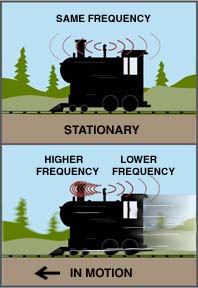
The Doppler effect was named after Christian Doppler, who first came up with the idea in 1842. He learned that sound waves would be pushed closer together if the source of the sound was moving toward you....more

Wave Beats

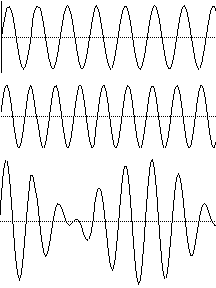
Sound travels in waves. When the waves hit your ear, you hear a sound. Have you ever noticed the waves in the ocean? They go up and down, up and down. Sound waves act the same way. The number of times...more

Chasing Tornadoes

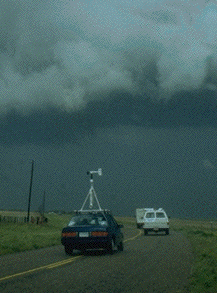
Storm chasers are different than storm spotters. Chasers travel around Tornado Alley looking for severe storms and tornadoes. Sometime there are dozens of chasers following the same storm. All kinds of...more

Energy Density

A tornado is the most destructive natural storm. You might think that this also means that tornadoes are the strongest storms; that's not the case. In fact, a thunderstorm which produces a tornado can...more

Tornado Forecasts

Tornadoes are hard to forecast. They don't last very long so there's not much time to figure out what's happening. Also, scientists don't really know how they form. They know what the weather's like when...more

Common Tornado Myths

Has someone told you to open your windows during a tornado? Or has someone told you that you don't have to worry about tornadoes because the place where you live is protected? These are two of the most...more

Tornado Notification

Tornadoes are very dangerous. This is why it's important to know when they are going to form. Forecastors at the National Weather Service are always looking for storms that could pop up. Nobody knows exactly...more

Shop Windows to the Universe

Earth Science Rocks! Select one of our four cool NESTA t-shirts from our online store, and express your love of Earth and space science!

Windows to the Universe, a project of the National Earth Science Teachers Association, is sponsored in part by the National Science Foundation and NASA, our Founding Partners (the American Geophysical Union and American Geosciences Institute) as well as through Institutional, Contributing, and Affiliate Partners, individual memberships and generous donors. Thank you for your support! NASA AGU AGI NSF