Current Events

  • Irish Chronicles Document Links Between Volcanoes and Weather
    A study of over 40,000 written entries in Irish Annals and ice core measurements shows a strong corr...Read more

    x

    Irish Chronicles Document Links Between Volcanoes and Weather

    A study of over 40,000 written entries in Irish Annals and ice core measurements shows a strong correlation between the occurrence of volcanic eruptions and extreme cold weather in Ireland over a 1200 year period. Data analyzed in this study cover the period from 431 to 1649, during which time up to 48 volcanic eruptions are identified in Greenland ice core records through deposition of volcanic sulfate in annual layers of ice. You can find the study (open access), published on 6 June 2013 in IOP Publishing's journal Environmental Research Letters, at http://iopscience.iop.org/1748-9326/8/2/024035/article. Find out more about how volcanoes can influence climate.
  • EF-5 Tornado in El Reno, Oklahoma Widest Ever Recorded in US
    The EF-5 tornado that hit El Reno, Oklahoma on May 31st was the widest ever recorded in the US, acco...Read more

    x

    EF-5 Tornado in El Reno, Oklahoma Widest Ever Recorded in US

    The EF-5 tornado that hit El Reno, Oklahoma on May 31st was the widest ever recorded in the US, according to the National Weather Service in Norman Oklahoma. The tornado, which remained on the ground for 40 minutes and reached 2.6 miles across (4.2 km), took the lives of 18 people including storm chasers Tim Samaras, Paul Samaras and Carl Young. For more information on the tornado, visit http://ow.ly/i/2hfDG.
  • Atmospheric CO2 Level Tops 400 ppm
    During the week of May 13th, the CO2 level at the Mauna Loa Observatory in Hawaii topped 400 ppm rep...Read more

    x

    Atmospheric CO2 Level Tops 400 ppm

    During the week of May 13th, the CO2 level at the Mauna Loa Observatory in Hawaii topped 400 ppm repeatedly. Daily levels of CO2 can vary due to weather, and there are seasonal trends as well. The level of atmospheric greenhouse gases continues to increase, now over 120 ppm since the Industrial Revolution began. For more on the Keeling Curve, see http://keelingcurve.ucsd.edu/. Find out more about greenhouse gases and warming.
Atmospheric conditions typical during tornado formation.

How a Tornado Forms

A tornado begins in a severe thunderstorm called a supercell. A supercell can last longer than a regular thunderstorm. The same property that keeps the storm going also produces most tornadoes. The wind coming into the storm starts to swirl and forms a funnel. The air in the funnel spins faster and faster and creates a very low pressure area which sucks more air (and possibly objects) into it.

The severe thunderstorms which produce tornadoes form where cold dry polar air meets warm moist tropical air. This is most common in a section of the United States called Tornado Alley. Also, the atmosphere needs to be very unstable.

Tornadoes can form any time during the year, but most form in May. But, more severe ones form earlier because the most damge is caused in April. The more north you go, the later the peak tornado season is. This is because it takes longer to warm the northern parts of the plains so tornadoes form later.

Most tornadoes spin cyclonically but a few spin anticyclonically. Because there are records of anticyclonic tornadoes, scientists don't think that the Coriolis Effect causes the rotations.

Shop Windows to the Universe Science Store!

The Fall 2009 issue of The Earth Scientist, which includes articles on student research into building design for earthquakes and a classroom lab on the composition of the Earth’s ancient atmosphere, is available in our online store.

Windows to the Universe Community

News

Opportunities

You might also be interested in:

Science, Evolution, and Creationism

How did life evolve on Earth? The answer to this question can help us understand our past and prepare for our future. Although evolution provides credible and reliable answers, polls show that many people turn away from science, seeking other explanations with which they are more comfortable....more

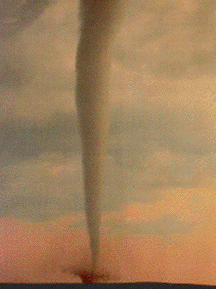
Tornadoes

Tornadoes form from severe thunderstorms. They have a very high energy density which means that they affect a small area but are very destructive to that area. They also don't last very long which makes...more

Tornado Forecasts

It's hard to forecast tornadoes. They don't last very long and are also very complicated. Scientists don't really know how they form, but they do where they tend to form. Using what they know about the...more

Tornado Notification

Tornadoes are very dangerous so it's important to know when they may form so you can take shelter. Forecastors at the National Weather Service are always looking for possible storms. Even though nobody...more

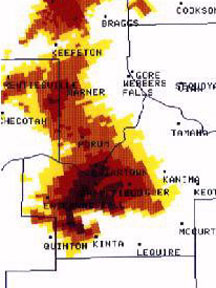
Tornado Lookouts

Meteorologists use radar to forecast where tornadoes might form. But, the radar can't detect actual tornadoes. People are needed to do that. The National Weather Service can't rely on tornado reports from...more

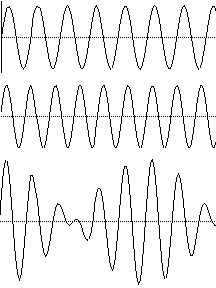
Wave Beats

Sound travels in waves. You hear sound because waves hit your ear. Sound waves are similar to ocean waves. They both have a certain frequency. The frequency is measured in hertz, which is one cycle per...more

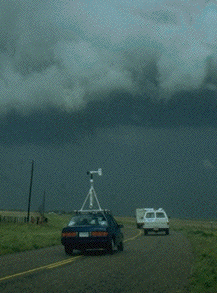
Chasing Tornadoes

Storm chasers are different than storm spotters. Chasers travel around Tornado Alley looking for severe storms and tornadoes. This area in the Great Plains is the best for chasing because of the frequency...more

Energy Density

A tornado is the most intense force in nature. That doesn't mean it's the most powerful. In fact, a thunderstorm can be 40,000 times more powerful than a tornado. Then why aren't thunderstorms as dangerous...more

Shop Windows to the Universe

With Explore the Planets, investigate the planets, their moons, and understand the processes that shape them. By G. Jeffrey Taylor, Ph.D. See our DVD collection.

Windows to the Universe, a project of the National Earth Science Teachers Association, is sponsored in part by the National Science Foundation and NASA, our Founding Partners (the American Geophysical Union and American Geosciences Institute) as well as through Institutional, Contributing, and Affiliate Partners, individual memberships and generous donors. Thank you for your support! NASA AGU AGI NSF