Two waves of slightly different frequency create beats when added together.
Click on image for full size
Wave Beats
Sound travels in waves. These waves have both a
frequency and an
amplitude. The
frequency is measured in hertz, which is one wave cycle per second. A
cycle is a repeated pattern of positive and negative amplitudes. These
cycles are repeated with a certain period, or time interval. This is why
waves are called periodic functions. The amplitude is a measure of the
height of the wave. Intensity is directly related to amplitude. Sound
wave intensity is measured using a logarithmic scale with units of
decibels. One bel is defined as the logarithm (base 10) of the ratio of
two intensities. The scale is actually a ratio; the lower number is
chosen arbitrarily. Zero decibels is set as the lower limit of our
hearing. Bels are too large for most uses, so instead we use decibels
(deci=1/10). The unit is named after Alexander Graham Bell, inventor of
the telephone.
When waves interact, they don't reflect off each other--they combine. If
the amplitudes of the waves are both positive or both negative, the
combined wave will have a larger amplitude. This is called
constructive interference. If the waves have opposite
amplitudes, the resulting wave will have a smaller amplitude. This is
called
destructive interference.
Two waves that add together may have different frequencies. If this
happens, at one point the waves will interfere constructively while later
they will interfere destructively. These changes in
constructive/destructive interference are also periodic functions. In
music this is known as a
wave beat. You can hear beats
when two instruments are trying to play the same note but one is off by a
little bit. Musicians use beats to help tune their instruments. Piano
tuners will strike a tuning fork (which vibrates with a constant
frequency) and then play a note on the piano. If they hear a beat, they
know that they need to loosen or tighten the string for that note. When
the beat disappears, the note is in tune. This is how
Doppler could tell that
the frequency of the trumpets on the moving train had changed--he could
hear the wave beat.
You might also be interested in:

How did life evolve on Earth? The answer to this question can help us understand our past and prepare for our future. Although evolution provides credible and reliable answers, polls show that many people turn away from science, seeking other explanations with which they are more comfortable.
...more
Christian Doppler was an Austrian mathematician who lived between 1803-1853. He is known for the principle he first proposed in Concerning the coloured light of double stars in 1842. This principle is
...more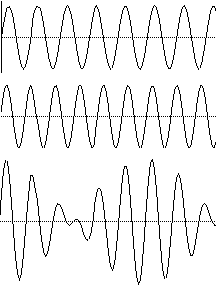
Sound travels in waves. These waves have both a frequency and an amplitude. The frequency is measured in hertz, which is one wave cycle per second. A cycle is a repeated pattern of positive and negative
...more
Storms chasers are different than storm spotters. Chasers travel around Tornado Alley looking for severe storms and tornadoes. This area in the Great Plains is the best for chasing. Besides having a lot
...more
A tornado is the most destructive force in nature; that doesn't mean it has the most energy. Thunderstorms which produce tornadoes can have 40,000 times as much energy as a tornado! Tornadoes are so destructive
...more
The Doppler effect was named after Christian Doppler, who first came up with the idea in 1842. He determined that the frequency of sound waves would change if either the source of the sound or the observer
...more
The short duration and complicated nature of tornadoes make them nearly impossible forecast. Meteorologists don't really know the specifics of how they form, but they do know what atmospheric conditions
...more
Scientists once thought that you should open your windows during a tornado so your house won't explode. The thinking behind this idea is that the extreme low pressure in a tornado would cause the air in
...more