Current Events

  • Kansas Legislator Proposes Bill to Outlaw Sustainability Education
    A bill has been introduced in the Kansas legislature this week that would prohibit the promotion of ...Read more

    x

    Kansas Legislator Proposes Bill to Outlaw Sustainability Education

    A bill has been introduced in the Kansas legislature this week that would prohibit the promotion of sustainability. Here is a link to the one-page bill: http://www.kslegislature.org/li/b2013_14/measures/documents/hb2366_00_0000.pdf. See report on Bloomberg News.
  • Earth's Center Is 1,000 Degrees Hotter Than Previously Thought, Synchrotron X-Ray Experiment Shows
    Scientists have determined the temperature near the Earth’s center to be 6000 degrees Celsius, 1000 ...Read more

    x

    Earth's Center Is 1,000 Degrees Hotter Than Previously Thought, Synchrotron X-Ray Experiment Shows

    Scientists have determined the temperature near the Earth’s center to be 6000 degrees Celsius, 1000 degrees hotter than in a previous experiment run 20 years ago. These measurements confirm geophysical models that the temperature difference between the solid core and the mantle above, must be at least 1500 degrees to explain why the Earth has a magnetic field. For more information about this study, see the press release from the European Synchrotron Radiation Facility.
  • Ocean Volcanic Rocks Contain Samples of Recycled Crust
    Scientists have long believed that lava erupted from certain oceanic volcanoes contains materials fr...Read more

    x

    Ocean Volcanic Rocks Contain Samples of Recycled Crust

    Scientists have long believed that lava erupted from certain oceanic volcanoes contains materials from the early Earth’s crust. But decisive evidence for this phenomenon has proven elusive. New research from a team including Carnegie’s Erik Hauri demonstrates that oceanic volcanic rocks contain samples of recycled crust dating back to the Archean era 2.5 billion years ago. Their work is published in Nature. Oceanic crust sinks into the Earth’s mantle at so-called subduction zones, where two plates come together. Much of what happens to the crust during this journey is unknown. Model-dependent studies for how long subducted material can exist in the mantle are uncertain and evidence of very old crust returning to Earth’s surface via upwellings of magma has not been found until now. For more information about these results, see the press release from the Carnegie Institution.
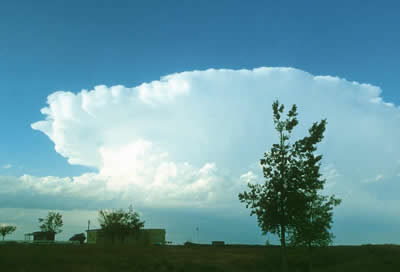
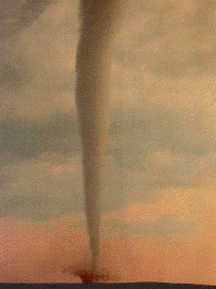
Picture of a May 11, 1991, tornado in Cimarron County, Oklahoma
Click on image for full size
Greg Stumpf

Tornadoes

Tornadoes form from severe thunderstorms. They have a very high energy density which means that they affect a small area but are very destructive to that area. They also don't last very long which makes it hard to learn about them. Since they're hard to study, they're also hard to forecast. People know even less about tornadoes, which is why there are a lot of different myths that aren't true.

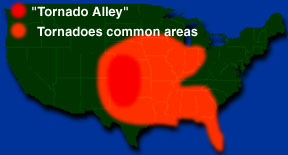
Tornadoes can occur anywhere in the world. About 75% of them happen in the United States, most in an area know as Tornado Alley. There are also some other interesting facts about tornadoes.

People who are interested in tornadoes sometimes become trained tornado spotters for their community. Others chase tornadoes, either to research these incredible storms, or to photograph them. After a tornado touches down, scientists try and figure out how strong it was by using the Enhanced Fujita Tornado Scale.
Last modified August 1, 2008 by Vanessa Pearce.

Shop Windows to the Universe Science Store!

The Fall 2009 issue of The Earth Scientist, which includes articles on student research into building design for earthquakes and a classroom lab on the composition of the Earth’s ancient atmosphere, is available in our online store.

Windows to the Universe Community

News

Opportunities

You might also be interested in:

Cool It! Game

Check out our online store - minerals, fossils, books, activities, jewelry, and household items!...more

How a Tornado Forms

A tornado begins in a severe thunderstorm called a supercell. A supercell can last longer than a regular thunderstorm. The same property that keeps the storm going also produces most tornadoes. The wind...more

Thunderstorms

Thunderstorms are one of the most thrilling and dangerous types of weather phenomena. Over 40,000 thunderstorms occur throughout the world each day. Thunderstorms form when very warm, moist air rises into...more

What is "Tornado Alley"?

The land in the central United States is the best breeding ground for the storms which produce tornadoes. The land in the Great Plains is relatively flat, which allows cold dry polar air from Canada to...more

Tornado-like Rotation is Key to Understanding Volcanic Plumes

Scientists are using information they have from past volcanic eruptions to better understand strong volcanic plumes. They have observed that in some volcanic eruptions, there is a spontaneous formation...more

Supercell Thunderstorms and Squall Lines

A supercell thunderstorm is a huge rotating thunderstorm. It can last for several hours as a single storm. These storms are the most likely to produce long-lasting tornadoes and baseball-sized hail. Tornadoes...more

Cumulonimbus

Cumulonimbus clouds belong to the Clouds with Vertical Growth group. They are generally known as thunderstorm clouds. A cumulonimbus cloud can grow up to 10km high. At this height, high winds will flatten...more

Types of Thunderstorms

There are two main types of thunderstorms: ordinary and severe. Ordinary thunderstorms are the common summer storm. Ordinary thunderstorms last about one hour. The precipitation associated with them is...more

Shop Windows to the Universe

The Spring 2011 issue of The Earth Scientist is focused on modernizing seismology education. Thanks to IRIS, you can download this issue for free as a pdf. Print copies are available in our online store.

Windows to the Universe, a project of the National Earth Science Teachers Association, is sponsored in part by the National Science Foundation and NASA, our Founding Partners (the American Geophysical Union and American Geosciences Institute) as well as through Institutional, Contributing, and Affiliate Partners, individual memberships and generous donors. Thank you for your support! NASA AGU AGI NSF