Current Events

  • Kansas Legislator Proposes Bill to Outlaw Sustainability Education
    A bill has been introduced in the Kansas legislature this week that would prohibit the promotion of ...Read more

    x

    Kansas Legislator Proposes Bill to Outlaw Sustainability Education

    A bill has been introduced in the Kansas legislature this week that would prohibit the promotion of sustainability. Here is a link to the one-page bill: http://www.kslegislature.org/li/b2013_14/measures/documents/hb2366_00_0000.pdf. See report on Bloomberg News.
  • Earth's Center Is 1,000 Degrees Hotter Than Previously Thought, Synchrotron X-Ray Experiment Shows
    Scientists have determined the temperature near the Earth’s center to be 6000 degrees Celsius, 1000 ...Read more

    x

    Earth's Center Is 1,000 Degrees Hotter Than Previously Thought, Synchrotron X-Ray Experiment Shows

    Scientists have determined the temperature near the Earth’s center to be 6000 degrees Celsius, 1000 degrees hotter than in a previous experiment run 20 years ago. These measurements confirm geophysical models that the temperature difference between the solid core and the mantle above, must be at least 1500 degrees to explain why the Earth has a magnetic field. For more information about this study, see the press release from the European Synchrotron Radiation Facility.
  • Ocean Volcanic Rocks Contain Samples of Recycled Crust
    Scientists have long believed that lava erupted from certain oceanic volcanoes contains materials fr...Read more

    x

    Ocean Volcanic Rocks Contain Samples of Recycled Crust

    Scientists have long believed that lava erupted from certain oceanic volcanoes contains materials from the early Earth’s crust. But decisive evidence for this phenomenon has proven elusive. New research from a team including Carnegie’s Erik Hauri demonstrates that oceanic volcanic rocks contain samples of recycled crust dating back to the Archean era 2.5 billion years ago. Their work is published in Nature. Oceanic crust sinks into the Earth’s mantle at so-called subduction zones, where two plates come together. Much of what happens to the crust during this journey is unknown. Model-dependent studies for how long subducted material can exist in the mantle are uncertain and evidence of very old crust returning to Earth’s surface via upwellings of magma has not been found until now. For more information about these results, see the press release from the Carnegie Institution.
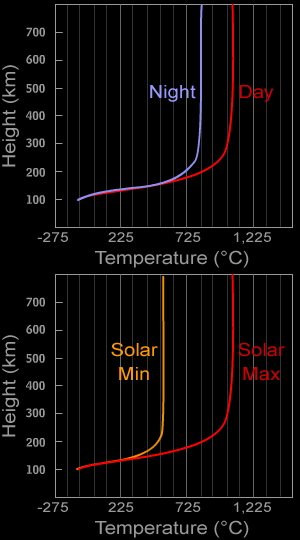
At first, the temperature gets warmer very quickly as you go upward in the thermosphere. After that, the temperature doesn't change much as you go higher. However, the hottest temperature changes between day and night. It also depends on whether the Sun is active (solar max) or not (solar min).
Click on image for full size
Images courtesy of The COMET Program and HAO at NCAR (modified by Windows to the Universe staff).

Temperature in the Thermosphere

At first, the temperature gets warmer very quickly as you go upward in the thermosphere. After that, the temperature doesn't change much as you go higher. However, the hottest temperature changes between day and night. It also depends on how active the Sun is during its 11-year sunspot cycle. The thermosphere is hottest when the Sun is very active during "solar max". It isn't quite so hot when the Sun is less active during "solar min".

Last modified April 2, 2009 by Randy Russell.

Shop Windows to the Universe Science Store!

Cool It! is the new card game from the Union of Concerned Scientists that teaches kids about the choices we have when it comes to climate change—and how policy and technology decisions made today will matter. Cool It! is available in our online store.

Windows to the Universe Community

News

Opportunities

You might also be interested in:

Cool It! Game

Check out our online store - minerals, fossils, books, activities, jewelry, and household items!...more

The Thermosphere

The thermosphere is the fourth layer of the Earth's atmosphere. It is found above the mesosphere. The air is really thin that high up. The temperature changes with the solar activity. If the sun is active,...more

Rainbows

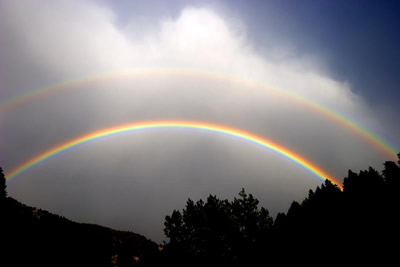
Rainbows appear in the sky when there is bright sunlight and rain. Sunlight is known as visible or white light and is actually a mixture of colors. The sun's rays pass through millions of raindrops. A...more

The Four Seasons

It takes the Earth one year to travel around the sun one time. During this year, there are four seasons: summer, autumn, winter, and spring. Each season depends on the amount of sunlight reaching the...more

Research Aircraft

Scientists sometimes travel in airplanes that carry weather instruments in order to gather data about the atmosphere. These research aircraft bring air from the outside into the plane so scientists can...more

Anemometer

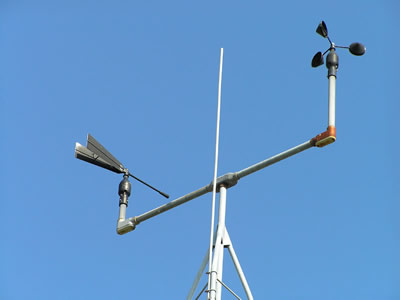
An anemometer is a weather instrument used to measure the wind (it can also be called a wind gauge). These instruments can be used in a backyard weather station or on a well-equipped scientific research...more

Thermometer

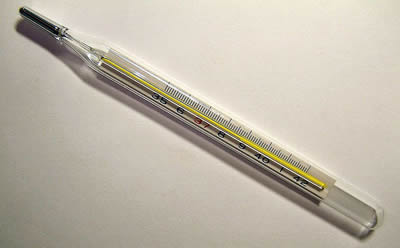
Thermometers measure temperature. "Thermo" means heat and "meter" means to measure. You can use a thermometer to measure the temperature of many things, including the temperature of...more

Weather Balloons

Weather balloons are used to carry weather instruments that measure temperature, pressure, humidity, and winds in the atmosphere. The information collected from the instruments on weather balloons are...more

Shop Windows to the Universe

Arches National Park Geology Tour provides an extensive, visually rich description of the geology of Arches, by Deborah Ragland, Ph.D. See our DVD collection.

Windows to the Universe, a project of the National Earth Science Teachers Association, is sponsored in part by the National Science Foundation and NASA, our Founding Partners (the American Geophysical Union and American Geosciences Institute) as well as through Institutional, Contributing, and Affiliate Partners, individual memberships and generous donors. Thank you for your support! NASA AGU AGI NSF