Current Events

  • Atmospheric CO2 Level Tops 400 ppm
    During the week of May 13th, the CO2 level at the Mauna Loa Observatory in Hawaii topped 400 ppm rep...Read more

    x

    Atmospheric CO2 Level Tops 400 ppm

    During the week of May 13th, the CO2 level at the Mauna Loa Observatory in Hawaii topped 400 ppm repeatedly. Daily levels of CO2 can vary due to weather, and there are seasonal trends as well. The level of atmospheric greenhouse gases continues to increase, now over 120 ppm since the Industrial Revolution began. For more on the Keeling Curve, see http://keelingcurve.ucsd.edu/. Find out more about greenhouse gases and warming.
  • Massive Tornado Outbreak on Tornado Alley
    The week of May 19 brings dozens of tornadoes to Tornado Alley in the states of Oklahoma, Kansas, Io...Read more

    x

    Massive Tornado Outbreak on Tornado Alley

    The week of May 19 brings dozens of tornadoes to Tornado Alley in the states of Oklahoma, Kansas, Iowa, Illinois and Missouri. On May 20th, a massive tornado struck Moore, Oklahoma, devastating communities - destroying over 100 homes and hitting two elementary schools and a hospital - with many casualties and deaths. Our thoughts are with our friends and colleagues suffering from these storms. For more on the May 20th storms, see the NOAA Storm Prediction Center Storm Report.
  • Kansas Legislator Proposes Bill to Outlaw Sustainability Education
    A bill has been introduced in the Kansas legislature this week that would prohibit the promotion of ...Read more

    x

    Kansas Legislator Proposes Bill to Outlaw Sustainability Education

    A bill has been introduced in the Kansas legislature this week that would prohibit the promotion of sustainability. Here is a link to the one-page bill: http://www.kslegislature.org/li/b2013_14/measures/documents/hb2366_00_0000.pdf. See report on Bloomberg News.

Click on image for full size
Copyright UCAR

Air Pollution and Climate Change

There are many different types of air pollution. Some types of air pollution make the Earth get warmer. Other types of air pollution make the Earth get cooler. Read on to learn more about how different types of air pollution change Earth’s temperature.

Air pollutants that make Earth warmer

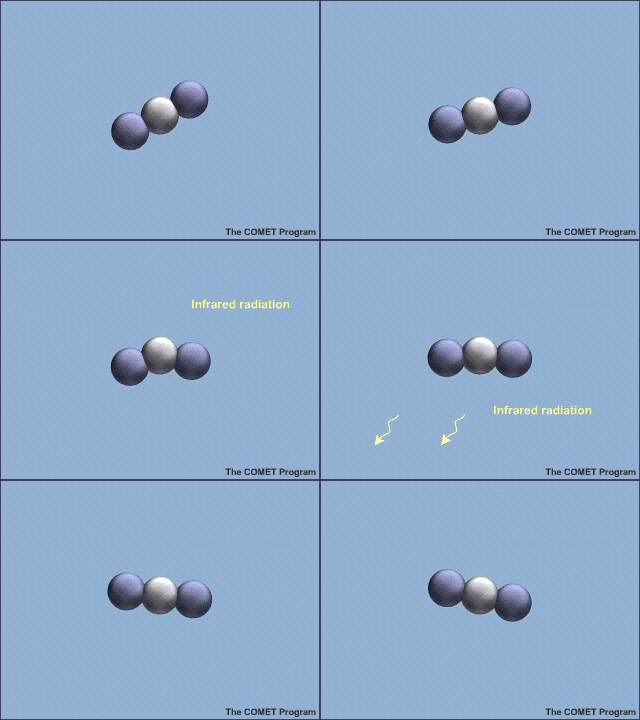
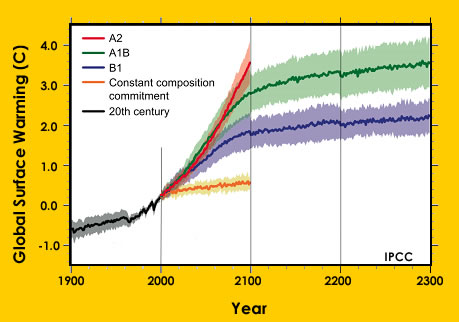
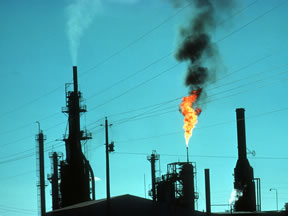
Air pollution includes greenhouse gases. One of these is carbon dioxide, a common part of the exhaust from cars and trucks. Greenhouse gases cause the Earth to warm by trapping heat from the Sun in the atmosphere. Some greenhouse gases are a natural part of the air. Some were added to the air by people’s cars and trucks that release greenhouse gases as fuel is burned. Some were added to the air from smokestacks at factories and power plants. More greenhouses gases in the air means more global warming. In fact, since cars were invented and factories and power plants were built more than a century ago, the Earth’s temperature has increased. Scientists say that the Earth will get even warmer during the next 100 years.

Air pollutants that slow down global warming

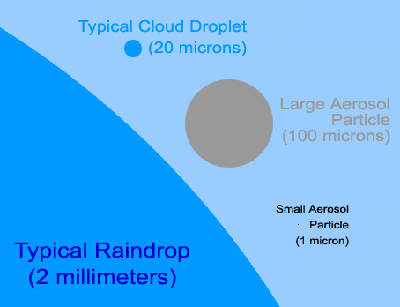
Cars, trucks, and smokestacks also let tiny particles loose into the atmosphere. These tiny particles are called aerosols and can be made of different things. Some of these particles get into the atmosphere naturally. They are released from the ocean, deserts, forests, volcanoes, and are a part of the smoke from wildfires. But air pollution released by cars and smokestacks also adds them to the atmosphere. Aerosols have an impact on climate. While different types of aerosols act differently in the atmosphere, the overall effect of aerosols is cooling.

Last modified June 17, 2008 by Lisa Gardiner.

Shop Windows to the Universe Science Store!

Cool It! is the new card game from the Union of Concerned Scientists that teaches kids about the choices we have when it comes to climate change—and how policy and technology decisions made today will matter. Cool It! is available in our online store.

Windows to the Universe Community

News

Opportunities

You might also be interested in:

Traveling Nitrogen Classroom Activity Kit

Check out our online store - minerals, fossils, books, activities, jewelry, and household items!...more

Air Pollution

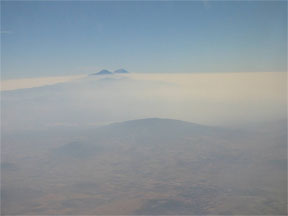
Have you ever heard of air pollution? Air pollution is not new. 700 years ago, when people started burning large amounts of coal 700 years ago in London, England, they complained about the dust and soot...more

Earth's Greenhouse Gases

Only a tiny amount of the gases in Earth’s atmosphere are greenhouse gases. But they have a huge effect on climate. There are several different types of greenhouse gases, but they all have something in...more

Carbon Dioxide - CO2

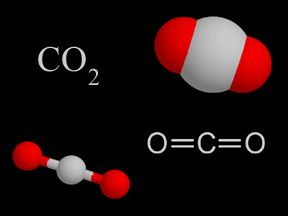
Carbon dioxide (CO2) is a kind of gas. There isn't that much carbon dioxide in Earth's atmosphere, but it is still very important. Carbon dioxide is a greenhouse gas. That means it helps trap heat coming...more

Global Warming: Scientists Say Earth Is Heating Up

Earth’s climate is getting warmer. During the past 100 years Earth’s average temperature rose about 0.6° Celsius (1.0° F). Things that people are doing like burning fossil fuels, changing the way land...more

Aerosols: Tiny Particulates in the Air

When you look up at the sky, you are looking at more than just air. There are also billions of tiny bits of solid and liquid floating in the air. These tiny particles are called aerosols or particulates....more

Releasing Nitrogen Pollutants to the Air

While most of the air in our atmosphere is made of nitrogen gas, there are other gases in our atmosphere that contain nitrogen too. They may make up only a small percentage of the air molecules in our...more

Air Pollution and Atmospheric Visibility

Would you be surprised if smoke from a fire stopped you from seeing nearby buildings or mountains? Probably not. What if there was no fire, and a brown or gray haze filled the sky. Would you be surprised...more

Shop Windows to the Universe

The Spring 2011 issue of The Earth Scientist is focused on modernizing seismology education. Thanks to IRIS, you can download this issue for free as a pdf. Print copies are available in our online store.

Windows to the Universe, a project of the National Earth Science Teachers Association, is sponsored in part by the National Science Foundation and NASA, our Founding Partners (the American Geophysical Union and American Geosciences Institute) as well as through Institutional, Contributing, and Affiliate Partners, individual memberships and generous donors. Thank you for your support! NASA AGU AGI NSF