This image shows the average temperature profile through the Earth's
atmosphere.
Click on image for full size
Layers of the Earth's Atmosphere
The atmosphere is divided into five layers. It is thickest near the surface and thins out with height until it eventually merges with space.
1) The troposphere is the first layer above the surface and contains half of the Earth's atmosphere. Weather occurs in this layer.
2) Many jet aircrafts fly in the stratosphere because it is very stable. Also, the ozone layer absorbs harmful rays from the Sun.
3) Meteors or rock fragments burn up in the mesosphere.
4) The thermosphere is a layer with auroras. It is also where the space shuttle orbits.
5) The atmosphere merges into space in the extremely thin exosphere. This is the upper limit of our atmosphere.
Related items in our online store:


Shop Windows to the Universe Science Store!
The
Fall 2009 issue of The Earth Scientist, which includes articles on student research into building design for earthquakes and a classroom lab on the composition of the Earth’s ancient atmosphere, is available in our
online store.
You might also be interested in:

Our 2010 Summer issue of The Earth Scientist includes six articles dealing with various aspects of Earth Science. An article from NOAA details how lake effect snow can, under the right conditions, actually occur on the narrow Mississippi River.
...more
The thermosphere is a layer of Earth's atmosphere. The thermosphere is directly above the mesosphere and below the exosphere. It extends from about 90 km (56 miles) to between 500 and 1,000 km (311 to
...more
Very high up, the Earth's atmosphere becomes very thin. The region where atoms and molecules escape into space is referred to as the exosphere. The exosphere is on top of the thermosphere.
...more
The exosphere is almost a vacuum. The "air" is very, very thin there. When air is thin, it doesn't transfer much heat to objects in the air, even if the air is very, very hot. One definition
...more
The belts of trapped radiation above the Earth's atmosphere, but within the magnetosphere, were first detected by James Van Allen in 1958. Therefore these belts are also known as Van Allen Belts. When
...more
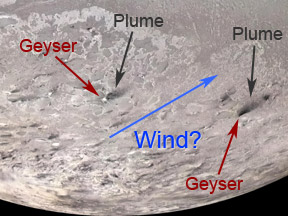
Triton is by far the largest moon of Neptune. It is slightly smaller than Earth's Moon. The surface of Triton is colder than the surface of any other planet or moon in our Solar System. It is so cold on
...more
Interested in doing a project related to space weather for a science fair? The Stanford SOLAR Center provides information about space weather monitors that you can build yourself, including the Sudden
...more
When you think of chemistry, do you think about mixing colored liquids in test tubes and maybe making an explosion... or at least a nice puff of smoke? Did you know that a lot of chemistry happens in Earth's
...more