Current Events

  • Kansas Legislator Proposes Bill to Outlaw Sustainability Education
    A bill has been introduced in the Kansas legislature this week that would prohibit the promotion of ...Read more

    x

    Kansas Legislator Proposes Bill to Outlaw Sustainability Education

    A bill has been introduced in the Kansas legislature this week that would prohibit the promotion of sustainability. Here is a link to the one-page bill: http://www.kslegislature.org/li/b2013_14/measures/documents/hb2366_00_0000.pdf. See report on Bloomberg News.
  • Earth's Center Is 1,000 Degrees Hotter Than Previously Thought, Synchrotron X-Ray Experiment Shows
    Scientists have determined the temperature near the Earth’s center to be 6000 degrees Celsius, 1000 ...Read more

    x

    Earth's Center Is 1,000 Degrees Hotter Than Previously Thought, Synchrotron X-Ray Experiment Shows

    Scientists have determined the temperature near the Earth’s center to be 6000 degrees Celsius, 1000 degrees hotter than in a previous experiment run 20 years ago. These measurements confirm geophysical models that the temperature difference between the solid core and the mantle above, must be at least 1500 degrees to explain why the Earth has a magnetic field. For more information about this study, see the press release from the European Synchrotron Radiation Facility.
  • Ocean Volcanic Rocks Contain Samples of Recycled Crust
    Scientists have long believed that lava erupted from certain oceanic volcanoes contains materials fr...Read more

    x

    Ocean Volcanic Rocks Contain Samples of Recycled Crust

    Scientists have long believed that lava erupted from certain oceanic volcanoes contains materials from the early Earth’s crust. But decisive evidence for this phenomenon has proven elusive. New research from a team including Carnegie’s Erik Hauri demonstrates that oceanic volcanic rocks contain samples of recycled crust dating back to the Archean era 2.5 billion years ago. Their work is published in Nature. Oceanic crust sinks into the Earth’s mantle at so-called subduction zones, where two plates come together. Much of what happens to the crust during this journey is unknown. Model-dependent studies for how long subducted material can exist in the mantle are uncertain and evidence of very old crust returning to Earth’s surface via upwellings of magma has not been found until now. For more information about these results, see the press release from the Carnegie Institution.
From top to bottom: WC-130H Hercules, WP-3D Orion, Gulfstream IV-SP
WC-130H photo courtesy of the U.S. Air Force. WP-3D photo courtesy of NOAA/Brad Smull. Gulfstream IV-SP photo courtesy NOAA/AOC

Why the Different Airplanes?

Why do the 53rd Weather Reconnaissance Squadron and the Hurricane Research Division use different airplanes? Actually, they only use two main types. The top two airplanes in the graphic, the WC-130H Hercules and the WP-3D Orion, are both turboprops. The bottom airplane in the graphic, the Gulfstream IV-SP, is a turbofan.

The difference between a turboprop and a turbofan is more than just a few letters. A turboprop is a propellor-driven aircraft. They are well-suited for the slower speeds and low altitude (between 1,000 and 10,000 feet) flying associated with hurricane penetration. Both the WC-130H and the WP-3D have four turboprop engines which allow them to stay in the air from 8-12 hours (the WP-3D) up to 15 hours (the WC-130H).

A better-known term for a turbofan engine is a jet engine. A jet isn't as economical as a prop at low altitudes and slow speeds but it is faster and more economical at higher altitudes. Because of this, the Gulfstream observes at a higher altitude (around 43,000 feet) around a hurricane. Also, the greater speed allows for a greater operating radius so the Gulfstream can record wind speed and direction away from the hurricane itself. This information is needed make the forecasted track more accurate.

Shop Windows to the Universe Science Store!

Cool It! is the new card game from the Union of Concerned Scientists that teaches kids about the choices we have when it comes to climate change—and how policy and technology decisions made today will matter. Cool It! is available in our online store.

Windows to the Universe Community

News

Opportunities

You might also be interested in:

Science, Evolution, and Creationism

How did life evolve on Earth? The answer to this question can help us understand our past and prepare for our future. Although evolution provides credible and reliable answers, polls show that many people turn away from science, seeking other explanations with which they are more comfortable....more

Chasing the Storm

The official "Hurricane Hunters" are the Air Force Reserve's 53rd Weather Reconnaissance Squadron. The squadron consists of ten WC-130 Hercules aircraft which are regularly flown through the eyes of hurricanes....more

Why the Different Airplanes?

Why do the 53rd Weather Reconnaissance Squadron and the Hurricane Research Division use different airplanes? Actually, they only use two main types. The top two airplanes in the graphic, the WC-130H Hercules...more

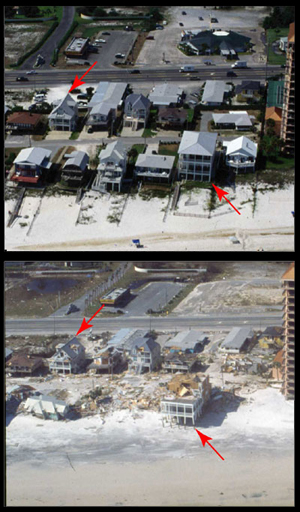
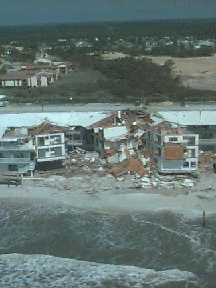
Hurricane Damage

Rain, wind, tornadoes, and storm surge related to hurricanes cause change to natural environments, damage to the human-built environment, and even loss of life. When a hurricane is over the ocean and far...more

Storm Strength

A cyclone is an area of low pressure with winds blowing counter-clockwise around it in the Northern Hemisphere and clockwise around it in the Southern Hemisphere. A tropical cyclone is a cyclone which...more

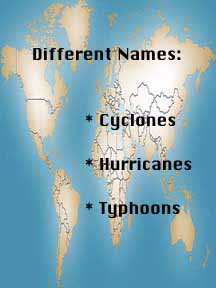
Different Names for Different Places

Different places in the world call tropical cyclones by different names. If you click on the image at left you will see which areas use "cyclone", which use "hurricane", and which use "typhoon" when refering...more

Create Your Own Lightning

Here's a safe and easy way to make lightning. You will need a cotton or wool blanket. This experiment works best on a dry, cool night. Turn out all the lights and let your eyes adjust to the darkness....more

How Far Away Is The Thunderstorm?

It takes 3 seconds for sound to travel 1 kilometer (5 seconds to travel 1 mile). The next time a thunderstorm comes your way, look out your bedroom window and watch for lightning. When you see a lightning...more

Shop Windows to the Universe

The Spring 2011 issue of The Earth Scientist is focused on modernizing seismology education. Thanks to IRIS, you can download this issue for free as a pdf. Print copies are available in our online store.

Windows to the Universe, a project of the National Earth Science Teachers Association, is sponsored in part by the National Science Foundation and NASA, our Founding Partners (the American Geophysical Union and American Geosciences Institute) as well as through Institutional, Contributing, and Affiliate Partners, individual memberships and generous donors. Thank you for your support! NASA AGU AGI NSF