Current Events

  • Irish Chronicles Document Links Between Volcanoes and Weather
    A study of over 40,000 written entries in Irish Annals and ice core measurements shows a strong corr...Read more

    x

    Irish Chronicles Document Links Between Volcanoes and Weather

    A study of over 40,000 written entries in Irish Annals and ice core measurements shows a strong correlation between the occurrence of volcanic eruptions and extreme cold weather in Ireland over a 1200 year period. Data analyzed in this study cover the period from 431 to 1649, during which time up to 48 volcanic eruptions are identified in Greenland ice core records through deposition of volcanic sulfate in annual layers of ice. You can find the study (open access), published on 6 June 2013 in IOP Publishing's journal Environmental Research Letters, at http://iopscience.iop.org/1748-9326/8/2/024035/article. Find out more about how volcanoes can influence climate.
  • EF-5 Tornado in El Reno, Oklahoma Widest Ever Recorded in US
    The EF-5 tornado that hit El Reno, Oklahoma on May 31st was the widest ever recorded in the US, acco...Read more

    x

    EF-5 Tornado in El Reno, Oklahoma Widest Ever Recorded in US

    The EF-5 tornado that hit El Reno, Oklahoma on May 31st was the widest ever recorded in the US, according to the National Weather Service in Norman Oklahoma. The tornado, which remained on the ground for 40 minutes and reached 2.6 miles across (4.2 km), took the lives of 18 people including storm chasers Tim Samaras, Paul Samaras and Carl Young. For more information on the tornado, visit http://ow.ly/i/2hfDG.
  • Atmospheric CO2 Level Tops 400 ppm
    During the week of May 13th, the CO2 level at the Mauna Loa Observatory in Hawaii topped 400 ppm rep...Read more

    x

    Atmospheric CO2 Level Tops 400 ppm

    During the week of May 13th, the CO2 level at the Mauna Loa Observatory in Hawaii topped 400 ppm repeatedly. Daily levels of CO2 can vary due to weather, and there are seasonal trends as well. The level of atmospheric greenhouse gases continues to increase, now over 120 ppm since the Industrial Revolution began. For more on the Keeling Curve, see http://keelingcurve.ucsd.edu/. Find out more about greenhouse gases and warming.
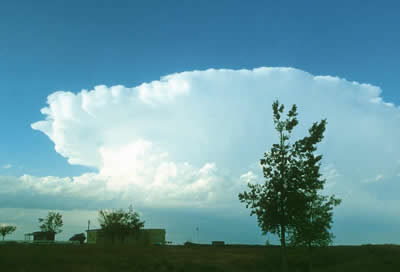
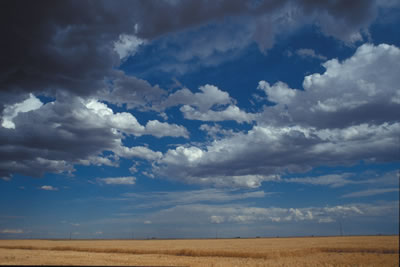
This is a photograph of cumulus clouds.
Click on image for full size
Courtesy of Carlye Calvin

Cumulus

Cumulus (weather symbol - Cu) clouds belong to the Clouds with Vertical Growth group. They are puffy white or light gray clouds that look like floating cotton balls. Cumulus clouds have sharp outlines and a flat base. Cumulus clouds generally have a lower cloud deck of 1000m and a width of 1km.

Cumulus clouds can be associated with good or bad weather. Cumulus humilis clouds generally show up on a warm summer day and are associated with fair weather. These clouds have only slight vertical growth and they are detached with lots of blue sky in between. Cumulus congestus clouds are usually associated with bad weather. These clouds grow to great heights and usually become cumulonimbus clouds. Their tops look like cauliflower heads and indicate that light to heavy showers can occur.

Here's a tip on how to know if you see a cumulus cloud in the sky. Cumulus cloud cells (the individual puffs of clouds) are about the size of your fist or larger when you hold up your hand at arm's length to look at the cloud.


Last modified May 21, 2009 by Becca Hatheway.

Shop Windows to the Universe Science Store!

The Fall 2009 issue of The Earth Scientist, which includes articles on student research into building design for earthquakes and a classroom lab on the composition of the Earth’s ancient atmosphere, is available in our online store.

Windows to the Universe Community

News

Opportunities

You might also be interested in:

Traveling Nitrogen Classroom Activity Kit

Check out our online store - minerals, fossils, books, activities, jewelry, and household items!...more

Clouds with Vertical Growth

Clouds with vertical growth include cumulus and cumulonimbus clouds. These clouds grow high up into the atmosphere rather than spreading across the sky. They span all levels of the troposphere and can...more

Cumulus Humilis Clouds

Cumulus clouds can be associated with good or bad weather. Cumulus humilis clouds are common in the summer and are associated with fair weather. They are usually widely spaced in the sky, have a flat base...more

Cumulus Congestus Clouds

Cumulus clouds can be associated with good or bad weather. Cumulus congestus clouds, also called towering cumulus, are in the last stage of development before becoming cumulonimbus clouds. The tops of...more

Nimbostratus

Nimbostratus (weather symbol - Ns) clouds are composed of water droplets and belong to the Low Cloud (surface to 2000m up) group. They are dark gray with a ragged base. Nimbostratus clouds are associated...more

Finding Answers in the Clouds

If you were fortunate to spend time recently in the Maldives, a collection of tropical islands in the central Indian Ocean, you may have seen a collection of tiny aircraft buzzing overhead. With a wingspan...more

Cloud Formation Due to Weather Fronts

Weather fronts can cause clouds to form. Fronts occur when two large masses of air collide at the Earth's surface. Warm fronts produce clouds when warm air replaces cold air by sliding above it. Many different...more

My Unique Flight Experience

On November 1st I flew onboard the Twin Otter aircraft. This day was an incredibly interesting day to fly. Not only did we fly through a large stratocumulus cloud but we also flew through lots of smaller...more

Shop Windows to the Universe

We now offer the Cool It! card game in our Science Store. Cool It! is the new card game from UCS that teaches kids about the choices we have when it comes to climate change.

Windows to the Universe, a project of the National Earth Science Teachers Association, is sponsored in part by the National Science Foundation and NASA, our Founding Partners (the American Geophysical Union and American Geosciences Institute) as well as through Institutional, Contributing, and Affiliate Partners, individual memberships and generous donors. Thank you for your support! NASA AGU AGI NSF