Current Events

  • Atmospheric CO2 Level Tops 400 ppm
    During the week of May 13th, the CO2 level at the Mauna Loa Observatory in Hawaii topped 400 ppm rep...Read more

    x

    Atmospheric CO2 Level Tops 400 ppm

    During the week of May 13th, the CO2 level at the Mauna Loa Observatory in Hawaii topped 400 ppm repeatedly. Daily levels of CO2 can vary due to weather, and there are seasonal trends as well. The level of atmospheric greenhouse gases continues to increase, now over 120 ppm since the Industrial Revolution began. For more on the Keeling Curve, see http://keelingcurve.ucsd.edu/. Find out more about greenhouse gases and warming.
  • Massive Tornado Outbreak on Tornado Alley
    The week of May 19 brings dozens of tornadoes to Tornado Alley in the states of Oklahoma, Kansas, Io...Read more

    x

    Massive Tornado Outbreak on Tornado Alley

    The week of May 19 brings dozens of tornadoes to Tornado Alley in the states of Oklahoma, Kansas, Iowa, Illinois and Missouri. On May 20th, a massive tornado struck Moore, Oklahoma, devastating communities - destroying over 100 homes and hitting two elementary schools and a hospital - with many casualties and deaths. Our thoughts are with our friends and colleagues suffering from these storms. For more on the May 20th storms, see the NOAA Storm Prediction Center Storm Report.
  • Kansas Legislator Proposes Bill to Outlaw Sustainability Education
    A bill has been introduced in the Kansas legislature this week that would prohibit the promotion of ...Read more

    x

    Kansas Legislator Proposes Bill to Outlaw Sustainability Education

    A bill has been introduced in the Kansas legislature this week that would prohibit the promotion of sustainability. Here is a link to the one-page bill: http://www.kslegislature.org/li/b2013_14/measures/documents/hb2366_00_0000.pdf. See report on Bloomberg News.

Click on image for full size
Images courtesy COMET.

Atmospheric Chemistry

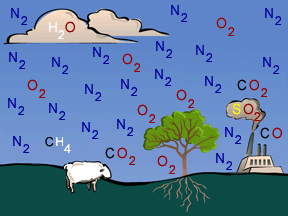
Chemistry plays an influential role in the behavior of Earth's atmosphere. The various gases in the atmosphere are constantly mixing with and reacting with each other. Gases released by the oceans, emitted by plants, animals, and microbes, and poured into the atmosphere by human activities continually alter the balance of atmospheric chemistry.

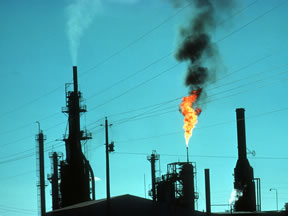
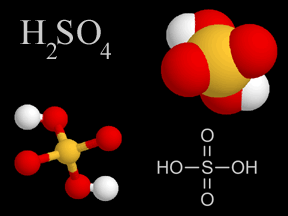
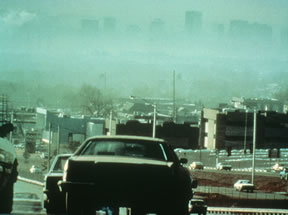
The activities of humans play an increasingly important role in atmospheric chemistry. Fossil fuel burning generates sulfur oxides, which create sulfuric acid - a component of acid rain. Exhaust gases from cars and trucks produce nitrogen oxides, which contribute to the formation of smog and of nitric acid - another component of acid rain.

Nature also does its share to alter the chemistry of the atmosphere. Volcanic eruptions, wildfires, lightning, and UV radiation from the Sun all add materials to the atmosphere or chemically alter those already there. The oceans and the biosphere exchange vast quantities of gases with the atmosphere. The Carbon and Nitrogen Cycles play key roles in these processes.

Last modified July 13, 2009 by Randy Russell.

Shop Windows to the Universe Science Store!

Cool It! is the new card game from the Union of Concerned Scientists that teaches kids about the choices we have when it comes to climate change—and how policy and technology decisions made today will matter. Cool It! is available in our online store.

Windows to the Universe Community

News

Opportunities

You might also be interested in:

Traveling Nitrogen Classroom Activity Kit

Check out our online store - minerals, fossils, books, activities, jewelry, and household items!...more

Chemical Composition of Earth's Atmosphere

Earth's atmosphere consists of about 78% nitrogen, 20% oxygen, and a mixture of small amounts of numerous other ingredients. Some of the minor constituents do, however, have big impacts. For example, greenhouse...more

Air Pollution Sources

Air pollution comes from many different sources. Natural processes that affect air quality include volcanic activity, which produce sulfur, chlorine, and ash particulates, and wildfires, which produce...more

Sulfuric Acid - H2SO4

Sulfuric acid is a viscous, oily liquid and a strong acid which can cause severe burns. Sulfuric acid consists of sulfur, oxygen, and hydrogen atoms. Sulfuric acid is one of the components of acid rain....more

Acid Rain

Acid rain is a general term used to describe different kinds of acidic air pollution. Although some acidic air pollutants return directly back to Earth, a lot of it returns in rain, snow, sleet, hail,...more

Photochemical Smog

Smog is a type of air pollution. Smog is a mixture of smoke and fog, hence the name (SMoke + fOG = SMOG). Victorian-era London was famous for its thick smogs, which resulted from the city's frequent, naturally...more

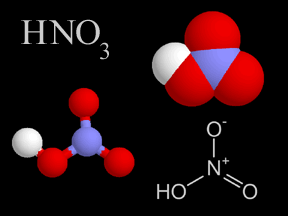
Nitric Acid - HNO3

Nitric acid is a colorless, corrosive liquid and a toxic acid which can cause severe burns. Nitric acid consists of nitrogen, oxygen, and hydrogen atoms. Nitric acid, in its gas phase, is present in very...more

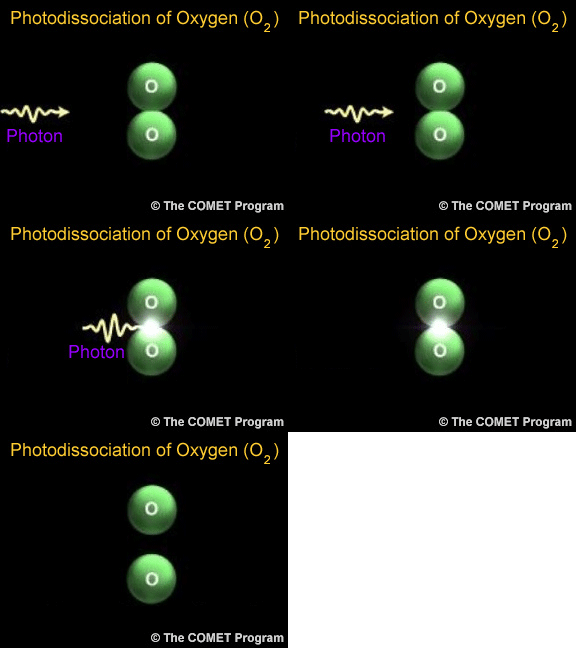
Photodissociation

Sometimes when a photon hits a molecule, the energy from the photon causes the molecule to break apart. Scientists use the term "photodissociation" for such events. Photodissociation plays a very important...more

Shop Windows to the Universe

Science, Evolution, and Creationism, by the National Academies, focuses on teaching evolution in today's classrooms. Check out the other publications in our online store.

Windows to the Universe, a project of the National Earth Science Teachers Association, is sponsored in part by the National Science Foundation and NASA, our Founding Partners (the American Geophysical Union and American Geosciences Institute) as well as through Institutional, Contributing, and Affiliate Partners, individual memberships and generous donors. Thank you for your support! NASA AGU AGI NSF