Current Events

  • Irish Chronicles Document Links Between Volcanoes and Weather
    A study of over 40,000 written entries in Irish Annals and ice core measurements shows a strong corr...Read more

    x

    Irish Chronicles Document Links Between Volcanoes and Weather

    A study of over 40,000 written entries in Irish Annals and ice core measurements shows a strong correlation between the occurrence of volcanic eruptions and extreme cold weather in Ireland over a 1200 year period. Data analyzed in this study cover the period from 431 to 1649, during which time up to 48 volcanic eruptions are identified in Greenland ice core records through deposition of volcanic sulfate in annual layers of ice. You can find the study (open access), published on 6 June 2013 in IOP Publishing's journal Environmental Research Letters, at http://iopscience.iop.org/1748-9326/8/2/024035/article. Find out more about how volcanoes can influence climate.
  • EF-5 Tornado in El Reno, Oklahoma Widest Ever Recorded in US
    The EF-5 tornado that hit El Reno, Oklahoma on May 31st was the widest ever recorded in the US, acco...Read more

    x

    EF-5 Tornado in El Reno, Oklahoma Widest Ever Recorded in US

    The EF-5 tornado that hit El Reno, Oklahoma on May 31st was the widest ever recorded in the US, according to the National Weather Service in Norman Oklahoma. The tornado, which remained on the ground for 40 minutes and reached 2.6 miles across (4.2 km), took the lives of 18 people including storm chasers Tim Samaras, Paul Samaras and Carl Young. For more information on the tornado, visit http://ow.ly/i/2hfDG.
  • Atmospheric CO2 Level Tops 400 ppm
    During the week of May 13th, the CO2 level at the Mauna Loa Observatory in Hawaii topped 400 ppm rep...Read more

    x

    Atmospheric CO2 Level Tops 400 ppm

    During the week of May 13th, the CO2 level at the Mauna Loa Observatory in Hawaii topped 400 ppm repeatedly. Daily levels of CO2 can vary due to weather, and there are seasonal trends as well. The level of atmospheric greenhouse gases continues to increase, now over 120 ppm since the Industrial Revolution began. For more on the Keeling Curve, see http://keelingcurve.ucsd.edu/. Find out more about greenhouse gases and warming.
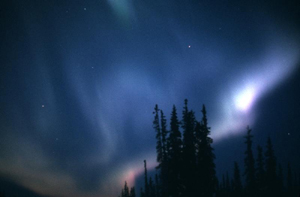
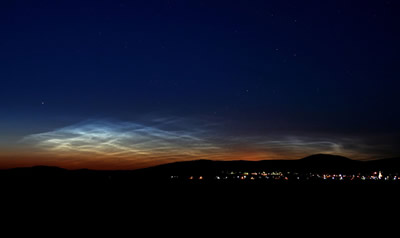
These mystifying clouds are called Polar Mesospheric Clouds, or PMCs, when they are viewed from space and referred to as "night-shining" clouds or Noctilucent Clouds, when viewed by observers on Earth. The clouds form in an upper layer of the Earth’s atmosphere called the mesosphere during the summer and can be seen from the high latitudes on Earth.
Image Courtesy of NASA/Veres Viktor

Noctilucent Clouds

Noctilucent clouds (NLC’s) or polar mesospheric clouds (PMC’s) are found very high in the Earth's atmosphere (about 85,300 meters above the Earth's surface!). They are called Polar Mesospheric Clouds when they are viewed from space, and are referred to as noctilucent clouds when viewed by observers on Earth. Unlike lower clouds that are associated with weather, these clouds form at the very edge of space in the atmospheric layer called the mesosphere. Like some of the clouds we see more regularly, scientists think NLC's are made of frozen water or ice crystals.

NLC’s are seen best just after sunset. They glow an electric, beautiful blue-white which makes sense as noctilucent actually means "night-shining". They are normally seen from locations near the poles of the Earth, but in recent years, they have been seen at much lower-latitude locations (like Colorado or Virginia in the U.S.). It’s this change in the distribution of NLC’s that makes scientist think they may be a sign of climate change on Earth, specifically global warming which is influenced by human activity.

These eerie looking clouds have only been studied in the recent past. Now there is an atmospheric mission, AIM (The Aeronomy of Ice in the Mesosphere), that will study these clouds more in depth. The AIM mission will specifically study how these clouds form and if they are an indicator for climate and global change.

Crews aboard the International Space Station routinely witness noctilucent clouds when flying over the Earth. You too can be an observer of these clouds and can even share that information with others on the Internet!

Last modified February 10, 2009 by Becca Hatheway.

Shop Windows to the Universe Science Store!

The Fall 2009 issue of The Earth Scientist, which includes articles on student research into building design for earthquakes and a classroom lab on the composition of the Earth’s ancient atmosphere, is available in our online store.

Windows to the Universe Community

News

Opportunities

You might also be interested in:

Traveling Nitrogen Classroom Activity Kit

Check out our online store - minerals, fossils, books, activities, jewelry, and household items!...more

Effects of Climate Change Today

The world's surface air temperature increased an average of 0.6° Celsius (1.1°F) during the last century according to the Intergovernmental Panel on Climate Change (IPCC). This may not sound like very...more

Global Warming: Scientists Say Earth Is Heating Up

Earth’s climate is warming. During the 20th Century Earth’s average temperature rose 0.6° Celsius (1.1°F). Scientists are finding that the change in temperature has been causing other aspects of our planet...more

The Biosphere Affects Climate

There are many different ways that the biosphere (the plants, animals and other life on our planet) affect climate. Some produce greenhouses gases and promote warming of our planet through the greenhouse...more

History of Observation of Noctilucent Clouds

Observations of noctilucent or "night-shining" clouds were first reported in the summer of 1885. The reports were from northern Europe and Russia. In the late 1880’s, it was proposed that the clouds had...more

AIM Mission Overview

The Aeronomy of Ice in the Mesosphere (AIM) mission is focused on the study of Polar Mesospheric Clouds (PMC’s), also known as noctilucent clouds (NLC’s). The mission will look at these clouds that form...more

International Space Station

The International Space Station (ISS) is a very large space station in orbit around Earth. The ISS is currently inhabited and in use, but it is also under construction; new modules are gradually being...more

The Polar Atmosphere

Phenomena in the Polar Atmosphere There are some unique phenomena that happen in the atmosphere that is above the Earth's polar regions. Read on to discover more about some of the unique parts of the polar...more

Shop Windows to the Universe

Warnings: The True Story of How Science Tamed the Weather by Mike Smith tells the story of our storm warning system. See our online store book collection.

Windows to the Universe, a project of the National Earth Science Teachers Association, is sponsored in part by the National Science Foundation and NASA, our Founding Partners (the American Geophysical Union and American Geosciences Institute) as well as through Institutional, Contributing, and Affiliate Partners, individual memberships and generous donors. Thank you for your support! NASA AGU AGI NSF