ExploraTour: A Peek into the Lives of the Stars

What Happens to High Mass Stars (>8 Solar Masses)?

STAGE 4a: Neutron Star

After the supernova blast blows off the outer layers of the star, all that is left is the central core. The core now contains a mass between 1.4 and 3.0 times the sun's mass but condensed into a volume 10- to 20- km across - roughly the size of a small town on Earth.

The matter in a neutron star would be incredible to behold. It is thought to be no longer gaseous. The surface may be crystalline.

Densities are a trillion times greater than those in a white dwarf. In fact, it is so dense that one teaspoonfull would outweigh the Empire State Building.
Shop Windows to the Universe Science Store!

Our online store includes a wide range of Nature's Own mineral specimens, as well as a mineral and fossil collection perfect for the classroom.

You might also be interested in:

Fluorite Slab

Check out our online store - minerals, fossils, books, activities, jewelry, and household items!...more

ExploraTour - Looking at the World in a Different Light

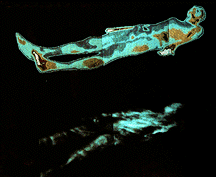
Even though the sleeping man is no longer on the bed, you can still see where he was lying down. The heat from his body warmed up the bed sheets which are now radiating infrared light toward your eyes....more

ExploraTour - Looking at the World in a Different Light

All warm objects radiate in the infrared. The warmer the object, the higher the frequency and intensity of the radiation. Very hot objects give off other types of radiation in addition to infrared. Click...more

ExploraTour - Looking at the World in a Different Light

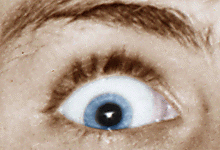
Your eye is a wonderful detector of visible light. Different frequencies of light produce different sensations in the eye which we interpret as colors. Our eyes detect light by using light sensitive components...more

ExploraTour - Looking at the World in a Different Light

Imagine you found a pair of special glasses that not only gave you telescopic vision but gave you the ability to see all forms of radiant energy. The universe in visible light contains all the familiar...more

ExploraTour - Looking at the World in a Different Light

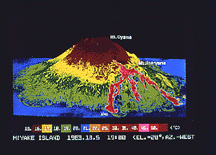
This is a volcano on the island of Miyake in Japan. It has erupted, sending hot lava and ash into the air, a total of ten times. The time after one eruption until the next occurred was about twenty years...more

ExploraTour - Looking at the World in a Different Light

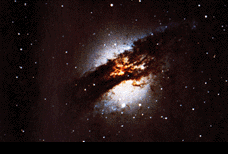
The awesome power of a giant black hole was revealed by looking at this galaxy in three different types of light. The picture that you see is of Centaurus A, a very peculiar galaxy. A galaxy is just a...more

ExploraTour - Looking at the World in a Different Light

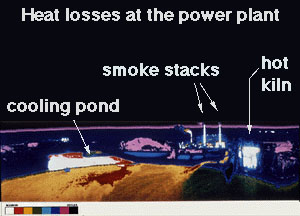
This is a plant in Gary, Indiana where power is made. We use power to run things like television sets, radios, lights, and microwave ovens. The picture looks very strange because it was taken in infrared....more

Shop Windows to the Universe

Science, Evolution, and Creationism, by the National Academies, focuses on teaching evolution in today's classrooms. Check out the other publications in our online store.

Generous sponsorship of Windows to the Universe is provided by the Hewlett Foundation, the American Geological Institute, the American Geophysical Union, the National Science Foundation, NASA, NCAR, and the CISM and CMMAP projects. NASA CMMAP AGU CISM NCAR Hewlett AGI NSF