ExploraTour: A Peek into the Lives of the Stars

Do the most massive stars last longer than smaller ones?

Interestingly enough smaller stars have much longer lifetimes than massive ones. The temperatures in the center of massive stars are hotter than those in their smaller counterparts. As a result nuclear reactions, which release energy within the star, proceed more rapidly using up the stars fuel in a short time.

The smallest stars have lifetimes that exceed an astounding 3 trillion years. They are evolving very slowly and have barely changed since the beginning of the Universe. In contrast, very large hot O and B type stars last a mere 10 million years or less. Our own sun is about 5 billion years old already and will probably last for some 5 billion more years.

Last modified May 6, 2008 by Randy Russell.

Shop Windows to the Universe Science Store!

Our online store includes a wide range of Nature's Own mineral specimens, as well as a mineral and fossil collection perfect for the classroom.

You might also be interested in:

The Earth Scientist, Volume XXVI, Issue 2, Summer 2010

Our 2010 Summer issue of The Earth Scientist includes six articles dealing with various aspects of Earth Science. An article from NOAA details how lake effect snow can, under the right conditions, actually occur on the narrow Mississippi River....more

ExploraTour - Looking at the World in a Different Light

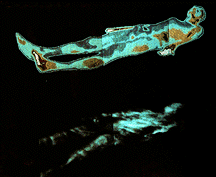
Even though the sleeping man is no longer on the bed, you can still see where he was lying down. The heat from his body warmed up the bed sheets which are now radiating infrared light toward your eyes....more

ExploraTour - Looking at the World in a Different Light

All warm objects (not just people) radiate in the infrared. Warmer objects give off more infrared radiation. Very hot objects radiate other types of light in addition to infrared. Click on the picture...more

ExploraTour - Looking at the World in a Different Light

Your eye is a wonderful detector of visible light. Different frequencies of light produce different sensations in the eye which we interpret as colors. Our eyes detect light by using light sensitive components...more

ExploraTour - Looking at the World in a Different Light

Imagine you found a pair of special glasses that not only gave you telescopic vision but gave you the ability to see all forms of radiant energy. The universe in visible light contains all the familiar...more

ExploraTour - Looking at the World in a Different Light

This is a volcano on the island of Miyake in Japan. It has erupted, sending hot lava and ash into the air, a total of ten times. The time after one eruption until the next occurred was about twenty years...more

ExploraTour - Looking at the World in a Different Light

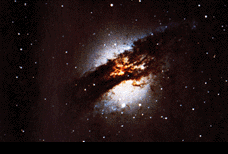
This is a picture of a galaxy in visible light. A galaxy is a large number of stars, some like our sun, some bigger, some smaller and all moving together through space. This galaxy is called Centaurus...more

ExploraTour - Looking at the World in a Different Light

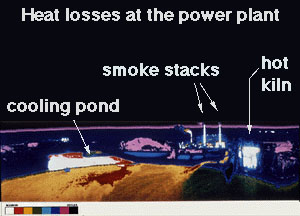
This is a plant in Gary, Indiana where power is made. We use power to run things like television sets, radios, lights, and microwave ovens. The picture looks very strange because it was taken in infrared....more

Shop Windows to the Universe

This eudialyte pendant and earrings are available in our online store, along with other jewelry, minerals, fossils, classroom materials, and household items.

Generous sponsorship of Windows to the Universe is provided by the Hewlett Foundation, the American Geological Institute, the American Geophysical Union, the National Science Foundation, NASA, NCAR, and the CISM and CMMAP projects. NASA CMMAP AGU CISM NCAR Hewlett AGI NSF