Exploratour - The Atmosphere of Mars

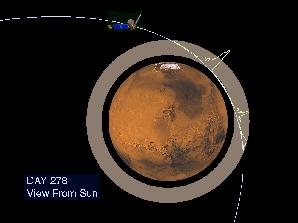
This image illustrates one way in which the magnetometer instrument studies the planet.
Click on image for full size
Image from: NASA/JPL

Just to show you that the ionosphere is an important layer of the atmosphere, the ionosphere of Mars was used to help put the brakes on the Mars Global Surveyor (MGS) spacecraft and place it into a circular orbit. When it flew through the ionosphere of Mars, it measured the amount of electrons it found there, as shown in this image by the squiggly line.

The Martian ionosphere is drawn into the picture as the shaded region circling the planet. (It is not to scale). Successful aerobraking depends upons the correctness of scientists' understanding of the heating and cooling of this layer of the atmosphere.


This is page 6 of 20
Shop Windows to the Universe Science Store!

Our online store includes books on science education, classroom activities in The Earth Scientist, mineral and fossil specimens, and educational games!

You might also be interested in:

The Earth Scientist, Volume XXV, Issue 3, Fall 2009

The Fall 2009 issue of The Earth Scientist includes a collection of Earth and Space Science articles for you, covering the current efforts to save Louisiana’s Lake Pontchartrain, student research into building design as it relates to earthquake damage, an exciting Earth Science project and resource from the United Kingdom...more

ExploraTour - Looking at the World in a Different Light

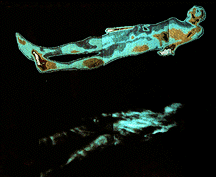
Even though the sleeping man is no longer on the bed, you can still see where he was lying down. The heat from his body warmed up the bed sheets which are now radiating infrared light toward your eyes....more

ExploraTour - Looking at the World in a Different Light

All warm objects (not just people) radiate in the infrared. Warmer objects give off more infrared radiation. Very hot objects radiate other types of light in addition to infrared. Click on the picture...more

ExploraTour - Looking at the World in a Different Light

Your eye is a wonderful detector of visible light. Different frequencies of light produce different sensations in the eye which we interpret as colors. Our eyes detect light by using light sensitive components...more

ExploraTour - Looking at the World in a Different Light

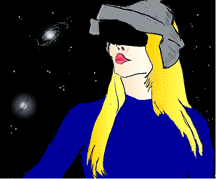
Imagine you found a pair of special glasses that not only gave you telescopic vision but gave you the ability to see all forms of radiant energy. The universe in visible light contains all the familiar...more

ExploraTour - Looking at the World in a Different Light

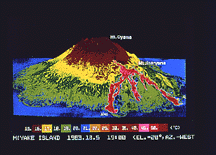
This is a volcano on the island of Miyake in Japan. It has erupted, sending hot lava and ash into the air, a total of ten times. The time after one eruption until the next occurred was about twenty years...more

ExploraTour - Looking at the World in a Different Light

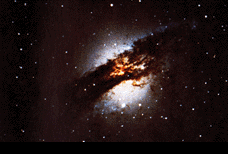
This is a picture of a galaxy in visible light. A galaxy is a large number of stars, some like our sun, some bigger, some smaller and all moving together through space. This galaxy is called Centaurus...more

ExploraTour - Looking at the World in a Different Light

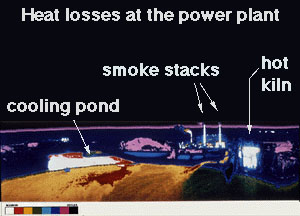
This is a plant in Gary, Indiana where power is made. We use power to run things like television sets, radios, lights, and microwave ovens. The picture looks very strange because it was taken in infrared....more

Shop Windows to the Universe

The Spring 2011 issue of The Earth Scientist is focused on modernizing seismology education. Thanks to IRIS, you can download this issue for free as a pdf. Print copies are available in our online store.

Generous sponsorship of Windows to the Universe is provided by the Hewlett Foundation, the American Geological Institute, the American Geophysical Union, the National Science Foundation, NASA, NCAR, and the CISM and CMMAP projects. NASA CMMAP AGU CISM NCAR Hewlett AGI NSF