Current Events

  • Irish Chronicles Document Links Between Volcanoes and Weather
    A study of over 40,000 written entries in Irish Annals and ice core measurements shows a strong corr...Read more

    x

    Irish Chronicles Document Links Between Volcanoes and Weather

    A study of over 40,000 written entries in Irish Annals and ice core measurements shows a strong correlation between the occurrence of volcanic eruptions and extreme cold weather in Ireland over a 1200 year period. Data analyzed in this study cover the period from 431 to 1649, during which time up to 48 volcanic eruptions are identified in Greenland ice core records through deposition of volcanic sulfate in annual layers of ice. You can find the study (open access), published on 6 June 2013 in IOP Publishing's journal Environmental Research Letters, at http://iopscience.iop.org/1748-9326/8/2/024035/article. Find out more about how volcanoes can influence climate.
  • EF-5 Tornado in El Reno, Oklahoma Widest Ever Recorded in US
    The EF-5 tornado that hit El Reno, Oklahoma on May 31st was the widest ever recorded in the US, acco...Read more

    x

    EF-5 Tornado in El Reno, Oklahoma Widest Ever Recorded in US

    The EF-5 tornado that hit El Reno, Oklahoma on May 31st was the widest ever recorded in the US, according to the National Weather Service in Norman Oklahoma. The tornado, which remained on the ground for 40 minutes and reached 2.6 miles across (4.2 km), took the lives of 18 people including storm chasers Tim Samaras, Paul Samaras and Carl Young. For more information on the tornado, visit http://ow.ly/i/2hfDG.
  • Atmospheric CO2 Level Tops 400 ppm
    During the week of May 13th, the CO2 level at the Mauna Loa Observatory in Hawaii topped 400 ppm rep...Read more

    x

    Atmospheric CO2 Level Tops 400 ppm

    During the week of May 13th, the CO2 level at the Mauna Loa Observatory in Hawaii topped 400 ppm repeatedly. Daily levels of CO2 can vary due to weather, and there are seasonal trends as well. The level of atmospheric greenhouse gases continues to increase, now over 120 ppm since the Industrial Revolution began. For more on the Keeling Curve, see http://keelingcurve.ucsd.edu/. Find out more about greenhouse gases and warming.

Exploratour - Evolution of the Solar System
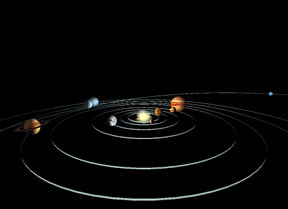

Click on image for full size

This page marks the beginning of section 2 of the tour, but it also marks the end of the tour for now. Come back later for more on the continuing evolution of the solar system.

The beginning of the solar system was in the shrinking of the nebula to form the proto-sun, the forming of planetismals to sweep up smaller rocks until a planet is formed, comets bringing water to the inner planets, these planets turning inside-out and separating into layers, and the sun entering its T-Tauri phase. Once the T-Tauri phase was finished, the solar system was officially "born". Now the Earths geologic "clock" starts to run. The first age of the Earth's history is called the Archean age. The Archean age started at this time.

Earth's surface was very hot and was still cooling. This means that there was no ocean on the Earth. We don't know for sure, but the rocks were probably all igneous rocks because they came out of volcanoes. Whatever the atmosphere there was prior to this time, at this point in history, the atmosphere of Earth began to change.

This is page 28 of 60
Shop Windows to the Universe Science Store!

Learn about Earth and space science, and have fun while doing it! The games section of our online store includes a climate change card game and the Traveling Nitrogen game!

You might also be interested in:

Cool It! Game

Check out our online store - minerals, fossils, books, activities, jewelry, and household items!...more

Exploratour - Evolution of the Solar System

This tour is not ready yet, but you can click through and look at the pictures if you wish! Please come back in 30 days. This page is the start of the tour of the Evolution of the Solar System. The navigation...more

ExploraTour - Looking at the World in a Different Light

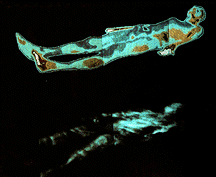
Look at the bed below the body of the sleeping man. You can still see where he was lying down. The heat from his body warmed up the bed sheets which are now radiating infrared light toward your eyes....more

ExploraTour - Looking at the World in a Different Light

All warm objects (not just people) release infrared light. Warmer objects give off more infrared light. Very hot objects radiate other types of light as well. Click on the picture to see the infrared...more

ExploraTour - Looking at the World in a Different Light

What kinds of light can people see? Our eyes can see visible light. When it passes into our eyes different types of visible light create different sensations that we see as colors. ...more

ExploraTour - Looking at the World in a Different Light

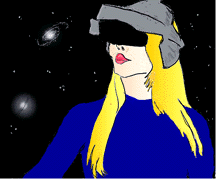
Imagine you found a pair of special glasses that not only gave you telescopic vision but gave you the ability to see all forms of radiant energy. The universe in visible light contains all the familiar...more

ExploraTour - Looking at the World in a Different Light

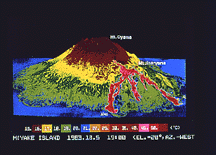
This is a volcano on the island of Miyake in Japan. It has erupted, sending hot lava and ash into the air, a total of ten times. The time after one eruption until the next occurred was about twenty years...more

ExploraTour - Looking at the World in a Different Light

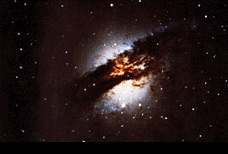
This is a picture of a galaxy in visible light. A galaxy is a large number of stars, some like our sun, some bigger, some smaller and all moving together through space. This galaxy is called Centaurus...more

Shop Windows to the Universe

Arches National Park Geology Tour provides an extensive, visually rich description of the geology of Arches, by Deborah Ragland, Ph.D. See our DVD collection.

Windows to the Universe, a project of the National Earth Science Teachers Association, is sponsored in part by the National Science Foundation and NASA, our Founding Partners (the American Geophysical Union and American Geosciences Institute) as well as through Institutional, Contributing, and Affiliate Partners, individual memberships and generous donors. Thank you for your support! NASA AGU AGI NSF