Current Events

  • Irish Chronicles Document Links Between Volcanoes and Weather
    A study of over 40,000 written entries in Irish Annals and ice core measurements shows a strong corr...Read more

    x

    Irish Chronicles Document Links Between Volcanoes and Weather

    A study of over 40,000 written entries in Irish Annals and ice core measurements shows a strong correlation between the occurrence of volcanic eruptions and extreme cold weather in Ireland over a 1200 year period. Data analyzed in this study cover the period from 431 to 1649, during which time up to 48 volcanic eruptions are identified in Greenland ice core records through deposition of volcanic sulfate in annual layers of ice. You can find the study (open access), published on 6 June 2013 in IOP Publishing's journal Environmental Research Letters, at http://iopscience.iop.org/1748-9326/8/2/024035/article. Find out more about how volcanoes can influence climate.
  • EF-5 Tornado in El Reno, Oklahoma Widest Ever Recorded in US
    The EF-5 tornado that hit El Reno, Oklahoma on May 31st was the widest ever recorded in the US, acco...Read more

    x

    EF-5 Tornado in El Reno, Oklahoma Widest Ever Recorded in US

    The EF-5 tornado that hit El Reno, Oklahoma on May 31st was the widest ever recorded in the US, according to the National Weather Service in Norman Oklahoma. The tornado, which remained on the ground for 40 minutes and reached 2.6 miles across (4.2 km), took the lives of 18 people including storm chasers Tim Samaras, Paul Samaras and Carl Young. For more information on the tornado, visit http://ow.ly/i/2hfDG.
  • Atmospheric CO2 Level Tops 400 ppm
    During the week of May 13th, the CO2 level at the Mauna Loa Observatory in Hawaii topped 400 ppm rep...Read more

    x

    Atmospheric CO2 Level Tops 400 ppm

    During the week of May 13th, the CO2 level at the Mauna Loa Observatory in Hawaii topped 400 ppm repeatedly. Daily levels of CO2 can vary due to weather, and there are seasonal trends as well. The level of atmospheric greenhouse gases continues to increase, now over 120 ppm since the Industrial Revolution began. For more on the Keeling Curve, see http://keelingcurve.ucsd.edu/. Find out more about greenhouse gases and warming.

Evidence of Evolution
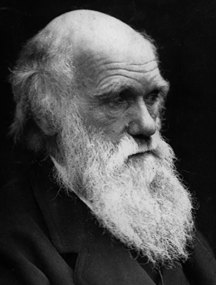
Picture of Charles Darwin
Click on image for full size
The Bettmann Archive

The Theory of Natural Selection

During the 19th century when Europeans were exploring their own countries as well as mounting large expeditions to explore foreign lands, natural historians such as Charles Darwin and Alfred Russel Wallace were making observations of the geographic distributions of species. They found that different species were found in different environments. Species in the tropics were well suited, or adapted, to live in the tropics and species in England were well adapted to live in England. Finches on different Galapagos Islands were well adapted to their particular environments. Independent of one another, Darwin and Wallace both developed the theory of natural selection to explain the geographic distributions of species. That theory states that there are variations in organisms of the same species. Some are tall, some are short, some have larger mouths, keen eyesight, etc. The organisms that are most well suited to live in a particular environment are more likely to survive. The survivors produce the next generation and those offspring are more likely to have their parent's special traits (such as keen eyesight, etc.)

Here are the main points of the theory of natural selection:

  1. Everyone’s Different: There are variations among individuals of the same species (better eyesight, extra feathers, longer legs, etc.)
  2. Resources are Limited: Resources such as food and shelter are limited
  3. Lots of Babies: Organisms make more babies (young) than could actually live in the environment.
  4. Organisms Compete: Organisms compete for food and other resources in the environment.
  5. The "Fittest" Survive: The organisms whose variations best fit the environment are most likely to survive, reproduce, and pass useful traits to the next generation.

The evidence of evolutionary changes in life forms through time has been well established and accepted for more than a century. Natural selection is an explanation for the mechanism of evolution. In addition, scientists continue to investigate more specific hypotheses that might further develop our understanding of how change through time happens. One of the main hypotheses, developed by Stephen J. Gould and Niles Eldridge, is called punctuated equilibrium. This hypothesis suggests that the rate of change in a population is not constant. No changes, or very few, may happen to a population of organisms over millions of years and then changes may happen rapidly over many thousands of years. Advances in technology over the past century have allowed scientists to continue to test hypotheses that further our understanding of evolutionary processes.
Last modified May 16, 2005 by Lisa Gardiner.

Shop Windows to the Universe Science Store!

Our online store includes issues of NESTA's quarterly journal, The Earth Scientist, full of classroom activities on different topics in Earth and space science, as well as books on science education!

You might also be interested in:

Traveling Nitrogen Classroom Activity Kit

Check out our online store - minerals, fossils, books, activities, jewelry, and household items!...more

Evolution Impacts Environment, Study Finds

For a long time, scientists have known that how living things interact with their environment – ecology – has an impact on their evolution. Now, scientists have found that evolution has an impact on ecology...more

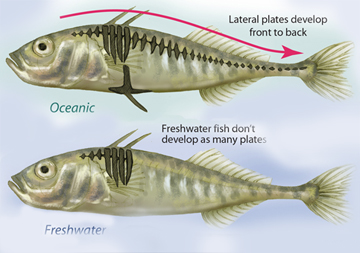
Fish Adapting to a Changing World

Scientists have been studying stickleback fish to learn more about how animals cope when their environment changes. Since the Earth is changing quickly because of global warming and other global changes,...more

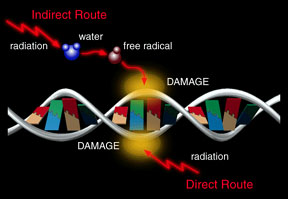
Radiation is Dangerous to Living Creatures

Radiation can be harmful to living creatures. Radiation can harm living things directly by damaging their cells. The cells might stop functioning, or they might be unable to reproduce. Radiation can also...more

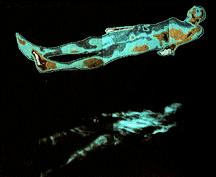
ExploraTour - Looking at the World in a Different Light

Even though the sleeping man is no longer on the bed, you can still see where he was lying down. The heat from his body warmed up the bed sheets which are now radiating infrared light toward your eyes....more

ExploraTour - Looking at the World in a Different Light

All warm objects (not just people) radiate in the infrared. Warmer objects give off more infrared radiation. Very hot objects radiate other types of light in addition to infrared. Click on the picture...more

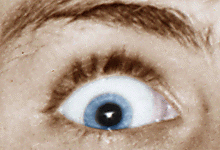
ExploraTour - Looking at the World in a Different Light

Your eye is a wonderful detector of visible light. Different frequencies of light produce different sensations in the eye which we interpret as colors. Our eyes detect light by using light sensitive components...more

ExploraTour - Looking at the World in a Different Light

Imagine you found a pair of special glasses that not only gave you telescopic vision but gave you the ability to see all forms of radiant energy. The universe in visible light contains all the familiar...more

Shop Windows to the Universe

With Explore the Planets, investigate the planets, their moons, and understand the processes that shape them. By G. Jeffrey Taylor, Ph.D. See our DVD collection.

Windows to the Universe, a project of the National Earth Science Teachers Association, is sponsored in part by the National Science Foundation and NASA, our Founding Partners (the American Geophysical Union and American Geosciences Institute) as well as through Institutional, Contributing, and Affiliate Partners, individual memberships and generous donors. Thank you for your support! NASA AGU AGI NSF