

Exploratour - Does Europa have an Ocean?

This is an image of "puddle-like" flows of Europa taken by the Galileo spacecraft. This image is called "the mitten".
Click on image for full size
NASA
Click on image for full size
NASA
This feature suggests a third process, one which geologists call "cryovolcanism" or icy-volcanism (cryo means cold). In this case, even though a volcanic cone is not formed, a liquid comes out of the ground and flows on the surface. That is why this feature gets the name cryovolcanism.
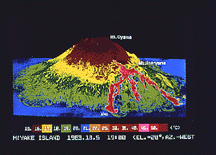
You may leave the tour and read more about terrestrial volcanism and how volcanic cones are formed on Earth using the link at the bottom of the page.
This is page 9 of 20