Exploratour - The Archean Age

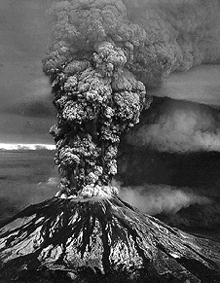
This is an image of Mt. St. Helens, in Washington, USA.
Click on image for full size
Image from: USGS, courtesy of Volcano World

The activity of all the volcanoes helped the Earth form an atmosphere.

All volcanoes are different but in general they release gases such as H2O, CO2, SO2, and a little nitrogen. Notice that these molecules are not the Nitrogen and Oxygen which are the majority of gases in the air today, however. In fact, oxygen, which is what humans and other animals require to live, was not a part of the Earth's earliest atmosphere! Oxygen came into the atmosphere later.

Because this atmosphere is different from the primitive atmosphere of the Earth (what might have formed with the Earth out of the cloud shown on page 1 of this tour), scientists call it a secondary atmosphere.

This is page 6 of 10

Shop Windows to the Universe Science Store!

Our online store includes a wide range of Nature's Own mineral specimens, as well as a mineral and fossil collection perfect for the classroom.

You might also be interested in:

Banded Iron Formation

Check out our online store - minerals, fossils, books, activities, jewelry, and household items!...more

Exploratour - The Archean Age
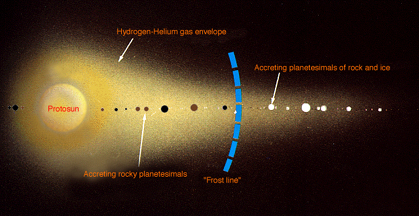
The Archean is the name of the age which began with the forming Earth, as illustrated in this picture. This period of Earth's history lasted a long time, 2.8 billion years! That is more than half the...more

ExploraTour - Looking at the World in a Different Light

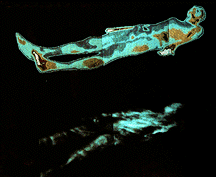
Even though the sleeping man is no longer on the bed, you can still see where he was lying down. The heat from his body warmed up the bed sheets which are now radiating infrared light toward your eyes....more

ExploraTour - Looking at the World in a Different Light

All warm objects (not just people) radiate in the infrared. Warmer objects give off more infrared radiation. Very hot objects radiate other types of light in addition to infrared. Click on the picture...more

ExploraTour - Looking at the World in a Different Light

Your eye is a wonderful detector of visible light. Different frequencies of light produce different sensations in the eye which we interpret as colors. Our eyes detect light by using light sensitive components...more

ExploraTour - Looking at the World in a Different Light

Imagine you found a pair of special glasses that not only gave you telescopic vision but gave you the ability to see all forms of radiant energy. The universe in visible light contains all the familiar...more

ExploraTour - Looking at the World in a Different Light

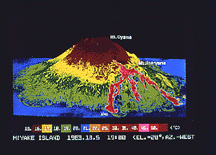
This is a volcano on the island of Miyake in Japan. It has erupted, sending hot lava and ash into the air, a total of ten times. The time after one eruption until the next occurred was about twenty years...more

ExploraTour - Looking at the World in a Different Light

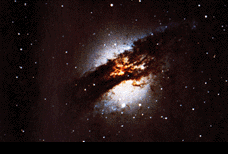
This is a picture of a galaxy in visible light. A galaxy is a large number of stars, some like our sun, some bigger, some smaller and all moving together through space. This galaxy is called Centaurus...more

Shop Windows to the Universe

Science, Evolution, and Creationism, by the National Academies, focuses on teaching evolution in today's classrooms. Check out the other publications in our online store.

Generous sponsorship of Windows to the Universe is provided by the Hewlett Foundation, the American Geological Institute, the American Geophysical Union, the National Science Foundation, NASA, NCAR, and the CISM and CMMAP projects. NASA CMMAP AGU CISM NCAR Hewlett AGI NSF