Current Events

  • Kansas Legislator Proposes Bill to Outlaw Sustainability Education
    A bill has been introduced in the Kansas legislature this week that would prohibit the promotion of ...Read more

    x

    Kansas Legislator Proposes Bill to Outlaw Sustainability Education

    A bill has been introduced in the Kansas legislature this week that would prohibit the promotion of sustainability. Here is a link to the one-page bill: http://www.kslegislature.org/li/b2013_14/measures/documents/hb2366_00_0000.pdf. See report on Bloomberg News.
  • Earth's Center Is 1,000 Degrees Hotter Than Previously Thought, Synchrotron X-Ray Experiment Shows
    Scientists have determined the temperature near the Earth’s center to be 6000 degrees Celsius, 1000 ...Read more

    x

    Earth's Center Is 1,000 Degrees Hotter Than Previously Thought, Synchrotron X-Ray Experiment Shows

    Scientists have determined the temperature near the Earth’s center to be 6000 degrees Celsius, 1000 degrees hotter than in a previous experiment run 20 years ago. These measurements confirm geophysical models that the temperature difference between the solid core and the mantle above, must be at least 1500 degrees to explain why the Earth has a magnetic field. For more information about this study, see the press release from the European Synchrotron Radiation Facility.
  • Ocean Volcanic Rocks Contain Samples of Recycled Crust
    Scientists have long believed that lava erupted from certain oceanic volcanoes contains materials fr...Read more

    x

    Ocean Volcanic Rocks Contain Samples of Recycled Crust

    Scientists have long believed that lava erupted from certain oceanic volcanoes contains materials from the early Earth’s crust. But decisive evidence for this phenomenon has proven elusive. New research from a team including Carnegie’s Erik Hauri demonstrates that oceanic volcanic rocks contain samples of recycled crust dating back to the Archean era 2.5 billion years ago. Their work is published in Nature. Oceanic crust sinks into the Earth’s mantle at so-called subduction zones, where two plates come together. Much of what happens to the crust during this journey is unknown. Model-dependent studies for how long subducted material can exist in the mantle are uncertain and evidence of very old crust returning to Earth’s surface via upwellings of magma has not been found until now. For more information about these results, see the press release from the Carnegie Institution.

Exploratour - The Archean Age
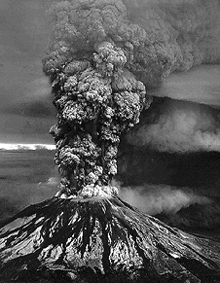
This is an image of Mt. St. Helens, in Washington, USA.
Click on image for full size
Image from: USGS, courtesy of Volcano World

The activity of all the volcanoes helped the Earth form an atmosphere.

All volcanoes are different but in general they release gases such as H2O, CO2, SO2, and a little nitrogen. Notice that these molecules are not the Nitrogen and Oxygen which are the majority of gases in the air today, however. In fact, oxygen, which is what humans and other animals require to live, was not a part of the Earth's earliest atmosphere! Oxygen came into the atmosphere later.

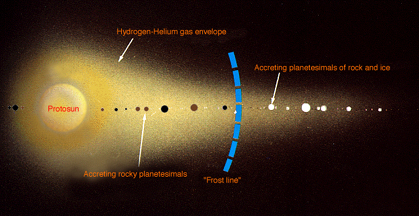
Because this atmosphere is different from the primitive atmosphere of the Earth (what might have formed with the Earth out of the cloud shown on page 1 of this tour), scientists call it a secondary atmosphere.

This is page 6 of 10
Shop Windows to the Universe Science Store!

Our online store includes books on science education, ranging from evolution, classroom research, and the need for science and math literacy!

You might also be interested in:

Cool It! Game

Check out our online store - minerals, fossils, books, activities, jewelry, and household items!...more

Exploratour - The Archean Age

The Archean is the name of the age which began with the forming Earth, as illustrated in this picture. This period of Earth's history lasted a long time, 2.8 billion years! That is more than half the...more

ExploraTour - Looking at the World in a Different Light

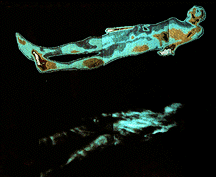
Even though the sleeping man is no longer on the bed, you can still see where he was lying down. The heat from his body warmed up the bed sheets which are now radiating infrared light toward your eyes....more

ExploraTour - Looking at the World in a Different Light

All warm objects (not just people) radiate in the infrared. Warmer objects give off more infrared radiation. Very hot objects radiate other types of light in addition to infrared. Click on the picture...more

ExploraTour - Looking at the World in a Different Light

Your eye is a wonderful detector of visible light. Different frequencies of light produce different sensations in the eye which we interpret as colors. Our eyes detect light by using light sensitive components...more

ExploraTour - Looking at the World in a Different Light

Imagine you found a pair of special glasses that not only gave you telescopic vision but gave you the ability to see all forms of radiant energy. The universe in visible light contains all the familiar...more

ExploraTour - Looking at the World in a Different Light

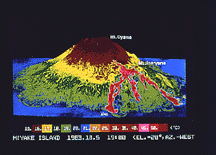
This is a volcano on the island of Miyake in Japan. It has erupted, sending hot lava and ash into the air, a total of ten times. The time after one eruption until the next occurred was about twenty years...more

ExploraTour - Looking at the World in a Different Light

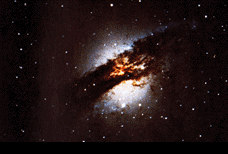
This is a picture of a galaxy in visible light. A galaxy is a large number of stars, some like our sun, some bigger, some smaller and all moving together through space. This galaxy is called Centaurus...more

Shop Windows to the Universe

Science, Evolution, and Creationism, by the National Academies, focuses on teaching evolution in today's classrooms. Check out the other publications in our online store.

Windows to the Universe, a project of the National Earth Science Teachers Association, is sponsored in part by the National Science Foundation and NASA, our Founding Partners (the American Geophysical Union and American Geosciences Institute) as well as through Institutional, Contributing, and Affiliate Partners, individual memberships and generous donors. Thank you for your support! NASA AGU AGI NSF