Current Events

  • Atmospheric CO2 Level Tops 400 ppm
    During the week of May 13th, the CO2 level at the Mauna Loa Observatory in Hawaii topped 400 ppm rep...Read more

    x

    Atmospheric CO2 Level Tops 400 ppm

    During the week of May 13th, the CO2 level at the Mauna Loa Observatory in Hawaii topped 400 ppm repeatedly. Daily levels of CO2 can vary due to weather, and there are seasonal trends as well. The level of atmospheric greenhouse gases continues to increase, now over 120 ppm since the Industrial Revolution began. For more on the Keeling Curve, see http://keelingcurve.ucsd.edu/. Find out more about greenhouse gases and warming.
  • Massive Tornado Outbreak on Tornado Alley
    The week of May 19 brings dozens of tornadoes to Tornado Alley in the states of Oklahoma, Kansas, Io...Read more

    x

    Massive Tornado Outbreak on Tornado Alley

    The week of May 19 brings dozens of tornadoes to Tornado Alley in the states of Oklahoma, Kansas, Iowa, Illinois and Missouri. On May 20th, a massive tornado struck Moore, Oklahoma, devastating communities - destroying over 100 homes and hitting two elementary schools and a hospital - with many casualties and deaths. Our thoughts are with our friends and colleagues suffering from these storms. For more on the May 20th storms, see the NOAA Storm Prediction Center Storm Report.
  • Kansas Legislator Proposes Bill to Outlaw Sustainability Education
    A bill has been introduced in the Kansas legislature this week that would prohibit the promotion of ...Read more

    x

    Kansas Legislator Proposes Bill to Outlaw Sustainability Education

    A bill has been introduced in the Kansas legislature this week that would prohibit the promotion of sustainability. Here is a link to the one-page bill: http://www.kslegislature.org/li/b2013_14/measures/documents/hb2366_00_0000.pdf. See report on Bloomberg News.

ExploraTour - How to Build a Star


Click on image for full size

Stars generate power through nuclear fusion. Fusion is the joining together of light nuclei to form a heavier nucleus. The heavier nucleus has less mass than the combined mass of the lighter nuclei. The missing mass is converted into energy. In the sun, hydrogen nuclei are being fused together to form helium.

Hydrogen is commonly found on Earth in water. Water is a molecule made up of 2 hydrogen and 1 oxygen atoms. Within water, a small percentage of the hydrogen exists as deuterium which is a heavy form of hydrogen. The deuterium nucleus contains a proton and a neutron; while the nucleus in a hydrogen atom contains only a proton. This heavy form of hydrogen can be used as fuel in fusion reactors. If we can find a way to make fusion power plants work, we will have a virtually limitless supply of power using the deuterium in seawater as fuel.

If all of the mass in a 20-gallon fish tank were converted into energy (not just the deuterium), it could supply the energy needs of the entire U.S. for nearly a month!

So far we have been unable to find a container that will hold the hot dense mixture of ions and electrons that is needed to force fusion to occur. This is not likely to be solved anytime soon.

So how is the sun able to do it so easily?

Shop Windows to the Universe Science Store!

Our online store includes issues of NESTA's quarterly journal, The Earth Scientist, full of classroom activities on different topics in Earth and space science, ranging from seismology, rocks and minerals, oceanography, and Earth system science to astronomy!

You might also be interested in:

Cool It! Game

Check out our online store - minerals, fossils, books, activities, jewelry, and household items!...more

ExploraTour - Looking at the World in a Different Light

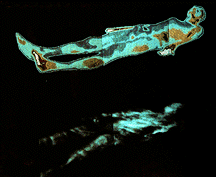
Even though the sleeping man is no longer on the bed, you can still see where he was lying down. The heat from his body warmed up the bed sheets which are now radiating infrared light toward your eyes....more

ExploraTour - Looking at the World in a Different Light

All warm objects radiate in the infrared. The warmer the object, the higher the frequency and intensity of the radiation. Very hot objects give off other types of radiation in addition to infrared. Click...more

ExploraTour - Looking at the World in a Different Light

Your eye is a wonderful detector of visible light. Different frequencies of light produce different sensations in the eye which we interpret as colors. Our eyes detect light by using light sensitive components...more

ExploraTour - Looking at the World in a Different Light

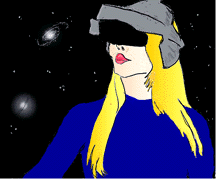
Imagine you found a pair of special glasses that not only gave you telescopic vision but gave you the ability to see all forms of radiant energy. The universe in visible light contains all the familiar...more

ExploraTour - Looking at the World in a Different Light

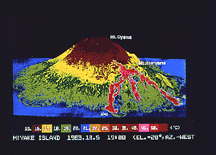
This is a volcano on the island of Miyake in Japan. It has erupted, sending hot lava and ash into the air, a total of ten times. The time after one eruption until the next occurred was about twenty years...more

ExploraTour - Looking at the World in a Different Light

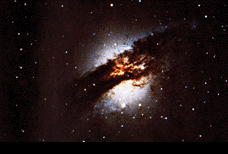
The awesome power of a giant black hole was revealed by looking at this galaxy in three different types of light. The picture that you see is of Centaurus A, a very peculiar galaxy. A galaxy is just a...more

ExploraTour - Looking at the World in a Different Light

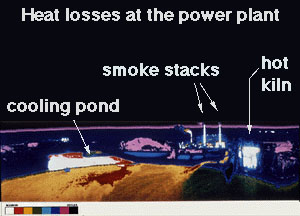
This is a plant in Gary, Indiana where power is made. We use power to run things like television sets, radios, lights, and microwave ovens. The picture looks very strange because it was taken in infrared....more

Shop Windows to the Universe

Earth Science Rocks! Select one of our four cool NESTA t-shirts from our online store, and express your love of Earth and space science!

Windows to the Universe, a project of the National Earth Science Teachers Association, is sponsored in part by the National Science Foundation and NASA, our Founding Partners (the American Geophysical Union and American Geosciences Institute) as well as through Institutional, Contributing, and Affiliate Partners, individual memberships and generous donors. Thank you for your support! NASA AGU AGI NSF