Current Events

  • Atmospheric CO2 Level Tops 400 ppm
    During the week of May 13th, the CO2 level at the Mauna Loa Observatory in Hawaii topped 400 ppm rep...Read more

    x

    Atmospheric CO2 Level Tops 400 ppm

    During the week of May 13th, the CO2 level at the Mauna Loa Observatory in Hawaii topped 400 ppm repeatedly. Daily levels of CO2 can vary due to weather, and there are seasonal trends as well. The level of atmospheric greenhouse gases continues to increase, now over 120 ppm since the Industrial Revolution began. For more on the Keeling Curve, see http://keelingcurve.ucsd.edu/. Find out more about greenhouse gases and warming.
  • Massive Tornado Outbreak on Tornado Alley
    The week of May 19 brings dozens of tornadoes to Tornado Alley in the states of Oklahoma, Kansas, Io...Read more

    x

    Massive Tornado Outbreak on Tornado Alley

    The week of May 19 brings dozens of tornadoes to Tornado Alley in the states of Oklahoma, Kansas, Iowa, Illinois and Missouri. On May 20th, a massive tornado struck Moore, Oklahoma, devastating communities - destroying over 100 homes and hitting two elementary schools and a hospital - with many casualties and deaths. Our thoughts are with our friends and colleagues suffering from these storms. For more on the May 20th storms, see the NOAA Storm Prediction Center Storm Report.
  • Kansas Legislator Proposes Bill to Outlaw Sustainability Education
    A bill has been introduced in the Kansas legislature this week that would prohibit the promotion of ...Read more

    x

    Kansas Legislator Proposes Bill to Outlaw Sustainability Education

    A bill has been introduced in the Kansas legislature this week that would prohibit the promotion of sustainability. Here is a link to the one-page bill: http://www.kslegislature.org/li/b2013_14/measures/documents/hb2366_00_0000.pdf. See report on Bloomberg News.
This picture shows the two different tails of a comet - the dust tail and the ion tail.
Click on image for full size
JPL

The Comet Tail

A comet generally has two tails, not one. One tail is due to the comet's dust particles, the other is due to ionized gas from the comet coma.

Dust particles form the first tail. This comet tail generally points back along the comet path (so if the comet is traveling right, the dust tail extends to the left).

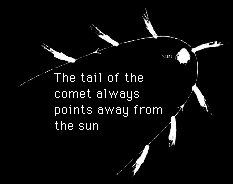
Ions (electrically charged particles), which first come from the nucleus as (neutral) gaseous particles, are swept into the second comet tail. Because of the special interaction with the Sun's magnetic field, this tail always points directly away from the Sun.

Last modified January 9, 2004 by Jennifer Bergman.

Shop Windows to the Universe Science Store!

Our online store includes books on science education, ranging from evolution, classroom research, and the need for science and math literacy!

Windows to the Universe Community

News

Opportunities

You might also be interested in:

Cool It! Game

Check out our online store - minerals, fossils, books, activities, jewelry, and household items!...more

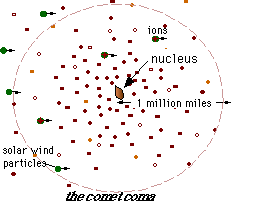
The Comet Coma

As the ices of the comet nucleus evaporate, they expand rapidly into a large cloud around the central part of the comet. This cloud, called the coma, is the atmosphere of the comet and can extend for millions...more

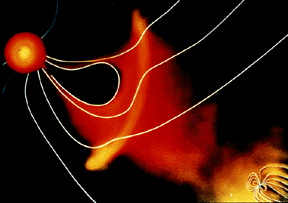
The comet's interaction with interplanetary space, part 2

The magnetic field of the sun (the IMF) is distorted in passing over the comet, taking a long time to slip around the sizeable ion cloud which forms the comet coma. The stretched magnetic field lines form...more

When a Comet comes close to the Sun

When comets are kicked out of the Oort Cloud, they begin a passage into the solar system, spinning and tumbling as they come. The trajectory which they acquire can be hyperbolic, parabolic, or elliptic...more

Comet Wild 2

Comet Wild 2 is named after the scientist who discovered it. Paul Wild is an astronomer from Switzerland who discovered the comet in January 1978. Wild 2 is pronounced "Vilt 2". The comet orbits the Sun...more

Nucleus of Comet Wild 2

The picture on this page shows the best views ever of the nucleus of a comet. It shows two pictures of the comet's nucleus that were taken at slightly different times. The pictures were taken by a spacecraft...more

Space Weather throughout the Solar System

There is a giant magnetic "bubble" in space around the Sun. That "bubble" is called the heliosphere. In a sense, we Earthlings live within the outer atmosphere of our Sun. The solar...more

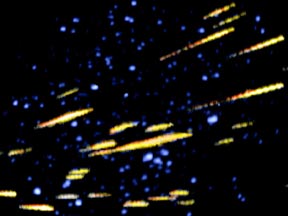
Meteor Showers

A meteor shower is an astronomical event during which many meteors can be seen in a short period of time. Most meteor showers have a peak activity period that lasts between several hours and a couple of...more

Shop Windows to the Universe

Arches National Park Geology Tour provides an extensive, visually rich description of the geology of Arches, by Deborah Ragland, Ph.D. See our DVD collection.

Windows to the Universe, a project of the National Earth Science Teachers Association, is sponsored in part by the National Science Foundation and NASA, our Founding Partners (the American Geophysical Union and American Geosciences Institute) as well as through Institutional, Contributing, and Affiliate Partners, individual memberships and generous donors. Thank you for your support! NASA AGU AGI NSF