The Rosetta lander.
Click on image for full size
Image courtesy NASA.
Rosetta lander instruments
The Rosetta lander has many instruments that it will use to make measurements when it lands on Comet Churyumov-Gerasimenko.
The instruments carried by the lander are described in the table below.
The instruments on the Rosetta orbiter are described on a separate page.
| Instrument |
Purpose |
| ALICE |
Analyzes gases in comet's coma and tail |
| CONSERT |
Uses radio waves to probe comet's
interior |
| COSIMA |
Chemical analysis of dust grains |
| GIADA |
Dust velocity and impact measurement - number, masses, and velocities of
dust grains coming from the comet |
| MIDAS |
Micro-imaging dust analysis - physical analysis (size, shape, etc.) of
dust grains |
| MIRO |
Measures major gases and sub-surface
temperature of the comet |
| OSIRIS |
Wide-angle and narrow-angle cameras |
| ROSINA |
Chemical analysis of comet's
atmosphere |
| RPC |
Plasma measurements - 5 sensors measure physical properties of the
nucleus, the structure of the coma, and the comet's interaction with the solar
wind |
| RSI |
Spacecraft's radio signals are used to measure the mass & density of the
nucleus and to define the comet's orbit |
| VIRTIS |
Maps the temperature on the surface of the nucleus & identifies
gases |
You might also be interested in:
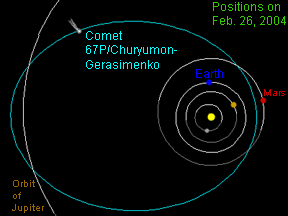
Comet 67P/Churyumov-Gerasimenko was discovered in 1969 by Klim Churyumov and Svetlana Gerasimenko. The comet orbits the Sun once every 6.57 years. Its orbit brings it closer to the Sun than Mars at the
...more
The Rosetta spacecraft has many instruments that it will use to measure Comet Churyumov-Gerasimenko during its visit. This diagram shows the two cameras that make up the OSIRIS imaging system: the Narrow-Angle
...more
Hale-Bopp continues to offer new surprises as two astronomers report of their study of the comet. Using the Hubble Space Telescope and the International Ultraviolet Explorer, the astronomers did a year-long
...more
Six spacecraft flew by Halley's comet in 1986. There were two spacecraft launched from Japan, Suisei and Sakigake, and two from the Soviet Union, Vega 1 & 2. One spacecraft, ICE, from the United States
...more
Comets are observed to go around the sun in a long period of time or a short period of time. Thus they are named "long-period" or "short-period" comets. One group of short-period comets, called the Jupiter
...more
Scientists have learned a great deal from the crash of comet Shoemaker-Levy 9. Scientists traced the orbit of the comet backwards in time to guess its origin. The crash of a comet like Shoemaker-Levy 9
...more
Mathematical theory suggests that comet Shoemaker-Levy 9 was likely a short-period comet which was captured into orbit around Jupiter in 1929 and began to execute the path plotted in this diagram. This
...more