Current Events

  • Atmospheric CO2 Level Tops 400 ppm
    During the week of May 13th, the CO2 level at the Mauna Loa Observatory in Hawaii topped 400 ppm rep...Read more

    x

    Atmospheric CO2 Level Tops 400 ppm

    During the week of May 13th, the CO2 level at the Mauna Loa Observatory in Hawaii topped 400 ppm repeatedly. Daily levels of CO2 can vary due to weather, and there are seasonal trends as well. The level of atmospheric greenhouse gases continues to increase, now over 120 ppm since the Industrial Revolution began. For more on the Keeling Curve, see http://keelingcurve.ucsd.edu/. Find out more about greenhouse gases and warming.
  • Massive Tornado Outbreak on Tornado Alley
    The week of May 19 brings dozens of tornadoes to Tornado Alley in the states of Oklahoma, Kansas, Io...Read more

    x

    Massive Tornado Outbreak on Tornado Alley

    The week of May 19 brings dozens of tornadoes to Tornado Alley in the states of Oklahoma, Kansas, Iowa, Illinois and Missouri. On May 20th, a massive tornado struck Moore, Oklahoma, devastating communities - destroying over 100 homes and hitting two elementary schools and a hospital - with many casualties and deaths. Our thoughts are with our friends and colleagues suffering from these storms. For more on the May 20th storms, see the NOAA Storm Prediction Center Storm Report.
  • Kansas Legislator Proposes Bill to Outlaw Sustainability Education
    A bill has been introduced in the Kansas legislature this week that would prohibit the promotion of ...Read more

    x

    Kansas Legislator Proposes Bill to Outlaw Sustainability Education

    A bill has been introduced in the Kansas legislature this week that would prohibit the promotion of sustainability. Here is a link to the one-page bill: http://www.kslegislature.org/li/b2013_14/measures/documents/hb2366_00_0000.pdf. See report on Bloomberg News.
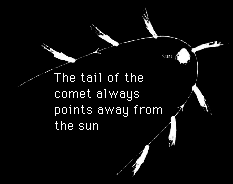
This is a drawing of how a comet behaves as it passes by the sun.
Click on image for full size
JPL

When a Comet comes close to the Sun

When comets are kicked out of the Oort Cloud, they begin a passage into the solar system, spinning and tumbling as they come. The trajectory which they acquire can be hyperbolic, parabolic, or elliptic in shape. Only if a comet takes an elliptic trajectory will it make repeated passes by the sun, as does Halley's comet every 76 years.

As the comet comes closer to the sun, near the region of space occupied by Mars it becomes warm enough for the comet to begin to evaporate. When evaporation begins, the coma and tail form.

This picture shows that, once the tails forms, it always points away from the sun. That means that the tail will point in different directions at different places in the comet's orbit.

Shop Windows to the Universe Science Store!

Learn about Earth and space science, and have fun while doing it! The games section of our online store includes a climate change card game and the Traveling Nitrogen game!

Windows to the Universe Community

News

Opportunities

You might also be interested in:

Cool It! Game

Check out our online store - minerals, fossils, books, activities, jewelry, and household items!...more

The Comet Coma

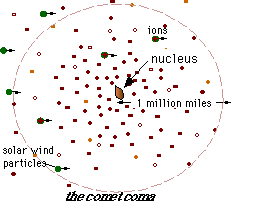
As the ices of the comet nucleus evaporate, they expand rapidly into a large cloud around the central part of the comet. This cloud, called the coma, is the atmosphere of the comet and can extend for millions...more

Orionid Meteor Shower

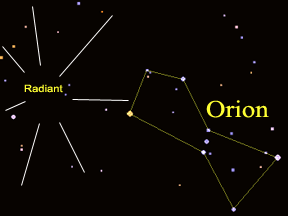
The Orionid meteor shower happens every year in October. Meteor showers are times when you can see many meteors or "shooting stars" in one night. There are several meteor showers each year. Most meteor...more

Leonid Meteor Shower

The Leonid meteor shower is one of several major meteor showers that occur on roughly the same date each year. The Leonids typically "peak" (are at their greatest level of activity) in mid to late November....more

Geminid Meteor Shower

The Geminid meteor shower happens every year in December. Meteor showers are times when you can see many meteors or "shooting stars" in one night. There are several meteor showers each year. Most meteor...more

Quadrantid Meteor Shower

The Quadrantid meteor shower happens every year in January. Meteor showers are times when you can see many meteors or "shooting stars" in one night. There are several meteor showers each year. Most meteor...more

Comet Hale-Bopp

Hale-Bopp continues to offer new surprises as two astronomers report of their study of the comet. Using the Hubble Space Telescope and the International Ultraviolet Explorer, the astronomers did a year-long...more

Missions to Halley's comet in 1986

Six spacecraft flew by Halley's comet in 1986. There were two spacecraft launched from Japan, Suisei and Sakigake, and two from the Soviet Union, Vega 1 & 2. One spacecraft, ICE, from the United States...more

Shop Windows to the Universe

Our Glaciers: Then and Now activity kit helps you see the changes taking place in glaciers around the world. See all our activity kits and classroom activities.

Windows to the Universe, a project of the National Earth Science Teachers Association, is sponsored in part by the National Science Foundation and NASA, our Founding Partners (the American Geophysical Union and American Geosciences Institute) as well as through Institutional, Contributing, and Affiliate Partners, individual memberships and generous donors. Thank you for your support! NASA AGU AGI NSF