This is an image showing a linear string of craters which may have been created when a broken comet such as SL-9 struck the surface.
Click on image for full size
NASA/NSSDC and the Space Telescope Science Institute
Craterchains
Observations such as these now suggest that moons of Jupiter have been struck in the past by strings of broken comet material such as that of comet
SL-9. The craterchain shown here is found on Jupiter's moon Callisto.
Other craterchains that have been found are:
You might also be interested in:

Scientists have learned a great deal from the crash of comet Shoemaker-Levy 9. Scientists traced the orbit of the comet backwards in time to guess its origin. The crash of a comet like Shoemaker-Levy 9
...more
Hale-Bopp continues to offer new surprises as two astronomers report of their study of the comet. Using the Hubble Space Telescope and the International Ultraviolet Explorer, the astronomers did a year-long
...more
Six spacecraft flew by Halley's comet in 1986. There were two spacecraft launched from Japan, Suisei and Sakigake, and two from the Soviet Union, Vega 1 & 2. One spacecraft, ICE, from the United States
...more
Comets are observed to go around the sun in a long period of time or a short period of time. Thus they are named "long-period" or "short-period" comets. One group of short-period comets, called the Jupiter
...more
Mathematical theory suggests that comet Shoemaker-Levy 9 was likely a short-period comet which was captured into orbit around Jupiter in 1929 and began to execute the path plotted in this diagram. This
...more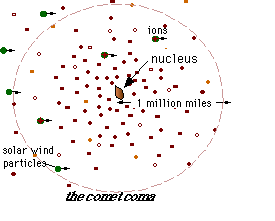
As the ices of the comet nucleus evaporate, they expand rapidly into a large cloud around the central part of the comet. This cloud, called the coma, is the atmosphere of the comet and can extend for millions
...more
When evaporation begins, the gas is propelled from the nucleus at supersonic speed (depicted by arrows in the figure). Because of the low gravity in space, this means that the molecules from the nucleus
...more