Current Events

  • Kansas Legislator Proposes Bill to Outlaw Sustainability Education
    A bill has been introduced in the Kansas legislature this week that would prohibit the promotion of ...Read more

    x

    Kansas Legislator Proposes Bill to Outlaw Sustainability Education

    A bill has been introduced in the Kansas legislature this week that would prohibit the promotion of sustainability. Here is a link to the one-page bill: http://www.kslegislature.org/li/b2013_14/measures/documents/hb2366_00_0000.pdf. See report on Bloomberg News.
  • Earth's Center Is 1,000 Degrees Hotter Than Previously Thought, Synchrotron X-Ray Experiment Shows
    Scientists have determined the temperature near the Earth’s center to be 6000 degrees Celsius, 1000 ...Read more

    x

    Earth's Center Is 1,000 Degrees Hotter Than Previously Thought, Synchrotron X-Ray Experiment Shows

    Scientists have determined the temperature near the Earth’s center to be 6000 degrees Celsius, 1000 degrees hotter than in a previous experiment run 20 years ago. These measurements confirm geophysical models that the temperature difference between the solid core and the mantle above, must be at least 1500 degrees to explain why the Earth has a magnetic field. For more information about this study, see the press release from the European Synchrotron Radiation Facility.
  • Ocean Volcanic Rocks Contain Samples of Recycled Crust
    Scientists have long believed that lava erupted from certain oceanic volcanoes contains materials fr...Read more

    x

    Ocean Volcanic Rocks Contain Samples of Recycled Crust

    Scientists have long believed that lava erupted from certain oceanic volcanoes contains materials from the early Earth’s crust. But decisive evidence for this phenomenon has proven elusive. New research from a team including Carnegie’s Erik Hauri demonstrates that oceanic volcanic rocks contain samples of recycled crust dating back to the Archean era 2.5 billion years ago. Their work is published in Nature. Oceanic crust sinks into the Earth’s mantle at so-called subduction zones, where two plates come together. Much of what happens to the crust during this journey is unknown. Model-dependent studies for how long subducted material can exist in the mantle are uncertain and evidence of very old crust returning to Earth’s surface via upwellings of magma has not been found until now. For more information about these results, see the press release from the Carnegie Institution.

Comets

year
found
closest distance
from Sun (AU)
time to orbit
Sun (years)
next or most recent
pass by Sun
inclination
(degrees)
Arend-Roland 1956 0.316 ? ? 119.95
Bennett 1970 0.538 ? ? 90.04
Biela 1772 0.861 6.62 ? 12.55
Borrelly 1904 1.358 6.68 2001 30.3
Brorsen-Metcalf 1847 0.479 70.6 2060 19.33
Chiron 1977 ? 51 2047 ?
Churyumov-Gerasimenko 1969 1.29 6.57 2009 7.12
d'Arrest 1851 1.291 6.38 2001 19.43
Donati 1858 0.578 ? ? 116.96
Encke 1786 0.341 3.31 2003 11.93
Giacobini-Zinner 1900 1.028 6.59 1999 31.88
Grigg-Skjellerup 1808
1902 (rediscovered)
.989 5.09 ? 21.1
Hale-Bopp 1995 0.9143 4000 1997 ?
Halley ? 0.587 76.09 2062 162.24
Hyakutake 1996 0.23 ~30,000 ~31,500 ?
Ikeya-Seki 1965 0.008 880 2845 141.86
IRAS-Araki-
Alcock
1983 0.991 ? ? 73.25
Kohoutek 1973 0.142 ? ? 14.31
Lexell 1770 0.674 5.60 ? 1.56
Linear 1999 0.762 ? ? 149
Morehouse 1908 0.945 ? ? 140.18
Mrkos 1957 0.355 ? ? 93.94
Schwassmann-
Wachmann 1
1908 5.448 15 2004 9.75
Schwassmann-
Wachmann 3
1930 .937 5.36 2006 11.4
Shoemaker-Levy 9 1993 collided with Jupiter in 1994
Swift-Tuttle 1862 0.963 120 ? 113.56
Tempel 1 1867 1.5 5.51 2005 10.5
Tempel 2 1873 1.381 5.29 1999 12.44
West 1976 0.197 ? ? 43.07
Wild 2 1978 1.583 6.39 2003 3.2
Wirtanen 1948 1.063 5.46 2013 11.7

Last modified January 9, 2004 by Randy Russell.

Shop Windows to the Universe Science Store!

Our online store includes issues of NESTA's quarterly journal, The Earth Scientist, full of classroom activities on different topics in Earth and space science, as well as books on science education!

Windows to the Universe Community

News

Opportunities

You might also be interested in:

Traveling Nitrogen Classroom Activity Kit

Check out our online store - minerals, fossils, books, activities, jewelry, and household items!...more

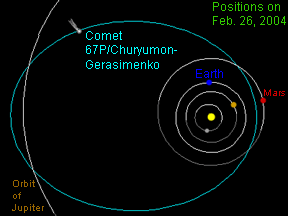
Comet Churyumov-Gerasimenko

Comet 67P/Churyumov-Gerasimenko was discovered in 1969 by Klim Churyumov and Svetlana Gerasimenko. The comet orbits the Sun once every 6.57 years. Its orbit brings it closer to the Sun than Mars at the...more

Comet Wild 2

Comet Wild 2 is named after the scientist who discovered it. Paul Wild is an astronomer from Switzerland who discovered the comet in January 1978. Wild 2 is pronounced "Vilt 2". The comet orbits the Sun...more

Rosetta Mission Update

The Rosetta Mission was suppose to launch in January 2003. Unfortunately, the launch had to be delayed! The Rosetta spacecraft was suppose to be launched on an Ariane 5 rocket. A month ago, another Ariane...more

Comet Hale-Bopp

Hale-Bopp continues to offer new surprises as two astronomers report of their study of the comet. Using the Hubble Space Telescope and the International Ultraviolet Explorer, the astronomers did a year-long...more

Missions to Halley's comet in 1986

Six spacecraft flew by Halley's comet in 1986. There were two spacecraft launched from Japan, Suisei and Sakigake, and two from the Soviet Union, Vega 1 & 2. One spacecraft, ICE, from the United States...more

The Jupiter family of comets

Comets are observed to go around the sun in a long period of time or a short period of time. Thus they are named "long-period" or "short-period" comets. One group of short-period comets, called the Jupiter...more

What we learned from Comet Shoemaker-Levy 9

Scientists have learned a great deal from the crash of comet Shoemaker-Levy 9. Scientists traced the orbit of the comet backwards in time to guess its origin. The crash of a comet like Shoemaker-Levy 9...more

Shop Windows to the Universe

Warnings: The True Story of How Science Tamed the Weather by Mike Smith tells the story of our storm warning system. See our online store book collection.

Windows to the Universe, a project of the National Earth Science Teachers Association, is sponsored in part by the National Science Foundation and NASA, our Founding Partners (the American Geophysical Union and American Geosciences Institute) as well as through Institutional, Contributing, and Affiliate Partners, individual memberships and generous donors. Thank you for your support! NASA AGU AGI NSF