Current Events

  • Irish Chronicles Document Links Between Volcanoes and Weather
    A study of over 40,000 written entries in Irish Annals and ice core measurements shows a strong corr...Read more

    x

    Irish Chronicles Document Links Between Volcanoes and Weather

    A study of over 40,000 written entries in Irish Annals and ice core measurements shows a strong correlation between the occurrence of volcanic eruptions and extreme cold weather in Ireland over a 1200 year period. Data analyzed in this study cover the period from 431 to 1649, during which time up to 48 volcanic eruptions are identified in Greenland ice core records through deposition of volcanic sulfate in annual layers of ice. You can find the study (open access), published on 6 June 2013 in IOP Publishing's journal Environmental Research Letters, at http://iopscience.iop.org/1748-9326/8/2/024035/article. Find out more about how volcanoes can influence climate.
  • EF-5 Tornado in El Reno, Oklahoma Widest Ever Recorded in US
    The EF-5 tornado that hit El Reno, Oklahoma on May 31st was the widest ever recorded in the US, acco...Read more

    x

    EF-5 Tornado in El Reno, Oklahoma Widest Ever Recorded in US

    The EF-5 tornado that hit El Reno, Oklahoma on May 31st was the widest ever recorded in the US, according to the National Weather Service in Norman Oklahoma. The tornado, which remained on the ground for 40 minutes and reached 2.6 miles across (4.2 km), took the lives of 18 people including storm chasers Tim Samaras, Paul Samaras and Carl Young. For more information on the tornado, visit http://ow.ly/i/2hfDG.
  • Atmospheric CO2 Level Tops 400 ppm
    During the week of May 13th, the CO2 level at the Mauna Loa Observatory in Hawaii topped 400 ppm rep...Read more

    x

    Atmospheric CO2 Level Tops 400 ppm

    During the week of May 13th, the CO2 level at the Mauna Loa Observatory in Hawaii topped 400 ppm repeatedly. Daily levels of CO2 can vary due to weather, and there are seasonal trends as well. The level of atmospheric greenhouse gases continues to increase, now over 120 ppm since the Industrial Revolution began. For more on the Keeling Curve, see http://keelingcurve.ucsd.edu/. Find out more about greenhouse gases and warming.

Comet Shoemaker-Levy 9 Image List


Impact A

(84K GIF)
This sequence shows the A impact of July 16, 1994. (Courtesy of NASA/NSSDC, Tom Herbst, Max-Planck-Institut fuer Astronomie, Heidelberg, Doug Hamilton, Max-Planck-Institut fuer Kernphysik, Heidelberg, Hermann Boehnhardt, Universitaets-Sternewarte, Muenchen, and Jose Luis Ortiz Moreno, Instituto de Astrofisica de Andalucia, Granada)

(46K GIF)
This is a sequence showing the impact of fragment A on Jupiter. (Courtesy of Tom Herbst, Kurt Birkle, Ulrich Thiele, Max Planck Institut fuer Astronomie (Heidelberg, Germany), Doug Hamilton, Max Planck Institut fuer Kernphysik (Heidelberg, Germany), Hermann Boehnhardt, Alex Fiedler, Karl-Heinz Mantel, Universitaets-Sternwarte Muenchen (Muenchen, Germany), Jose Luis Ortiz, Instituto de Astrofisica de Andalucia (CSIC Granada, Spain), Giovanni Calamai, Andrea Richichi, Astrophysical Institute Arcetri (Florence, Italy), and NASA/NSSDC)

Impact G

(136K GIF)
This is an image after the impact of fragment A by the Hubble Space Telescope on July 16, 1994. (Courtesy of NASA/NSSDC)

(60K GIF)
This is a near-infrared image of the G and D impacts on Jupiter taken from the Apache Point Observatory on July 19, 1994. (Courtesy of Mark Marley and Nancy Chanover, Department of Astronomy, New Mexico State University)

(14K GIF)
This is a near-ifrared image showing the sequence of fragment G. (Courtesy of NASA/NSSDC, David Crisp, Vikki Meadows, Stuart Lumsden, Jonathan Pogson, and Steven Lee)

(108K GIF)
This is an infrared color image of the fragment G impact taken on July 18, 1994. (Courtesy of NASA/NSSDC)

(155K GIF)
This is a color image of the fragment G impact site taken by the Hubble Space Telescope. (Courtesy of Hubble Space Telescope Jupiter Imaging Team)

(53K GIF)
This is an infrared color composite showing fragments A, E and F, H and G impacts and the Red Spot on Jupiter. This was taken on July 19, 1994. (Courtesy of NASA/NSSDC)


Shop Windows to the Universe Science Store!

Our online store includes issues of NESTA's quarterly journal, The Earth Scientist, full of classroom activities on different topics in Earth and space science, as well as books on science education!

Windows to the Universe Community

News

Opportunities

You might also be interested in:

Traveling Nitrogen Classroom Activity Kit

Check out our online store - minerals, fossils, books, activities, jewelry, and household items!...more

Comet Hale-Bopp

Hale-Bopp continues to offer new surprises as two astronomers report of their study of the comet. Using the Hubble Space Telescope and the International Ultraviolet Explorer, the astronomers did a year-long...more

Missions to Halley's comet in 1986

Six spacecraft flew by Halley's comet in 1986. There were two spacecraft launched from Japan, Suisei and Sakigake, and two from the Soviet Union, Vega 1 & 2. One spacecraft, ICE, from the United States...more

The Jupiter family of comets

Comets are observed to go around the sun in a long period of time or a short period of time. Thus they are named "long-period" or "short-period" comets. One group of short-period comets, called the Jupiter...more

What we learned from Comet Shoemaker-Levy 9

Scientists have learned a great deal from the crash of comet Shoemaker-Levy 9. Scientists traced the orbit of the comet backwards in time to guess its origin. The crash of a comet like Shoemaker-Levy 9...more

The trajectory of Comet Shoemaker-Levy 9 over time

Mathematical theory suggests that comet Shoemaker-Levy 9 was likely a short-period comet which was captured into orbit around Jupiter in 1929 and began to execute the path plotted in this diagram. This...more

The Comet Coma

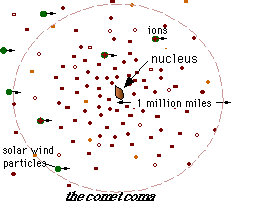
As the ices of the comet nucleus evaporate, they expand rapidly into a large cloud around the central part of the comet. This cloud, called the coma, is the atmosphere of the comet and can extend for millions...more

The comet's interaction with interplanetary space, part 1

When evaporation begins, the gas is propelled from the nucleus at supersonic speed (depicted by arrows in the figure). Because of the low gravity in space, this means that the molecules from the nucleus...more

Shop Windows to the Universe

Science, Evolution, and Creationism, by the National Academies, focuses on teaching evolution in today's classrooms. Check out the other publications in our online store.

Windows to the Universe, a project of the National Earth Science Teachers Association, is sponsored in part by the National Science Foundation and NASA, our Founding Partners (the American Geophysical Union and American Geosciences Institute) as well as through Institutional, Contributing, and Affiliate Partners, individual memberships and generous donors. Thank you for your support! NASA AGU AGI NSF